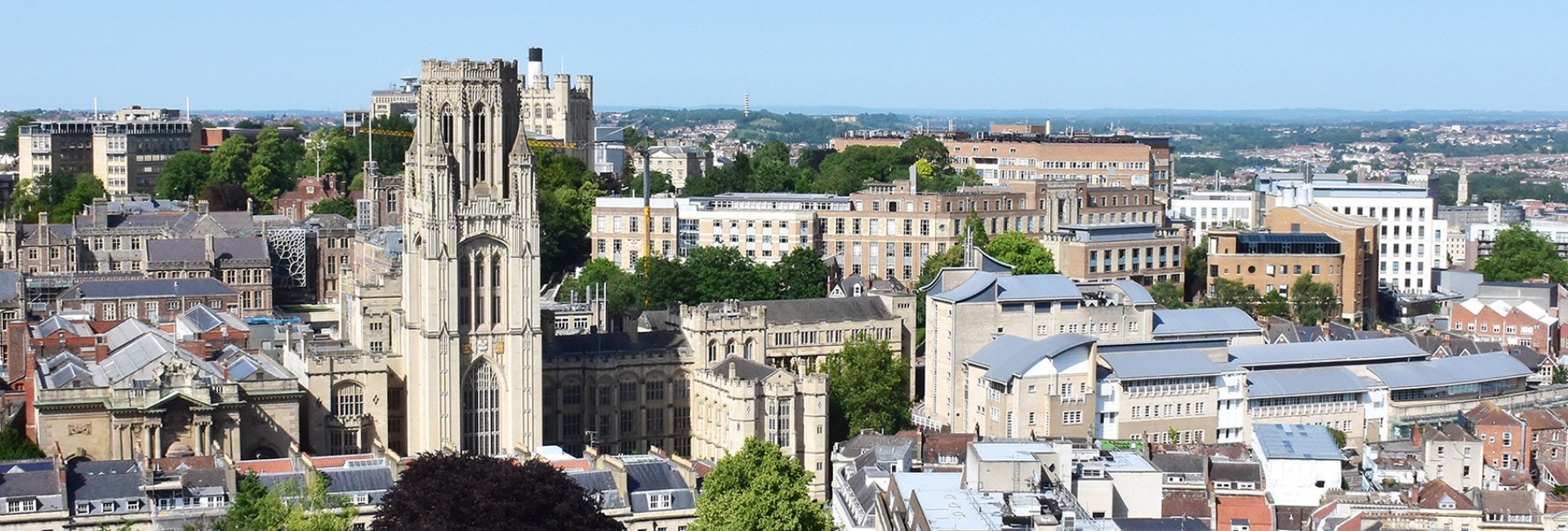
University of Bristol - Open Day 12 June 2026
12 Jun 2026, 08:30
Bristol

This four-year course in Aerospace Engineering combines advanced theory with practical experience and is tailored to equip you with the broad set of skills required to solve the engineering problems of the future.
You will study a wide range of subjects, organised across four main themes: aerodynamics, structures and materials, dynamics and control, and systems and design. You will apply your knowledge and professional engineering skills to diverse applications such as fixed and rotary wing aircraft, spacecraft and space missions, and renewable energy.
The first two years of the course are devoted to core concepts, which are taught via lectures, supported by practical experience through coursework, and computer and physical lab activities. In addition to core theoretical knowledge, you will develop wider skills, such as teamwork and presentation skills, as part of our design-build-test project.
The third-year research project will allow you to apply your technical knowledge to tackle an open-ended problem; for example, the automated landing of an unmanned air vehicle (UAV), the design of a potential space mission, or experimental testing of advanced composite materials. You will be working closely with academics who are world-leading specialists in their research areas, and make use of our extensive facilities.
In your final year, you will complete an industry-focused design project, working in groups to undertake the design of a whole aerospace vehicle and replicate processes commonly used in industry. You could be tasked with designing a hydrogen-powered civil aircraft, a future uncrewed aerial vehicle, or even an interplanetary science mission. You will also choose from optional units, allowing you to specialise in the areas that align with your interests and career plans.
The city of Bristol is at the heart of aerospace engineering in the UK, and our Industrial Liaison Office organises company engagement through all years of the course, making the most of nearby aerospace companies.
The diversity of topics in aerospace engineering makes this a challenging degree, but the reward is a uniquely broad education which equips you for an exciting career in solving the problems of the future.
This course is currently undergoing its scheduled five-year re-accreditation process with the Royal Aeronautical Society (RAeS). It has previously been accredited by RAeS. The outcome of the current review is expected by January 2026.
Professionally accredited courses provide industry-wide recognition of the quality of your qualification.
This course is not accepting applications at this time. Please contact the provider to find out more.
This is the equal consideration deadline. You can still apply after this date, but your application may not receive guaranteed consideration.

University of Bristol has participated in the Teaching Excellence Framework. These ratings were awarded in 2023, for four years.
See why these ratings were awarded
What does this TEF outcome mean?
This course is not accepting applications at this time. Please contact the provider to find out more.
The following entry points are available for this course:
The University of Bristol welcomes applications from international students and accepts a wide range of qualifications for undergraduate study. If you studied at a school, college or university outside the UK, please select the relevant page for further information on qualification equivalences, scholarships and details of our education representatives in your country/region: bristol.ac.uk/international/countries/
Standard offer: AAA including AA (in any order) in Mathematics and any one of Physics, Chemistry, Further Mathematics, Computer Science, or Electronics.
Contextual offer: AAB including AA in Mathematics and any one of Physics, Chemistry, Further Mathematics, Computer Science, or Electronics.
Please visit: bristol.ac.uk/study/undergraduate/entry-requirements-qualifications/contextual-offers/ for more information about contextual offers.
D*DD in EITHER Engineering BTEC National Level 3 Extended Diploma, with Distinctions in four Physics units, plus A in Mathematics at A-level (or equivalent), OR in Applied Science BTEC National Level 3 Extended Diploma, with Distinctions in five specified Chemistry units, plus A in Mathematics at A-level (or equivalent). Applicants taking Engineering BTEC may be invited to take the University of Bristol Maths test in place of A-level Mathematics: https://www.bristol.ac.uk/study/undergraduate/after-you-apply/interviews/maths-tests/
Access to HE Diploma in Engineering, Science, or Computing (or similar titles) with 30 credits at Distinction and 15 at Merit, including at least 12 credits at Distinction from units in one of Physics, Chemistry or Computer Science, and A in A-level Mathematics.
Or
Access to HE Diploma in Engineering, Science, or Computing (or similar titles) with 30 credits at Distinction and 15 at Merit, including at least 12 Level 3 graded Maths credits at Distinction which must cover Algebra, Calculus and Trigonometry (we may ask for Distinctions in particular units or combinations of units to satisfy subject requirements), and at least 12 credits at Distinction from units in one of Physics, Chemistry or Computer Science and achieving the required level in the University of Bristol mathematics test: https://www.bristol.ac.uk/study/undergraduate/after-you-apply/interviews/maths-tests/
Mature students can contact mature-students@bristol.ac.uk to check the suitability of their Access course.
Standard Higher: AAAAA
Advanced Higher: AA in Mathematics and any one of Physics, Chemistry, Mathematics of Mechanics or Computer Science
Standard offer: 38 points overall with 18 at Higher Level including 7, 6 (in any order) at Higher Level in Mathematics (either Analysis and Approaches or Applications and Interpretations) and any one of Physics, Chemistry, Further Mathematics or Computer Science.
Contextual offer: 34 points overall with 17 at Higher Level including 6, 6 at Higher Level in Mathematics (either Analysis and Approaches or Applications and Interpretations) and any one of Physics, Chemistry, Further Mathematics or Computer Science.
Please visit: bristol.ac.uk/study/undergraduate/entry-requirements-qualifications/contextual-offers/ for more information about contextual offers.
Requirements are as for A-levels, where you can substitute a non-subject specific grade for the Advanced Skills Baccalaureate Wales or the Welsh Baccalaureate Advanced Skills Challenge Certificate at that grade.
Requirements are as for A-levels where you can substitute a non-subject specific grade for the Welsh Baccalaureate Advanced Skills Challenge Certificate at that grade
Requirements for principal subjects are as for A-level, where D1/ D2 is A*, D3 is A, M1/ M2 is B and M3 is C
Find out more about qualification requirements for this course.
We accept a wide variety of qualifications and welcome applications from students of all backgrounds. We consider a large range of contextual factors when making application decisions.
If you receive and accept an offer from the University of Bristol, and you meet the terms of your offer in full, you will be accepted.
This section shows the range of grades that students who received offers were previously accepted on to this course with (learn more).
It is designed to support your research but does not guarantee whether you will or won't get a place.
Admissions teams consider various factors, including interviews, subject requirements, and entrance tests. Check all course entry requirements for eligibility.
We are unable to show previous accepted grades for this course. This could be because the course is new, it's a postgraduate course, there isn't enough historical data, or the provider has opted out of sharing their entry grades data for this course - learn more.
| Location | Fee | Year |
|---|
Tuition fee status depends on a number of criteria and varies according to where in the UK you will study. For further guidance on the criteria for home or overseas tuition fees, please refer to the UKCISA website.
Fees are subject to annual review and are liable to rise each year. Home fees will be set in line with UK government policy and updated as per their guidance, while international fees increase annually in line with expected inflation rises. Visit bristol.ac.uk/ug-fees-funding for further information, including estimated fees for subsequent years and typical total costs.
Email:choosebristol-ug@bristol.ac.uk
Phone:0117 394 1649
Beacon House
Queen’s Road
Bristol
BS8 1QU
At University of Bristol