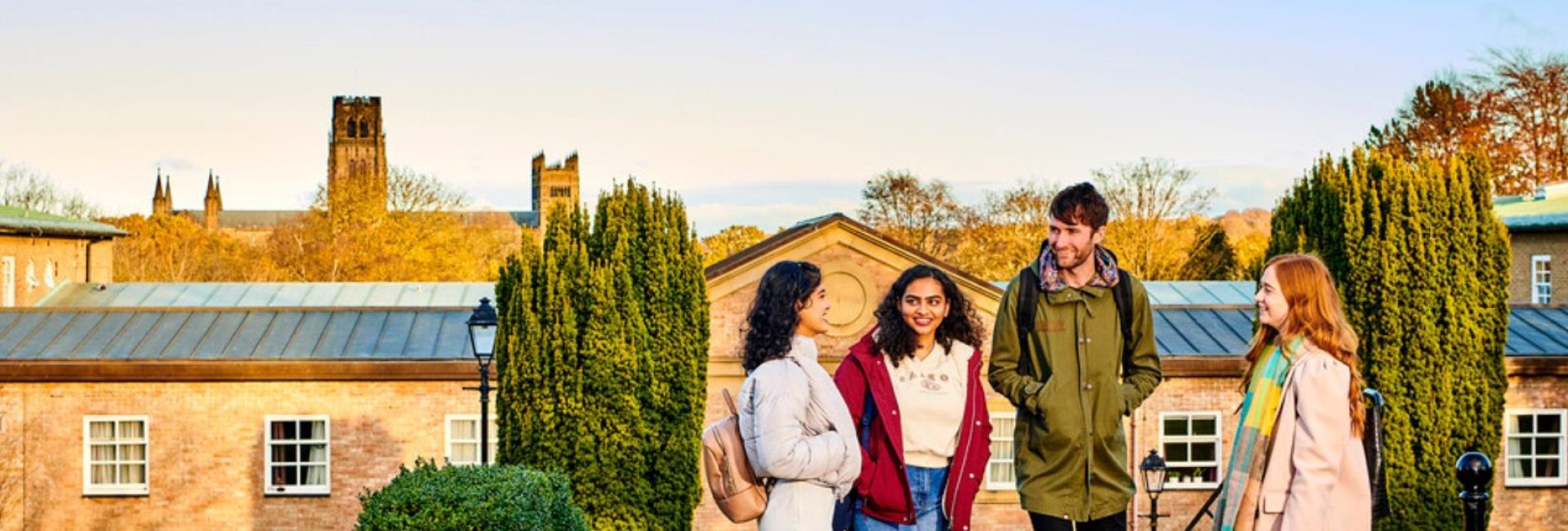
Durham University - Undergraduate Pre-application Open Day
26 Jun 2026, 08:00
Durham

Course details
rom personalised medicine, to smart cities and sustainable solutions, data science is building a better world. At the same time, developments in technology have made the field of data science more accessible than ever, creating new opportunities to gain insight into the interactions between people and their environment. This has led to a significant increase in demand for skilled data scientists, and this demand is predicted to further grow.
Drawing on this, we have created the Master of Data Science (Earth and Environment), a conversion course that equips you with the skills to access, clean, analyse and visualise data, opening a future in data science even if your first degree is in a non-quantitative subject. It is likely to appeal to geographers, earth and environmental scientists who want to learn how to use the data produced in modern industry, science and government in the management of natural resources and spatio-temporal information flows.
Why Durham University?
Durham University is home to the specialist Institute for Data Science, which acts as a hub for new ideas and works to realise its vision to help transform nature, society and culture. The Institute has many years of supporting taught degrees from Departments across the University.
The Masters of Data Science programmes develop expertise on the capture and processing information derived from the vast volumes of complex data being generated across the globe that affects all our lives.
A wide range of groups such as businesses, researchers, governments, communities, families and individuals can all use that data to make more informed decisions and therefore increase the chances of better outcomes for society, in fields such as health, environmental sciences, and social analytics.
Facilities
Data Science is a conversion course that incorporates content from many Departments across the University. This provides access to a selection of related state-of-the-art facilities from across the University, in particular Computer Science and Mathematics.
Facilities will depend on the subject specialism but include laboratories, libraries, project spaces, lecture theatres, study and networking spaces as well as shared social spaces. Most departments are close to the historic centre of Durham which is a UNESCO World Heritage site.
Career Opportunities
The skills and knowledge that constitute a Masters qualification in Data Science are widely sought by employers around the globe. In today’s data-driven society, the ability to capture, analyse and communicate information and trends from the data generated by business, governments and their agencies, communities and organisations is highly prized.
It follows that Data Science is a rapidly expanding career sector with opportunities for stimulating and rewarding work in many sectors including the areas of science, humanities, health, environmental and social where understanding and expertise in data is leading to transformations in the way people live and work.
For current information please scroll to the bottom of the page for Provider Information and select Visit our Course Page under Course Contact Details.
The Master of Data Science (Environmental Data Science) is assessed via a combination of essays, online assessments, reports and presentations – both individual and in small groups.
The course culminates in a major research project, which is conducted and written up as an independent piece of work with support from your appointed supervisor.
In addition to the help provided by your subject lecturers, you can also access extensive support for your assessments through ASC, the Academic Skills Centre. See below for details: https://www.durham.ac.uk/departments/centres/academic-skills-centre/
Durham has a long and proud history of welcoming students from countries across the globe. For further details please see: https://www.durham.ac.uk/study/international/
If you are an international student who does not meet the requirements for direct entry to this degree, you may be eligible to take a pre-Masters pathway programme at the Durham University International Study Centre. Please see: https://www.durham.ac.uk/study/international/pathway-programmes/pre-masters/
Discover what it's like to study Master of Data Science (Environmental Data Science) at Durham University: insights on the course, making friends, personal statement tips, uni prep, and recommended books, podcasts, and videos.

We require a 2:1 Bachelor (Honours) degree or international equivalent in any degree subject.
Applicants with a strong data science or mathematical background may wish to consider our MSc Scientific Computing and Data Analysis programmes.
For International Country and Region specific qualifications please see: https://www.durham.ac.uk/study/international/regional-pages/
Please check the Requirements and Admissions section of the course database for details and exact requirements.
Guidance for Home Applicants
You can apply to this course by clicking the link “Apply” at the top right of the page above Course Summary. This will redirect you to Durham University Post Graduate information page where you will be able to apply via the Post Graduate Applicant Portal.
English Language requirements https://www.durham.ac.uk/study/international/entry-requirements/english-language-requirements/
| Location | Fee | Year |
|---|---|---|
| England | £15000 | Whole course |
| Northern Ireland | £15000 | Whole course |
| Scotland | £15000 | Whole course |
| Wales | £15000 | Whole course |
| Channel Islands | £15000 | Whole course |
| Republic of Ireland | £15000 | Whole course |
| EU | £34500 | Whole course |
| International | £34500 | Whole course |
Tuition fee status depends on a number of criteria and varies according to where in the UK you will study. For further guidance on the criteria for home or overseas tuition fees, please refer to the UKCISA website.
The tuition fees shown are for the whole course, completed in the 2026/2027 academic year, 1 year of full-time study, and are set according to the academic year of entry.
Tuition fee status depends on a number of criteria and varies according to where in the UK you will study. For further guidance on the criteria for home or overseas tuition fees, please refer to the UKCISA website .
For further information regarding fees go to: https://www.durham.ac.uk/study/postgraduate/tuition-fees-and-charges/tuition-fees---how-much-are-they/
Durham University offers a range of scholarship opportunities to academically well-qualified and highly motivated students. For further details, including deadlines for application, please visit: https://www.durham.ac.uk/study/scholarships/
The Palatine Centre
Stockton Road
Durham
DH1 3LE
Visit our website Visit our course page
Phone:0191 334 1000