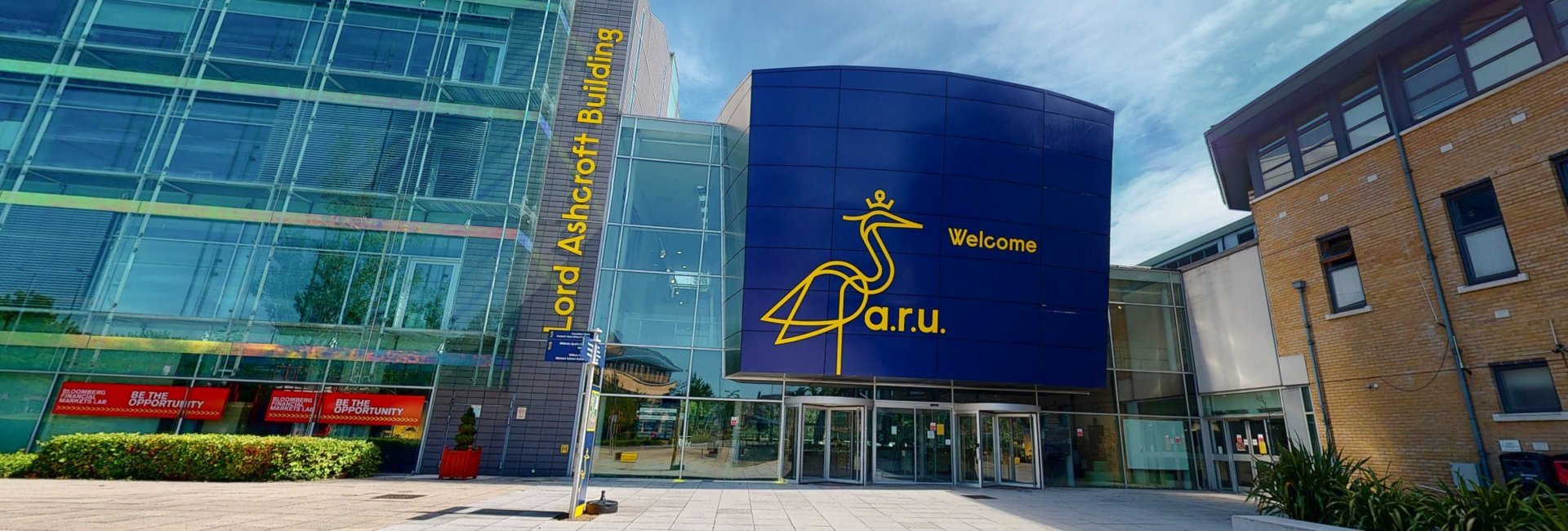
Anglia Ruskin University - Undergraduate Open Day - Cambridge
6 Jun 2026, 09:00
Cambridge

Start your journey into the world of optometry by studying our four-year integrated Masters degree in Cambridge.
Qualified optometrists are hands-on, examining patients and managing their eye health – and we know that it’s important for you to gain this kind of practical experience.
At ARU, you’ll study in our specialist eye care facilities. You’ll learn how to perform eye examinations, diagnose and treat sight problems, dispense spectacles, fit contact lenses, and manage a range of eye conditions.
With support from expert tutors, this is the perfect place to train as an optometrist.
Why ARU?
Study a course that’s offered in partnership with the College of Optometrists, the professional body for optometry.
Get the best start to your career with our clinical learning in practice modules.
Work in our University Eye Clinic, featuring consulting rooms and specialist equipment.
Gain essential clinical experience by providing optical care to the local community.
Learn from experienced and qualified optometrists.
Join our student-led Optics Society and enjoy support, events and activities.
Year 1
Geometrical and Visual Optics
Clinical Optometry 1- Introduction to Optometric Practice
Human and Ocular Anatomy
Theoretical and Practical Ophthalmic Lenses
Vision Science
Into ARU
Year 2
Clinical Optometry 2 - Skills for Optometric Practice
Pharmacology and Pathology
Binocular and Paediatric Vision
Introduction to Ocular Disease
Clinical Optometry 3 - Introduction to Professional Practice
Ruskin Module: How can Professionalism Promote Patient Safety? (15 credits)
Year 3
Clinical Optometry 4 - Low Vision Assessment and Management
Clinical Optometry 5 - Professional Practice
Clinical Optometry 6 - Advanced Contact Lens Practice
Management of Ocular Disease
Advanced Clinical Skills
Research Methods
Optometry, Lifestyle and the Workplace
Year 4
Clinical Learning in Practice 1
Clinical Learning in Practice 2
Major Project
Advanced Glaucoma Management *
Advanced Management of Medical Retina *
*optional
Throughout the course, we’ll use a range of assessment methods to measure your progress. Because our course is so practical, a lot of your assessment will be practical too – including exams and clinical competence.
You’ll also do written exams, problem-solving exercises, essays, presentations and data analysis. Additionally, you’ll be encouraged to critically reflect on your work to feed forward for the next stages of your career.
Professionally accredited courses provide industry-wide recognition of the quality of your qualification.
This is the equal consideration deadline. You can still apply after this date, but your application may not receive guaranteed consideration.

Anglia Ruskin University has participated in the Teaching Excellence Framework. These ratings were awarded in 2023, for four years.
See why these ratings were awarded
What does this TEF outcome mean?
The following entry points are available for this course:
with grades AA to come from 2 of the following subjects: Maths, Physics, Biology, Chemistry at first sitting or first resit.
5 GCSEs at grade C, or grade 4, or above, including English and Maths at grade C, or grade 4, and either Physics at grade B, or grade 5, or Double Award Science at grades BB, or grades 55
ARU operates a policy of making contextualised offers for this course which may be a reduced conditional offer or an unconditional offer, using data from UCAS to make our assessment. We consider that this approach promotes the equality of educational opportunity for applicants from low participation groups in HE. ARU welcomes students from diverse backgrounds and helping them achieve their full potential. The offer of a place through the contextual offer process is at the discretion of ARU.
This section shows the range of grades that students who received offers were previously accepted on to this course with (learn more).
It is designed to support your research but does not guarantee whether you will or won't get a place.
Admissions teams consider various factors, including interviews, subject requirements, and entrance tests. Check all course entry requirements for eligibility.
We are unable to show previous accepted grades for this course. This could be because the course is new, it's a postgraduate course, there isn't enough historical data, or the provider has opted out of sharing their entry grades data for this course - learn more.
| Location | Fee | Year |
|---|---|---|
| England, Scotland, Wales, Northern Ireland, Channel Islands & Republic of Ireland | £10050 |
Tuition fee status depends on a number of criteria and varies according to where in the UK you will study. For further guidance on the criteria for home or overseas tuition fees, please refer to the UKCISA website.
https://www.aru.ac.uk/student-life/preparing-for-study/help-with-finances/undergraduate
https://www.aru.ac.uk/study/tuition-fees
International fee TBC
Email:answers@aru.ac.uk
Phone:+44 (0)1245 686868
Email:international@anglia.ac.uk
Phone:+44 1245 683680
East Road
Cambridge
CB1 1PT
At Anglia Ruskin University