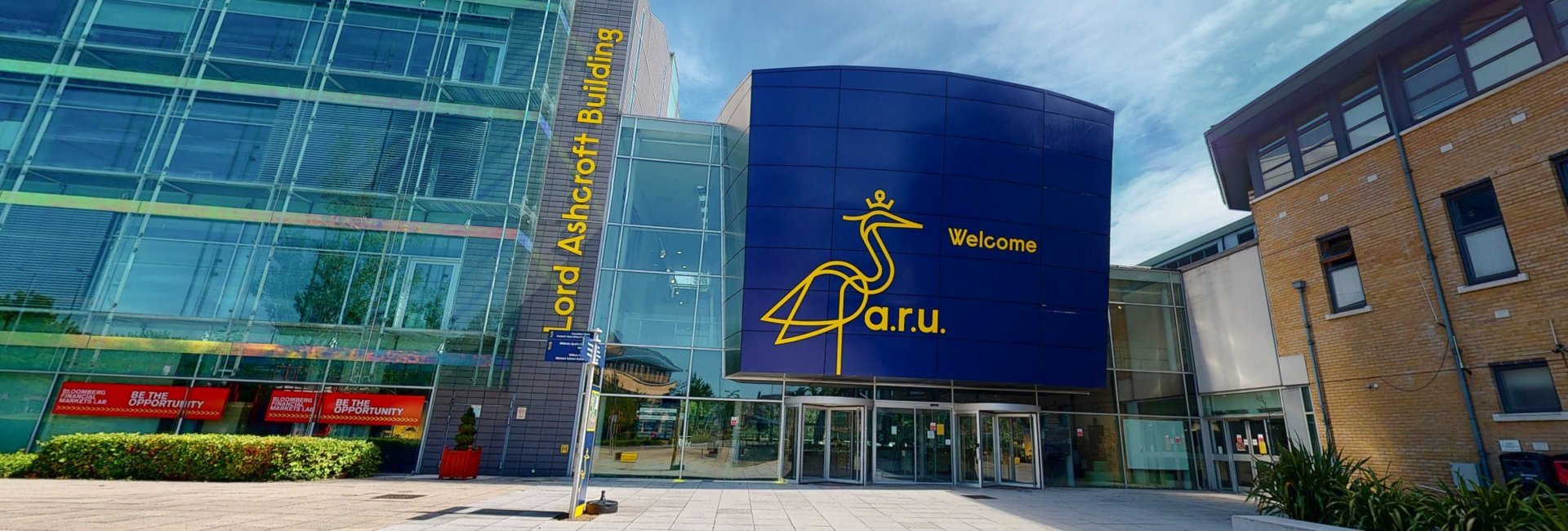
Anglia Ruskin University - Undergraduate Open Day - Cambridge
6 Jun 2026, 09:00
Cambridge

Discover how sound works and how technology can help you master it with our JAMES-accredited Audio & Music Technology degree.
Use our BSc (Hons) Audio & Music Technology degree as a launchpad for a range of employment opportunities where audio expertise is needed. This applied course provides a firm scientific foundation that empowers you to master technology and produce the best creative outcomes.
Guided by expert academics and industry-active practitioners, you’ll build a compelling portfolio for a future-oriented career in the creative industries, including studio engineering, live sound, film, video games, broadcast, and acoustics.
Our Audio & Music Technology course is accredited by JAMES (Joint Audio Media Education Support). Their trained assessors and accreditation panel members are working professionals with extensive knowledge and experience of today’s music and audio industry – so you can be sure our course will give you all the relevant skills you need for a successful career.
Join our community of graduates who engineer in studios, tour the world as live-sound production managers, or become successful entrepreneurs.
Work in industry-standard recording studios and audio/video production facilities supported by our technical team.
Learn from expert academics and industry-active practitioners.
Take an optional work placement year, or internships with our industry partners and practitioners.
Make the most of Cambridge’s diverse music scene with our links to local venues and groups.
Collaborate with students from other music courses to develop all-important skills for your professional life.
Careers
Our Audio & Music Technology course equips you with a balanced, blended skillset, preparing you for many different career destinations.
As a JAMES-accredited graduate, you can join the JAMES Graduate Database after graduating to promote your skills and portfolio to potential employers.
You can develop your skills further by getting involved in the vibrant collaborative community across Cambridge School of Creative Industries, such as our cross-disciplinary CSCI Podcast team or in-house recording label.
Our graduates enjoy successful careers in the music industry and beyond: from recording and mixing engineers, front-of-house engineers for live events, audio specialists and acoustic consultants through to educators and technicians, the choice is yours.
Graduation doesn’t need to be the end of your time with us, of course. You might decide to stay at ARU and study for a Masters, such as our renowned MA Music Therapy. Take advantage of our Alumni Scholarship and get 20% off your fees.
Joseph Simpson was named winner of ARU’s Alumni Contribution to Culture Award 2023 after touring the world with internationally acclaimed artists as a tour / production manager and providing sound experiences for prestigious venues and events like the Mercury Awards and Glastonbury Festival.
Teaching
You’ll jump straight into learning fundamental concepts of audio signals in analogue and digital systems. We'll cover topics like constructing and exploring audio effects, designing acoustical treatments, and using current AI audio tools.
In Year 2 you’ll cover the full breadth of studio engineering, learning to record sound using advanced stereophonic microphone techniques then shape and mix the material further.
Finally, you'll work toward becoming an independent audio expert, tackling an individual research- informed project, producing a compelling portfolio, and applying your audio expertise to a collaborative project with other graduating students.
=optional.
Year 1: Foundation in Engineering, Computing and Technology.
Year 2: Core Skills for Audio; Studio Techniques; Acoustics; Live Sound; Into ARU.
Year 3: Music Business; Advanced Audio Technology; Ruskin Module; Interactive Sound Design for Games; Production Sound for Film and Media*; Music Marketing and Promotion*; Post-Production Sound for Film and Media* Synthesis and Sound Design*; Live Event Production*.
Year 4: Collaborative Project; Creative Industries Major Project; Portfolio.
Modules are subject to change and availability.
You’ll show your progress through a variety of methods that will best prepare you for your future career. These include portfolios of recorded works, essays, reports, log books, posters and presentations.
Professionally accredited courses provide industry-wide recognition of the quality of your qualification.
This is the equal consideration deadline. You can still apply after this date, but your application may not receive guaranteed consideration.

Anglia Ruskin University has participated in the Teaching Excellence Framework. These ratings were awarded in 2023, for four years.
See why these ratings were awarded
What does this TEF outcome mean?
The following entry points are available for this course:
5 GCSEs at grade D, or grade 3, or above and evidence of two years post-GCSE study at Level 3.
If you have achieved at least grade E in one A level, or equivalent, you are exempt from the two years post-GCSE study requirement, but you still must meet the GCSE requirements.
Applicants who do not meet the two years post GCSE study at level 3 may be considered based on their satisfactory employment history, which must be a minimum of two years full time employment supported by employer evidence and deemed appropriate by the University for meeting the course of study applied for.
| Test | Grade | Additional details |
|---|---|---|
| IELTS (Academic) | 5.5 | With minimum 5.5 in each component |
This section shows the range of grades that students who received offers were previously accepted on to this course with (learn more).
It is designed to support your research but does not guarantee whether you will or won't get a place.
Admissions teams consider various factors, including interviews, subject requirements, and entrance tests. Check all course entry requirements for eligibility.
We are unable to show previous accepted grades for this course. This could be because the course is new, it's a postgraduate course, there isn't enough historical data, or the provider has opted out of sharing their entry grades data for this course - learn more.
| Location | Fee | Year |
|---|
Tuition fee status depends on a number of criteria and varies according to where in the UK you will study. For further guidance on the criteria for home or overseas tuition fees, please refer to the UKCISA website.
https://aru.ac.uk/student-life/preparing-for-university/help-with-finances/undergraduate
https://www.aru.ac.uk/study/tuition-fees
Email:answers@aru.ac.uk
Phone:01245 683680
East Road
Cambridge
CB1 1PT
At Anglia Ruskin University