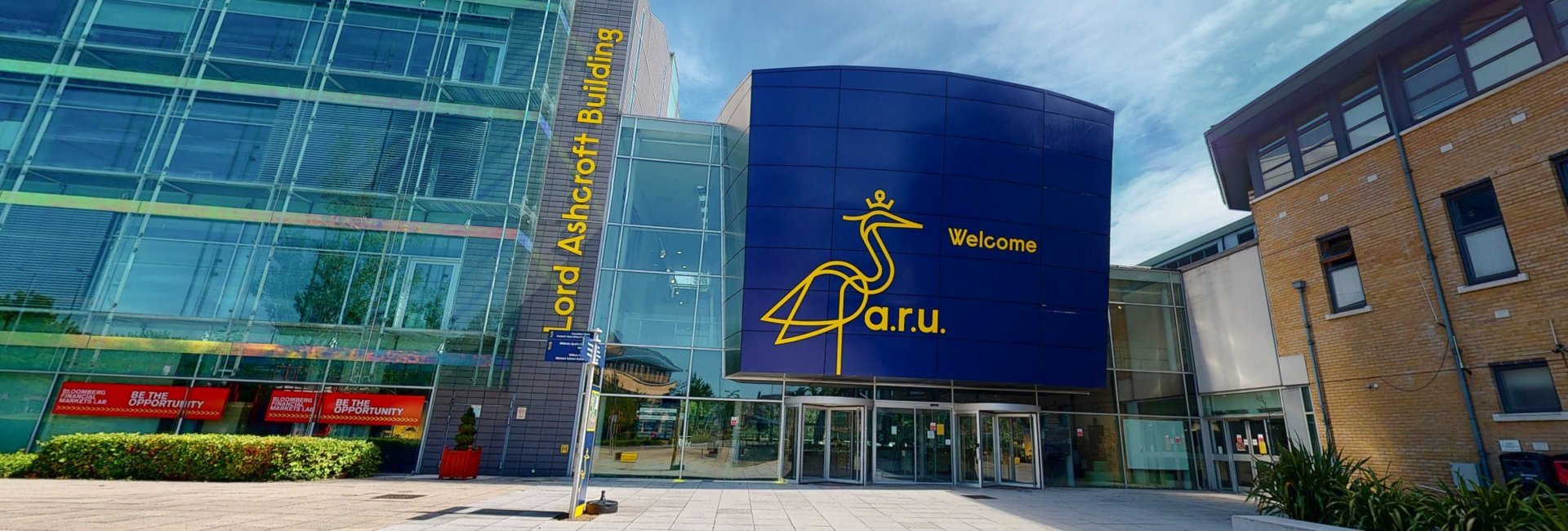
Anglia Ruskin University - Undergraduate Open Day - Cambridge
6 Jun 2026, 09:00
Cambridge

Whether you want to write science fiction, poetry, or for the stage or screen, our Creative Writing degree will support your development as a professional writer.
Explore complex types of communication, digital literacy and innovative storytelling, developing your skills in these areas.
You’ll become part of our vibrant ARU writing community, including postgraduates and alumni, helping you build your professional network and the entrepreneurial skills you’ll need for freelancing and portfolio careers.
Based in the Cambridge School of Creative Industries, you’ll be surrounded by professionals with expertise in performance, film, games, publishing, and digital media.
Get invaluable feedback on all your written work from professional writers, including our teaching staff and Royal Literary Fund fellows.
Attend guest lectures by visiting authors, editors, agents, and other writing-industry professionals.
Join our Cambridge Writing Centre events to showcase your writing and make new contacts.
Develop skills needed by industry and the professional environment on our Careers in Writing module.
Our Business of Being a Writer module will help you understand the path to getting published.
We'll help you find placements and work experience, and you can even opt to take a placement year.
Careers
At ARU, you’ll get invaluable feedback on all your written work from professional writers - including our Royal Literary Fund fellows - and other students, giving you the opportunity to consider a range of responses and sharpen your critical skills.
You’ll also develop skills including literacy, communication, research, creative thinking, self-reliance and teamwork. These can help you start a career in many areas, from film, games development and journalism, to publishing, digital media and marketing.
You’ll also have opportunities to take part in collaborative projects, like our HMS Belfast project with Imperial War Museums to commemorate D-Day, and 60 Second Shakespeare with the Globe theatre, London.
By the time you graduate, you’ll have built up your own professional network and entrepreneurial skills required for freelancing and portfolio careers.
An enhanced CV for you to present to future employers and clients. You’ll also develop transferable skills such as research, teamwork, communication, problem solving, and resourcefulness. These skills are invaluable in other areas of the creative industries, and in other sectors.
Graduation doesn’t have to be the end of your time with us. You might decide to stay at ARU and study for a Masters, such as our renowned MA Creative Writing or MA Creative Writing and Publishing. Take advantage of our Alumni Scholarship and get 20% off your fees.
Teaching
In your first year, you’ll take five introductory modules designed to bring all students to a similar level of subject knowledge and competence. Learn how to reflect on your own practice and assess your own writing work, developing skills around self-concept and personal narrative.
In year 2 you’ll deepen your reflective practice and self-assessment, as well as investigating online methods of finding markets and literary agents and enhancing the digital and information literacy needed to be a successful working writer.
Your final year will involve mostly independent, self-directed work, focusing largely on your Major Project.
=optional.
Year 1: Introduction to Imaginative Writing; Screenwriting: The Short Film; Multiplatform Storytelling 1; Contemporary Publishing for Writers; Multiplatform Storytelling 2; Into ARU.
Year 2: Ruskin Module; Writing Short Fiction; Careers in Writing: Editing and Copywriting; Writing for the Stage; Writing Creative Non-Fiction; Film Criticism and Reviewing; Science Fiction*; Online Journalism*; Performing New Writing*; From Script to Screen*; Cult Media*; From Script to Screen*; Anglia Language Programme.
Year 3: Placement.
Year 4: Creative Industries Major Project; Worldbuilding; The Business of Being a Writer: Craft and Professional Practice; Writing Poetry; Crime and Detective Fiction *; The Cultural Politics of Celebrity *; Screenwriting: Writing and Selling the Feature Film *; Novel Writing: Long-Form Prose *; Writing and the Present *; Film Journalism ; Anglia Language Programme.
Modules are subject to change and availability.
Many of our assessment methods mirror the process for writers working with editors and others in the publishing industry, with a high level of feedback through workshops and individual attention, in both written and in oral forms.
This is the equal consideration deadline. You can still apply after this date, but your application may not receive guaranteed consideration.

Anglia Ruskin University has participated in the Teaching Excellence Framework. These ratings were awarded in 2023, for four years.
See why these ratings were awarded
What does this TEF outcome mean?
The following entry points are available for this course:
Find out more about qualification requirements for this course.
ARU operates a policy of making contextualised offers for this course which may be a reduced conditional offer or an unconditional offer, using data from UCAS to make our assessment. We consider that this approach promotes the equality of educational opportunity for applicants from low participation groups in HE. ARU welcomes students from diverse backgrounds and helping them achieve their full potential. The offer of a place through the contextual offer process is at the discretion of ARU.
This section shows the range of grades students (with UK A-Levels or Pearson BTEC Level 3 National Extended Diplomas) who received offers were previously accepted with (learn more). It is designed to support your research but does not guarantee whether you will or won't get a place. Admissions teams consider various factors, including interviews, subject requirements, and entrance tests. Check all course entry requirements for eligibility.
Students aged 17/18 who applied to this course were offered a place.
See how students with your grades have been accepted onto this course in the past.
Operated by the Office for Students
Employment after 15 months (Most common jobs)
Go onto work and study
The number of student respondents and response rates can be important in interpreting the data – it is important to note your experience may be different from theirs. This data will be based on the subject area rather than the specific course. Read more about this data on the Discover Uni website.
| Location | Fee | Year |
|---|---|---|
| England | £9790 | Year 1 |
| Northern Ireland | £9790 | Year 1 |
| Scotland | £9790 | Year 1 |
| Wales | £9790 | Year 1 |
| Channel Islands | £9790 | Year 1 |
| Republic of Ireland | £9790 | Year 1 |
Tuition fee status depends on a number of criteria and varies according to where in the UK you will study. For further guidance on the criteria for home or overseas tuition fees, please refer to the UKCISA website.
Please visit our website for further information on fees for the Placement year:
https://www.aru.ac.uk/study/tuition-fees
https://www.aru.ac.uk/student-life/preparing-for-study/help-with-finances
https://www.aru.ac.uk/student-life/support-and-facilities/careers-and-employability/placements
East Road
Cambridge
CB1 1PT
Visit our website Visit our course page
Email:answers@aru.ac.uk
Phone:01245 68 68 68