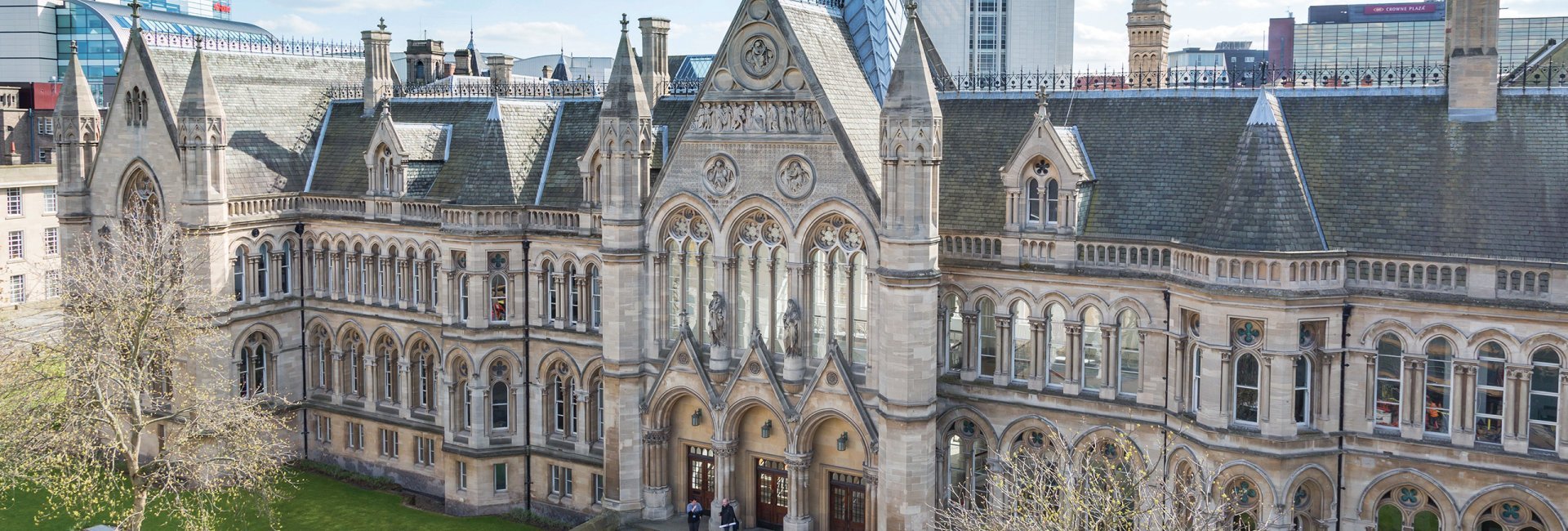
Nottingham Trent University - 7 March Open Day
7 Mar 2026, 09:00
Nottingham

Our world is a complex, contradictory place. In many ways, we’re broader minded and better connected than ever before; in others, the impact of war, disease, intolerance and instability threatens to undermine our progress. With divisive, post-factual ‘truths’ continuing to infiltrate the news, it’s often hard to know what’s really happening — but we’ll give you the critical skills to hear through that noise.
Emphasising the interplay between leadership, communication, and creativity,we’ve combined the insights of our separate politics and international relations courses into one exciting, interdisciplinary degree. The core modules give you the theoretical rudiments, while the electives offer you the chance to specialise in the debates and issues that interest you the most. The focus throughout is on applied skill: you can work with local activist groups, complete a placement, design and trial your own campaign proposals, and debate the biggest issues with NTU’s Politics and International Relations Society.
The change you want to see starts here, with you. Studying with us, you’ll learn to identify and diffuse conflict. You’ll develop as a leader, an effective communicator, and someone who can formulate and pitch ideas with creativity and confidence. You’ll thrive, you’ll grow, and you’ll inspire — whether that’s as an MP, a diplomat, a lobbyist, a community leader, a security analyst, or any of the other roles this highly versatile degree lends itself to.
Why study Politics and International Relations at NTU?
Work on real-world collaborations, projects and simulations on topics which matter to you and develop core skills such as digital literacies and data visualization throughout.
Study in the heart of the vibrant and multicultural city of Nottingham, with a proud political history steeped in community activism.
You will have the opportunity to undertake an optional year-long placement and/or study abroad in your second year, with one of our international partners across the world.
Learn a language as part of your degree with optional modules in your second and final year. Choosing between Arabic, French, German, Italian, Japanese, Mandarin or Spanish, a new world of opportunities will open for you with beginner to advanced classes.
This degree is for the politically curious, the global visionaries, and the change-makers. With a blend of rigorous theory and exciting, hands-on practice, we’ll nurture you as an academic, a critic, a socially and politically conscious citizen, and — most importantly of all — a person. At NTU, we dare you to be different: to show the intellectual courage, independence and adaptability that’ll guide your future career.
Our politics and international relations course unpacks the big and the small, the local and the global, the remarkable and the everyday. Explore the nature of international relationships, and how those relationships can influence things like economic and foreign policy, laws, human rights, security, and governance; assess the political factors that determine elections and leadership contests; examine the economics of daily life, whether that’s the lifecycle of a single cup of coffee, or how (and why) a particular mobile phone ends up in your hand. Through our fascinating range of optional modules, you can take a deep dive into everything from pandemics, poverty, climate change, security, and Brexit, to worldwide migration trends, instability in the European project, the politicisation of everyday life, and the emerging political powers in Asia, the Middle East, and North Africa. It’s your course, and your call.
We’ll be encouraging you to look at the world differently, through more informed, balanced, and critically aware eyes. We’ll be asking you to explore and assess your own values and beliefs — to make the familiar unfamiliar.
Here’s a breakdown of the core and optional modules you’ll be studying across your course:
Year One modules include Study and Research Skills, Politics and International Relations in Practice, Media, Power and Truth, British Politics and Beyond, and Introduction to International Relations, and Politics.
Year Two modules include Applied Social Research, Careers and Experience in Politics and International Relations and Global Political Marketing. Optional modules include Contemporary European Politics, Justice, Ethics and Democracy, Security Studies, The Politics of Art, Film and Literature, Understanding Foreign Policy, Global Politics of Postcolonialism, Global Political Economy of Everyday Life, UK Parliamentary Studies, Foreign Language, and Environmental Politics and Policy.
You may choose to take an optional year-long placement in Year Three, either in the UK or overseas. You will be supported by our experienced Employability Team to source a suitable placement.
Final Year modules include a Dissertation and Leadership, Activism and Campaigning module. Optional modules include Political Violence and Terror, Global Politics of Pop Culture, Feminist Thought and Praxis, The International Relations of the Middle East and North Africa, British Politics in Uncertain Times, US Politics and Policy, Interpreting Contemporary Politics, Negotiating in International Contexts, Politics of the Global South, East of the West: Eurasian Geopolitics, The Emerging Powers of Asia, Globalisation in Crisis, and Foreign Language.
The BA Politics and International Relations course has been designed to provide a broad, varied, and consistent range of assessments to ensure a fair and balanced representation of the skills and knowledge you gain throughout.
Study Skills sessions – including advice on academic essay planning/writing/editing and referencing – are embedded into the course early and further, continual support is available throughout your degree.
Throughout your three years, each module will include both formative (i.e., non-bearing feedback, designed to help you improve in the future) and summative (i.e., bearing feedback which is then translated into overall grades) forms, which might include academic essays, case studies and reports, to individual/group presentations, policy briefs, simulation exercises, strategic communications plans, and infographic factsheets.
Assessments are submitted online, via NOW, and in response to student feedback, you can expect to receive feedback on your work within 15 working days of submission.
This is the equal consideration deadline. You can still apply after this date, but your application may not receive guaranteed consideration.

Nottingham Trent University has participated in the Teaching Excellence Framework. These ratings were awarded in 2023, for four years.
See why these ratings were awarded
What does this TEF outcome mean?
The following entry points are available for this course:
A lower offer may be made based on a range of factors, including your background (such as where you live and the school or college you attended), your experiences and individual circumstances (you may have been in care, for example). This is called a contextual offer and we get data from UCAS to make these decisions. NTU offers a student experience like no other, and this approach helps us to find students who have the potential to succeed here, but may have faced barriers that can make it more difficult to access university.
We also consider equivalent qualifications and combinations. Please contact Nottingham Trent University Admissions team for further information.
NTU makes contextual offers for this course to give everyone a fair chance to access their chosen degree.
Contextual offers are lower than our standard entry criteria or may be an unconditional offer for courses that require a portfolio. We also take individual circumstances into account when we receive results and may accept grades lower than our published criteria.
We use a range of data from UCAS to make our offers and more information on our approach is available at the link below.
This section shows the range of grades students (with UK A-Levels or Pearson BTEC Level 3 National Extended Diplomas) who received offers were previously accepted with (learn more). It is designed to support your research but does not guarantee whether you will or won't get a place. Admissions teams consider various factors, including interviews, subject requirements, and entrance tests. Check all course entry requirements for eligibility.
Students aged 17/18 who applied to this course were offered a place.
See how students with your grades have been accepted onto this course in the past.
Operated by the Office for Students
Employment after 15 months (Most common jobs)
Go onto work and study
The number of student respondents and response rates can be important in interpreting the data – it is important to note your experience may be different from theirs. This data will be based on the subject area rather than the specific course. Read more about this data on the Discover Uni website.
| Location | Fee | Year |
|---|---|---|
| England | £9790 | Year 1 |
| Northern Ireland | £9790 | Year 1 |
| Scotland | £9790 | Year 1 |
| Wales | £9790 | Year 1 |
| EU | £17950 | Year 1 |
| International | £17950 | Year 1 |
Tuition fee status depends on a number of criteria and varies according to where in the UK you will study. For further guidance on the criteria for home or overseas tuition fees, please refer to the UKCISA website.
The tuition fees above are subject to parliamentary procedure. They haven't been confirmed yet, but we expect them to be finalised by May 2026. The level of tuition fees for the second and subsequent years of your undergraduate course may increase in line with inflation and as specified by the UK government.
50 Shakespeare Street
Nottingham
NG1 4FQ
Visit our website Visit our course page
Phone:+44(0)115 848 4200
Phone:+44 (0) 115 848 4200