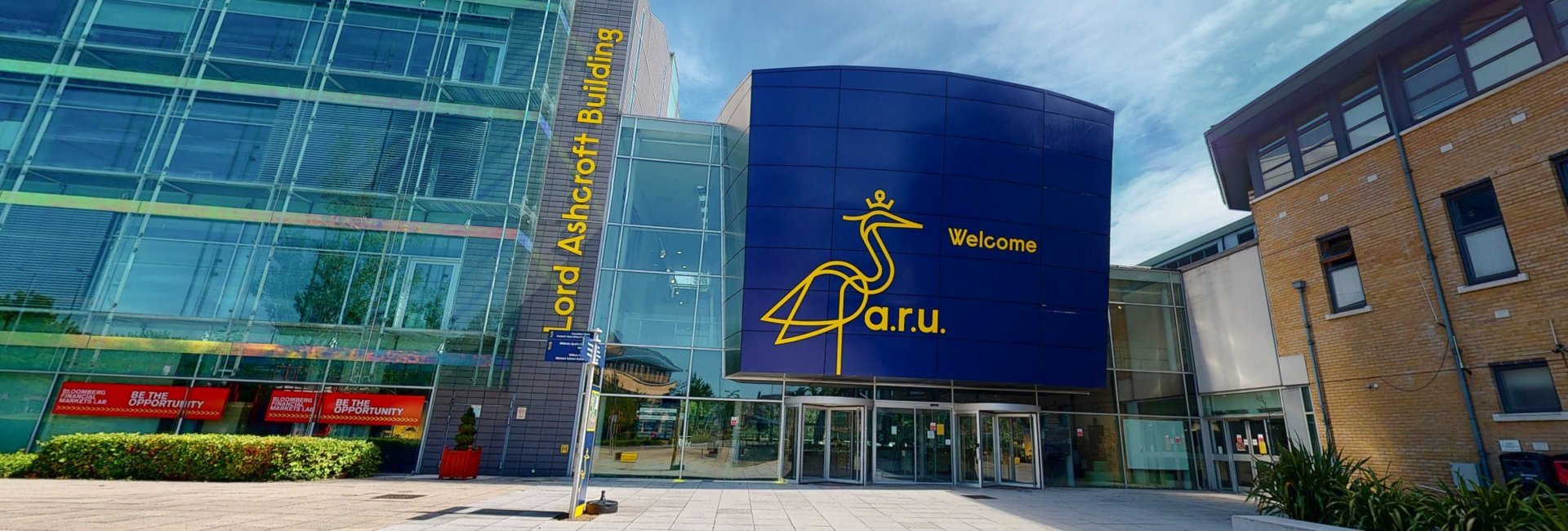
Anglia Ruskin University - Undergraduate Open Day - Cambridge
6 Jun 2026, 09:00
Cambridge

Explore English language and literature to understand how they reflect and are influenced by the culture, technology and economics of different places and historical periods.
Study a range of texts including classic literary forms such as the novel, poetry, and plays, but also theatrical performances, films, essays, reviews, and critical and cultural works, developing your ability to read and respond critically.
You’ll explore the power of the English language in communication, and how it expresses and reflects global issues such as ideologies, culture wars, conflict, social justice, equality, diversity, inclusion, and sustainability.
Studying English will give you a broad interdisciplinary experience where you can develop your own areas of interest and expertise.
Why ARU?
1st in the East of England for undergraduates employed as managers, directors or senior officials. Source: GOS 2025.
Develop transferable skills valued by employers, including literacy, communication, critical thinking, problem-solving, and research
Study in Cambridge, home to major publishing houses and over 30 English language schools
Expand your network and your knowledge at events with professional writers, publishers and language teachers
Showcase your work and make new contacts at events organised by our Cambridge Writing Centre
Get support from expert lecturers, including published authors and our Royal Literary Fund Fellows
Explore topics from other subjects on optional modules, including writing, film, media, sociology and politics
Careers
Gain vital skills particularly valued by business leaders, including narrative communication, empathy and perspective taking, critical analysis, synthesis of and managing complex data, creativity and imagination, and digital skills.
You’ll also develop transferable skills valued by employers from all industries, including literacy, creative thinking, problem-solving, research, and computer/digital skills.
Every year of the course, your core modules include employability sessions as well as live briefs, which allow you to devise solutions for industry professionals, giving you work experience and connections for your future career.
The skills you develop can transfer to a wide range of occupations, including journalism, teaching, business, law, consultancy, administration, librarianship, and the Civil Service.
Figures from the Department for Education show that English is the joint fourth subject for annual average wage growth at 6.2%, and a key contributor to the creative industries, the fastest growing part of the UK economy. 25% of SHAPE (Social Sciences, Humanities and Arts for People and the Economy) graduates work in the creative sector – currently worth £84.1bn to the UK. By 2030, it’s expected that there will be 900,000 new jobs in this sector. (Source: Qualified for the Future (PDF), The British Academy).
Or you might choose to stay at ARU and study a Master’s degree, like our MA English Literature or MA Intercultural Communication. Take advantage of our Alumni Scholarship to get 20% off your fees.
Teaching
In Year 1 you’ll explore periods of literary history, learning to use writing as a tool for thinking and discovering approaches for your critical analyses.
You’ll also learn about semiotics and structuralism, sociolinguistics, and the development of the novel.
In Year 2 you’ll examine interpersonal communication in a culturally diverse world, consider what it means to be ‘woke’, and continue building your knowledge of literary history.
Finally, you’ll complete a major research project on a topic of your choice, and learn to communicate your ideas to a range of audiences through a variety of formats.
Year 1
Year 2
How Texts Work
Introduction to the Study of Literature and Writing
Deconstructing Communication
Language, Communication and Society
The History of the Novel
Year 3
Ruskin Module (15 credits)
Bridging Cultures
Woke Wars
From Modernism to the Millenium
Sounds and Communication *
Podcasting *
Nineteenth Century Literature and the Environment *
Nineteenth Century Afterlives and Adaptations *
Professional Placement *
Digital Media Theory: Social Media, AI, and the Cultures of the Internet *
Online Journalism *
Crocodiles, Pirates and Moon-men: Renaissance Encounters *
Science Fiction *
Performing Shakespeare *
Writing Short Fiction *
Philosophy of Art and Image *
Key Paradigms 2: Sociology and Politics *
Digital Stylistics *
Cult Media *
Writing Creative Non-Fiction *
Anglia Language Programme (15 credits) *
Year 4
Prejudice and Ideologies
Research Communication
Major Project
New Media Discourse *
Communication Disorders *
The Cultural Politics of Celebrity *
Spectacle and Representation in Renaissance Drama *
Literature and Exile: Displacement, Identity, Self *
Crime and Detective Fiction *
Renaissance Magic *
Writing Poetry *
Language and the Law *
Communication, Flesh, Philosophy *
The Making of Modern Media *
Life Writing *
Key Paradigms 3: International and Global Perspectives in Education *
Digital Methods *
Film Journalism *
Anglia Language Programme (15 credits) *
*optional
You’ll use a range of methods to show your progress, including essays, portfolios, self-reflection, and presentations. These will allow you to engage with multidisciplinary resources in a collaborative and structured manner, and with practical or ‘real world’ contexts in which you can explore and evaluate concepts and arguments. Alongside tools such as open-form project work (including creative multimedia outputs) and peer assessment, they will also help you develop key transferable skills. The Major Project acts as the capstone for your degree. You’ll work on a detailed piece of research that builds on earlier course materials and perspectives to create a final project in a format agreed with your supervisor, but equivalent to 10,000 words.
This is the equal consideration deadline. You can still apply after this date, but your application may not receive guaranteed consideration.

Anglia Ruskin University has participated in the Teaching Excellence Framework. These ratings were awarded in 2023, for four years.
See why these ratings were awarded
What does this TEF outcome mean?
The following entry points are available for this course:
5 GCSEs at grade D, or grade 3, or above and evidence of two years post-GCSE study at Level 3.
If you have achieved at least grade E in one A level, or equivalent, you are exempt from the two years post-GCSE study requirement, but you still must meet the GCSE requirements.
Applicants who do not meet the two years post GCSE study at level 3 may be considered based on their satisfactory employment history, which must be a minimum of two years full time employment supported by employer evidence and deemed appropriate by the University for meeting the course of study applied for. https://www.aru.ac.uk/study/undergraduate/english
| Test | Grade | Additional details |
|---|---|---|
| IELTS (Academic) | 5.5 | With minimum 5.5 in each component |
Equivalent English Language qualifications, as recognised by Anglia Ruskin University, are also accepted.
This section shows the range of grades that students who received offers were previously accepted on to this course with (learn more).
It is designed to support your research but does not guarantee whether you will or won't get a place.
Admissions teams consider various factors, including interviews, subject requirements, and entrance tests. Check all course entry requirements for eligibility.
We are unable to show previous accepted grades for this course. This could be because the course is new, it's a postgraduate course, there isn't enough historical data, or the provider has opted out of sharing their entry grades data for this course - learn more.
| Location | Fee | Year |
|---|
Tuition fee status depends on a number of criteria and varies according to where in the UK you will study. For further guidance on the criteria for home or overseas tuition fees, please refer to the UKCISA website.
https://aru.ac.uk/student-life/preparing-for-university/help-with-finances/undergraduate
https://www.aru.ac.uk/study/tuition-fees
International fee TBC
Email:answers@aru.ac.uk
Phone:+44 (0)1245 686868
Email:international@anglia.ac.uk
Phone:+44 1245 683680
East Road
Cambridge
CB1 1PT
At Anglia Ruskin University