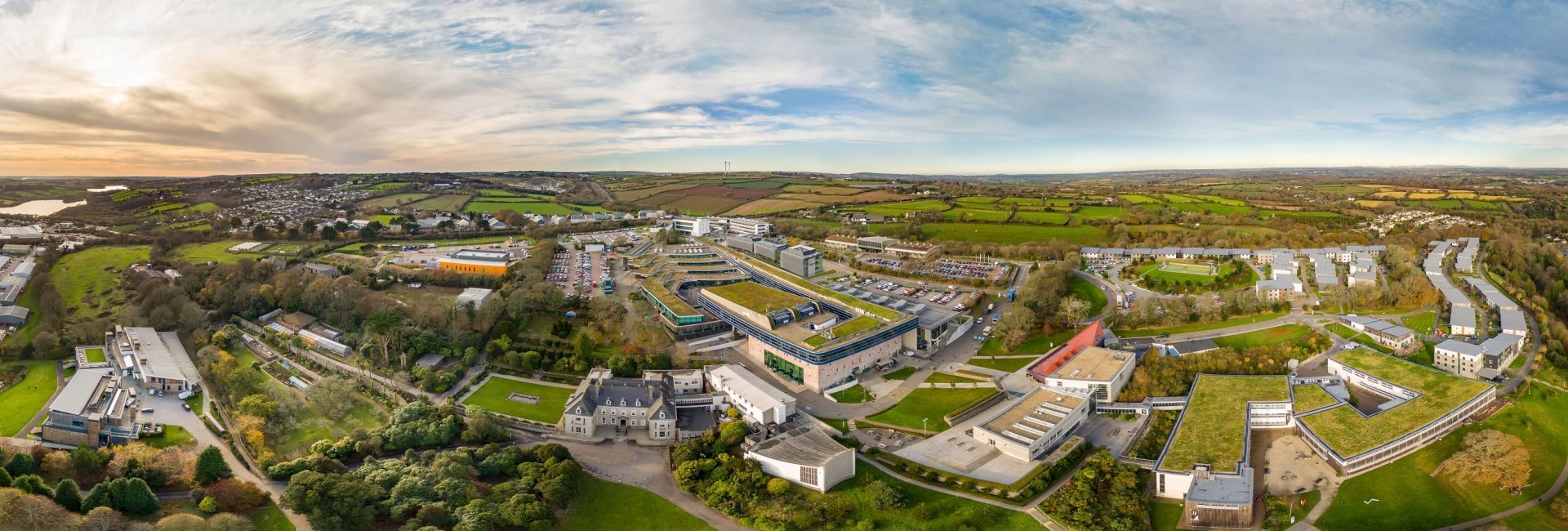
Open Day (in-person)
3 Oct 2026, 08:00
Falmouth

Develop your skills by entering the creative industries on an Integrated Foundation Year degree.
If you’re interested in taking on a new subject that you’ve not had the opportunity to study in depth before, or have been out of education for a while, then our Integrated Foundation Year courses might be for you. These four-year courses include an introductory year to help you build the core skills needed for specialist degree-level study.
This is a chance for you to let your imagination run wild and explore your creativity, expand your professional skills and develop enhanced subject knowledge in the domain you want to study. We’ll help nurture your expertise in problem solving, risk-taking, designing and making as you develop your abilities through five core modules.
After your foundation year, you’ll have a deeper knowledge of your subject, a clear understanding of your strengths, a developed practical and technical skill set and the confidence to excel in your chosen degree subject when you join other students for the rest of your course.
Develop your unique craft in storytelling through television and short film production.
Develop your authentic voice through moving-image storytelling, whether you aspire to create high-end drama with full-scale crews, meaningful documentaries, music videos, commercials or new forms of content – investing in the story and understanding why you’re telling it. You’ll learn by doing, gaining hands-on experience in areas including cinematography (camera and lighting), producing, directing and sound. You’ll build expertise in scriptwriting for short film and TV serial drama, editing, analysis and critical thinking, empowering you to create work that is artistically and technically inventive.
You will:
Develop technical, design thinking and production skills in your chosen specialism.
Learn teamwork, leadership and project management skills through a variety of learning environments.
Develop critical thinking and creative problem-solving skills through the development of unique and innovative projects.
Complete your chosen degree over a four-year period.
Learn from award-winning staff and industry experts. Recent masterclasses and visiting professionals include Distinguished Professor Mark Jenkin (Enys Men), graduate Daisy Allen (Camera Loader, No Time to Die), Tom Morgan (Head of Client Services at ENVY Post), Ben Coren (Development Executive at Film4), and Johnie Burn (sound design for Nope, Zone of Interest)
Collaborate in teams to create original content while gaining hands-on experience in various production roles, including director, sound designer, script supervisor, or cinematographer.
Have the opportunity to work in-house through our production centre, the Sound/Image Cinema Lab. Previous productions include Film4’s Rose of Nevada (Mark Jenkin, 2025), Long Way Back (Simon Harvey, 2022) and Wilderness (Justin Doherty, 2021)
Attend technical workshops, led by experienced professionals, offering training on specialist industry-standard equipment and software; such as technical and creative use of the camera and visual storytelling, sound design in Pro Tools, picture grading in DaVinci Resolve, and lighting techniques such as 3-point lighting
Study in a facility that’s part of the ENVY Academy for post production and CILECT, the global association of the world’s best film, television and animation schools – on a course accredited by ScreenSkills, the industry-led skills body for the screen industries
This Television & Film Production degree is industry recognised by ScreenSkills, the industry-led skills body for the UK's screen-based industries, and carries the ScreenSkills Select quality-mark which indicates courses best suited to prepare students for a career in the screen industries.
Learning in our industry-standard production and post-production facilities, you’ll grow your technical excellence and creative flare to produce moving image work with impact, relevance and reach. Working in teams that mirror professional production crews, you’ll learn how to create and negotiate with others in a collaborative environment that strives towards inclusivity and emotional intelligence.
Foundation Year
In your foundation year, you'll study five core modules: three short modules in the first study block and two in the second (one short, one long). These are all designed to help you explore the foundational elements of both creative practice and your chosen specialism. You'll gain relevant technical skills, learn to experiment and take risks, develop an understanding of professional practice, have opportunities to work across disciplines and collaborate with other students on live project briefs.
After your foundation year, you'll have a deeper knowledge of your subject, a clear understanding of your strengths, a developed practical and technical skillset and the confidence to excel in your chosen degree subject when you join other students for the rest of your course.
Modules:
Explore
Technique
Apply
Industry
Launch
Year One
In the first year of your degree, you’ll explore your place as a creative and critical practitioner and develop your creative voice and artistic expression through the crafts of screenwriting, cinematography (camera and lighting), sound (recording, design and audio-post) and post-production (editing and finishing). You will consider the background context and conventions of the television and film industry and how this will inform your own making. Building on what you’ve learnt, you’ll collaborate in small teams to produce documentary and drama outputs. You’ll take on key roles within a production crew, honing your communication and teamwork skills. You will consider your sense of belonging and how to be increasingly aware and inclusive of the perspectives of others when producing moving image work.
Modules
Discovery
Backdrop
First Positions
Represent
Year Two
You’ll further develop your creative voice, specialist skills and your ability to collaborate effectively and sensitively. You will start to focus on particular areas of interest such as cinematography, screenwriting, sound, producing, production design, and post-production. You’ll further develop your collaboration and teamworking skills by working in groups and filming on location to produce a number of original projects.
You will develop an understanding of the marketplace as a working professional and how to seek funding, find an audience, and build greater acclaim. You will also explore a research topic of your choice to develop into your third year.
Modules:
Artistry
Blue Skies
Impact
Inception
Year Three
In your final year, you’ll produce a unique research output and ambitious major project(s) in the roles that you’re most passionate about pursuing, such as screenwriting, producing, directing, cinematography, editing, sound, 1st assistant directing, and production design.
You’ll further develop your unique creative voice and be given the space to take risks and explore new territory in screen media. You will make multiple small projects in the first half of the year, building to one or more major projects in the second half. Throughout the year, you'll receive regular feedback through specialist sessions, guided supervision, and constructive live critiques.
Modules:
Dare
Realisation
Showcase
Futures
We regularly review course and module content to ensure our students receive a high-quality and rewarding academic experience. As such, there may be changes made to the curriculum which are not immediately reflected in the content displayed on our website. Optional modules may be updated to maintain the best experience. Any students or applicants affected will be informed of approved changes directly.
Foundation Year assessments are 100% coursework based.
Assessment will take place at the end of each module, and you'll get feedback and evaluation throughout the year. You'll be assessed through visual, verbal and written assignments, including your portfolio and a reflective journal. In your foundation year all assessments are pass/fail to encourage students to take risks and engage with the feedback provided.
Progressing in your specialism
Students studying on courses with an Integrated Foundation Year must successfully complete and pass all foundation modules before they can progress to the next stage of their course.
Your specialism:
You'll be assessed with practical and written coursework. There are no formal exams on the course.
Assessment Methods
Portfolios
Filmed productions
Presentations
Essays
Video essays
Scripts
Preparatory work
Critical evaluation
Work towards assessment takes place throughout the study block with submission deadlines towards the end of each term. You will receive feedback throughout each module via bookable tutorials and campfires, crit sessions and feedback tutorials which provide support and guidance leading up to assessment deadlines. Summative feedback will also be provided after each assessment deadline.
This is the equal consideration deadline. You can still apply after this date, but your application may not receive guaranteed consideration.

Falmouth University has participated in the Teaching Excellence Framework. These ratings were awarded in 2023, for four years.
See why these ratings were awarded
What does this TEF outcome mean?
The following entry points are available for this course:
We welcome A Levels in a wide range of subjects, especially in those relevant to the course for which you apply.
60 credits (with a minimum of 45 credits achieved at level 3) in a relevant subject.
We accept BTEC Extended Diplomas in a wide range of subjects, especially those relevant to the course you are applying to.
Acceptable when combined with other qualifications
Acceptable when combined with other qualifications
Acceptable when combined with other qualifications
Acceptable with UCAS tariff points from the Supporting Qualifications
We accept BTEC Extended Diplomas in a wide range of subjects, especially those relevant to the course you are applying to.
Acceptable when combined with other qualifications
Acceptable when combined with other qualifications
Acceptable with UCAS tariff points from the Supporting Qualifications
Accepted
At Falmouth, we recognise excellence in many forms, and we see the whole you.
Our diverse community is creative, innovative and entrepreneurial.
We recognise that these qualities aren’t always shown in academic grades alone. That’s why, while many of our applicants achieve high academic grades, we also welcome those who can demonstrate their potential through an exceptional portfolio or performance.
At a minimum, we typically require the equivalent of 64 UCAS Tariff points for undergraduate courses where we can review a portfolio or audition, or a minimum of 96 UCAS points for those courses that do not require a portfolio or audition. For our Integrated Foundation Year courses, we typically require a minimum of 32 UCAS points for courses where we can review a portfolio or audition, or 64 UCAS points for those that do not require a portfolio or audition.
To support this approach, during a friendly conversation with our academic team, we’ll consider your ideas, your creative output and your ambition to ensure you’ll thrive at Falmouth.
If you are able to demonstrate relevant, current, equivalent experience instead of formal qualifications, we encourage you to apply. Please contact our Applicant Services team before applying, for advice regarding your individual experience and eligibility.
If you are an international applicant and require a Student visa to study in the UK, you must have a recognised English language test approved and vouched for by the University at the appropriate level. You can see what we accept on our website https://www.falmouth.ac.uk/study/international/english-language-requirements Our Applicant Services team can help you with any general questions you may have about study visas or suitable language tests. For more specific advice, we recommend you also consult UKCISA http://www.ukcisa.org.uk/ https://www.falmouth.ac.uk/study/entry-requirements
If English is not your first language, you will need to demonstrate English language skills that are sufficiently developed for successful completion of your studies. We accept a range of recognised English language qualifications that are equivalent to the International English Language Testing System (IELTS) Academic minimum score of 6.0 overall, with a minimum of 5.5 in Reading, Writing, Speaking and Listeninghttps://www.falmouth.ac.uk/study/international/english-language-requirements
At Falmouth University, we take a rounded approach to admissions. Instead of focusing on criteria like grades alone, we operate a contextual admissions policy, where we look at you as a person: your talents, your experiences and your potential. Every offer we make is shaped around you and your circumstances, and our conditional offers are always intended to be realistic and achievable.
https://www.falmouth.ac.uk/study/apply/apply-as-an-international-student
This section shows the range of grades that students who received offers were previously accepted on to this course with (learn more).
It is designed to support your research but does not guarantee whether you will or won't get a place.
Admissions teams consider various factors, including interviews, subject requirements, and entrance tests. Check all course entry requirements for eligibility.
We are unable to show previous accepted grades for this course. This could be because the course is new, it's a postgraduate course, there isn't enough historical data, or the provider has opted out of sharing their entry grades data for this course - learn more.
| Location | Fee | Year |
|---|---|---|
| England, Scotland, Wales, Northern Ireland, Channel Islands, Republic of Ireland, EU & International | TBC |
Tuition fee status depends on a number of criteria and varies according to where in the UK you will study. For further guidance on the criteria for home or overseas tuition fees, please refer to the UKCISA website.
No additional fees or cost information has been supplied for this course, please contact the provider directly.
We offer bursaries and awards to help support our undergraduate students.
The bursaries and awards you are eligible for will depend on your chosen course and pathway as well as your individual circumstances. These bursaries and awards are separate from any other Government loans or grants, helping you to fund your studies while at Falmouth.
Through the award of international scholarships, we aim to support academic enrichment by encouraging diversity and excellence at Falmouth.
For details of our scholarships and bursaries, and how to apply for them, please visit our website at www.falmouth.ac.uk/study/student-funding/undergraduate-bursaries-awards
https://www.falmouth.ac.uk/study/student-funding/undergraduate-bursaries-awards
Email:applicantservices@falmouth.ac.uk
Phone:01326 213730
Woodlane
Falmouth
TR11 4RH
At Falmouth University