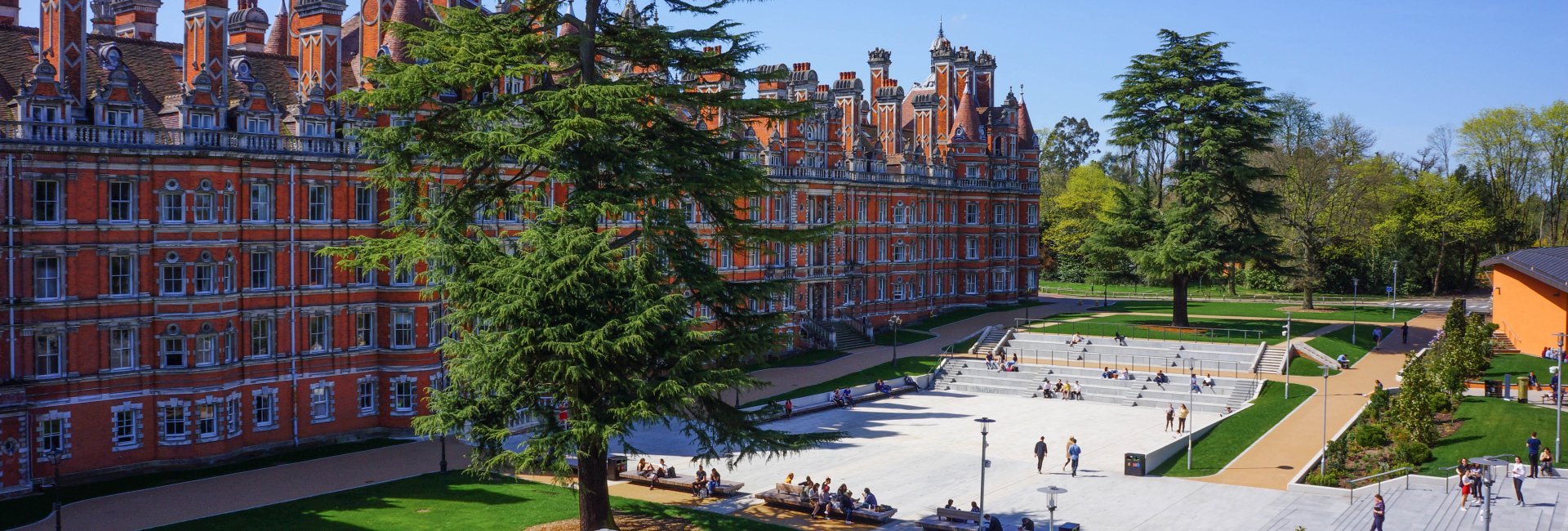
Royal Holloway, University of London - Postgraduate Open Morning (Egham campus)
13 Jun 2026, 08:00
Egham

Our students often say their enthusiasm to study Physics stems from wanting to learn more about the Higgs particle, dark matter, nanotechnology or just a wide-ranging curiosity about how things really work. Whatever your reasons, our Physics department aims to inform and excite you in the study of Physics, the most fundamental of the sciences.
On our four-year Astrophysics MSci, you’ll come to understand new concepts and paradigms, developing the deep conceptual framework that will allow an advanced understanding and appreciation of nature. You’ll develop core Physics concepts, including classical physics, quantum phenomena as well as mathematical and experimental skills.
Unlike solid-state physics (as with the Physics MSci) the emphasis will shift to astronomy, astrophysics and cosmology, and in later years you’ll cover topics such as Stellar Astrophysics and Atomic & Nuclear Physics. As you progress through the course, modules in Particle Astrophysics, Planetary Geology and Geophysics, General Relativity & Cosmology and Optics will lead you into research level topics which you'll cover in greater depth as an MSci student, than on a BSc degree. In your fourth year you can choose from an incomparably wide range of options and expertise, including courses from University College London, King's College London and Queen Mary, University of London.
We’re a research-intensive department based at our Surrey campus – well away from the light pollution of the big city, which allows our telescopes to provide the best observational astronomy in the University of London. We also have close ties with, and conduct research at major international laboratories such as CERN, ISIS and Diamond, plus collaborations with SEPnet universities and other major institutions around the world.
Our teaching is informed by the most up-to-date research, and you’ll get to work closely with research groups, in laboratories where they work first hand on Physics at the forefront of research.
Mathematics for Scientists 1
Mathematics for Scientists 2
Scientific Skills 1
Scientific Skills 2
Classical Mechanics
Fields and Waves
Classical Matter
Physics of the Universe
Academic Integrity
Mathematical Methods
Scientific Computing Skills
Quantum Mechanics
Scientific Skills for Astrophysicists
Optics
Electromagnetism
Classical and Statistical Thermodynamics
The Solid State
General Relativity and Cosmology
Advanced Skills in Physics
Quantum Theory
Particle Physics
Astronomy
Stellar Astrophysics
Particle Astrophysics
Major Project in Physics
Research Review
Below is a taster of some of the exciting optional modules that students on the course could choose from during this academic year. Please be aware these do change over time, and optional modules may be withdrawn or new ones added.
Energy and Climate Science
Advanced Classical Physics
Further Mathematical Methods
Planetary Geology and Geophysics
Lie Groups and Lie Algebras
Statistical Mechanics
Advanced Quantum Theory
Photonics and Metamaterials
Particle Accelerator Physics
Theoretical Treatments of Nano-systems
Nano-Electronics and Quantum Technology
Superconductors and Superfluids
Standard Model Physics and Beyond
Statistical Data Analysis
String Theory and Branes
Supersymmetry and Conformal Field Theory
Astroparticle Cosmology
Theory of Complex Networks
Equilibrium Analysis of Complex Systems
Dynamical Analysis of Complex Systems
Mathematical Biology
Elements of Statistical Learning
Advanced Classical Physics
Further Mathematical Methods
Quantum Field Theory
Modelling Quantum Many-Body Systems
Advanced Condensed Matter
Gravitational Wave Physics
Dark Matter & Dark Energy
Research Topics in Astrophysics
Advanced Particle Physics
Advanced Astrophysics
Gravitational Waves Astronomy
Order and Excitations in Quantum Materials
https://www.royalholloway.ac.uk/studying-here/undergraduate/physics/astrophysics-msci/
As teachers, we want to introduce, explain, challenge and excite students on the course.
A year’s worth of study is normally broken down into eight modules, each of a nominal 150 hours of study. Physics combines experimental work with conceptual thinking and mathematical analysis, each demanding its own teaching and assessment techniques. So these modules can take a variety of forms, including small group tutorials, problem classes, lectures, laboratory and computing assignments, teamwork, and one-to-one teaching in our laboratories.
For lecture course units, you’ll normally be assessed by a two-hour examination at the end of the year. Coursework and in-class tests also contribute to the assessment of many course units. Experimental work is generally assessed by written reports or oral presentation. You have to pass a minimum of six of the eight course units, with a minimum score of 40 per cent each year.
You’ll be taught the most up-to-date and exciting physics by internationally recognised experts in their fields – all who are still involved in research and bring their working knowledge to the course. We teach Physics in an understandable and rigorous style through, and our teaching consistently scores high satisfaction ratings in the annual National Student Survey.
Our close-knit, small-group teaching structure helps create a friendly environment, with an open-door policy, so students feel comfortable coming to us for advice and support.
This is the equal consideration deadline. You can still apply after this date, but your application may not receive guaranteed consideration.

Royal Holloway, University of London has participated in the Teaching Excellence Framework. These ratings were awarded in 2023, for four years.
See why these ratings were awarded
What does this TEF outcome mean?
The following entry points are available for this course:
Where an applicant is taking the EPQ alongside A-levels, the EPQ will be taken into consideration and result in lower A-level grades being required.
Socio-economics factors which may have impacted an applicant's education will be taken into consideration and alternative offers may be made to these applicants.
Required subjects: A in Mathematics and Physics, plus a Pass in the practical element of any Science A-levels being taken
Including A in Maths and Physics.
Pass in a relevant subject with at least 33 level 3 credits at Distinction, including Distinction in all Maths and Physics units and Merit in the remaining level 3 units PLUS A-Level Maths.
We require English and Mathematics at grade 4/C.
Including A in Maths and Physics.
Plus A-level grades AA in Maths and Physics, plus a Pass in the practical element of any Science A-levels taken.
6,6,6 at Higher Level or 36 points overall, including 6 in Maths at Higher Level and 6 in Physics at Higher Level
Including Maths and Physics
Plus A-level grades AA Maths and Physics. Plus a Pass in the practical element of any Science A-levels taken.
Requirements are as for A-levels where one non-subject-specified A-level can be replaced by the same grade in the Welsh Baccalaureate - Advanced Skills Challenge Certificate.
Applicants with the Cambridge Pre-U are strongly encouraged to apply to Royal Holloway. Offers will be made on the basis of equivalent A-Level grades as can be found on the Royal Holloway website.
Combinations of qualifications will be considered on an individual basis, please contact us on admissions.enquiries@rhul.ac.uk to discuss your situation
At Royal Holloway, we know every student approaches university with different experiences and backgrounds. We look at each application individually, and different factors can affect the exact offer a student receives. For instance, our contextual offer scheme means students from disadvantaged socio-economic background can receive a different offer. For full details please see our website.
Learn more on the Royal Holloway, University of London website
This section shows the range of grades that students who received offers were previously accepted on to this course with (learn more).
It is designed to support your research but does not guarantee whether you will or won't get a place.
Admissions teams consider various factors, including interviews, subject requirements, and entrance tests. Check all course entry requirements for eligibility.
We are unable to show previous accepted grades for this course. This could be because the course is new, it's a postgraduate course, there isn't enough historical data, or the provider has opted out of sharing their entry grades data for this course - learn more.
| Location | Fee | Year |
|---|---|---|
| EU & International | £29900* | |
| England, Scotland, Wales, Northern Ireland & Channel Islands | £9790* |
* This is a provisional fee and subject to change.
Tuition fee status depends on a number of criteria and varies according to where in the UK you will study. For further guidance on the criteria for home or overseas tuition fees, please refer to the UKCISA website.
Other essential costs: Students are recommended to purchase a laptop before starting their course, to assist with their studies. The optional residential field courses incur an extra fee.
*The tuition fee for Home (UK) undergraduates is controlled by Government regulations. This figure is the fee for the academic year 2026/27 and is shown as a guide. The fee for the academic year 2027/28 has not yet been confirmed.
*This figure is the fee for EU and international students starting a degree in the academic year 2026/27 and is shown as a guide. The fee for the academic year 2027/28 has not yet been confirmed.
Royal Holloway reserves the right to increase tuition fees annually for all students. For further information see fees and funding: https://www.royalholloway.ac.uk/studying-here/fees-and-funding/
Email:Admissions.Enquiries@RoyalHolloway.ac.uk
Phone:01784 414944
Egham
TW20 0EX
At Royal Holloway, University of London