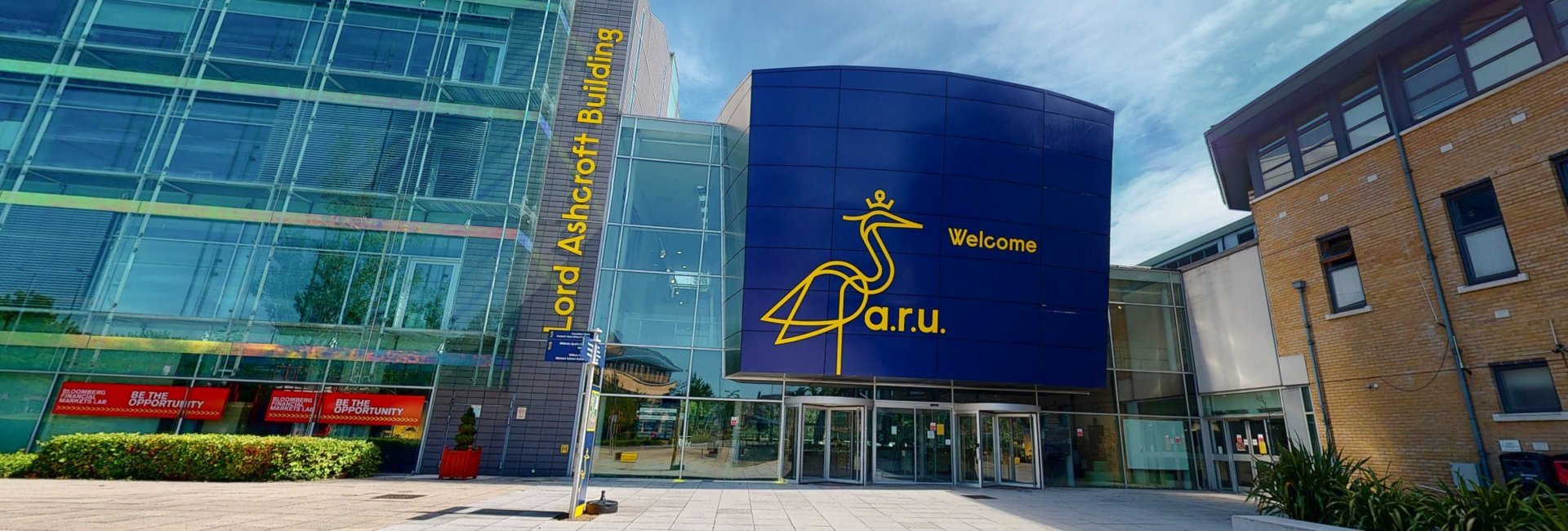
Anglia Ruskin University - Undergraduate Open Day - Cambridge
6 Jun 2026, 09:00
Cambridge

Join a course that combines the principles of engineering, biology and medicine to advance and improve healthcare treatments.
Advances in healthcare technologies have the power to transform patients' lives.
Our BEng (Hons) Biomedical Engineering degree gives you a solid grounding in various engineering approaches to healthcare challenges.
As a graduate, you'll be ready to design, develop and deliver the medical devices of tomorrow.
Why ARU?
Cover areas including biomaterials and nanotechnology, microelectronics, robotics and machine intelligence, and biomechanics.
Bring the world of work to life through Live Briefs, developed with employers to give you exposure to ‘real world’ problem-solving.
Learn from experts in electronics, mechatronics and medicine.
Study in our Biomedical Engineering Laboratory and School of Medicine.
Use new technologies to create medical devices, with our project-based course.
Take opportunities for summer internships, as well as placements at a local hospital.
Year 1
Human Anatomy and Physiology (30 credits)
Introduction to Biology and Biomedical Engineering (30 credits)
Applied Engineering Mathematics (15 credits)
Electronics and Embedded Systems (30 credits)
Structural Mechanics (15 credits)
Into ARU
Year 2
Ruskin Module (15 credits)
Electronic Design Project (30 credits)
Biomaterials (15 credits)
Robotic Control Design Project (30 credits)
Advanced Engineering Mathematics (15 credits)
Signals and Signal Processing (15 credits)
Year 3
Placement year
Year 4
Human Motion Biomechanics (15 credits)
Tissue Engineering (15 credits)
Automation and Control (15 credits)
Computer Aided Engineering (15 credits)
Nanotechnology (15 credits)
Robotics and Machine Intelligence (15 credits)
Research Methods and Individual Project (30 credits)
Throughout the course we’ll use various assessment methods to measure your progress and provide constructive feedback.
Besides exams, we use lab reports, oral presentations, computer-based assessments, in-class tests, video blogs, mock
research grant applications, and practical lab outputs such as electronic devices.
This is the equal consideration deadline. You can still apply after this date, but your application may not receive guaranteed consideration.

Anglia Ruskin University has participated in the Teaching Excellence Framework. These ratings were awarded in 2023, for four years.
See why these ratings were awarded
What does this TEF outcome mean?
The following entry points are available for this course:
We accept A Levels, T Levels, BTECs, OCR, Access to HE and most other qualifications within the UCAS Tariff.
4 GCSEs at grade C, or grade 4, or above, including English and science and Maths at grade B, or grade 6.
ARU operates a policy of making contextualised offers for this course which may be a reduced conditional offer or an unconditional offer, using data from UCAS to make our assessment. We consider that this approach promotes the equality of educational opportunity for applicants from low participation groups in HE. ARU welcomes students from diverse backgrounds and helping them achieve their full potential. The offer of a place through the contextual offer process is at the discretion of ARU.
This section shows the range of grades that students who received offers were previously accepted on to this course with (learn more).
It is designed to support your research but does not guarantee whether you will or won't get a place.
Admissions teams consider various factors, including interviews, subject requirements, and entrance tests. Check all course entry requirements for eligibility.
We are unable to show previous accepted grades for this course. This could be because the course is new, it's a postgraduate course, there isn't enough historical data, or the provider has opted out of sharing their entry grades data for this course - learn more.
| Location | Fee | Year |
|---|---|---|
| England, Scotland, Wales, Northern Ireland, Channel Islands & Republic of Ireland | £10050 |
Tuition fee status depends on a number of criteria and varies according to where in the UK you will study. For further guidance on the criteria for home or overseas tuition fees, please refer to the UKCISA website.
Please visit our website for further information on fees for the Placement year:
https://www.aru.ac.uk/study/tuition-fees
https://www.aru.ac.uk/student-life/preparing-for-study/help-with-finances
International fee TBC
https://www.aru.ac.uk/student-life/support-and-facilities/careers-and-employability/placements
Email:answers@aru.ac.uk
Phone:+44 (0)1245 686868
Email:international@anglia.ac.uk
Phone:+44 1245 683680
East Road
Cambridge
CB1 1PT
At Anglia Ruskin University