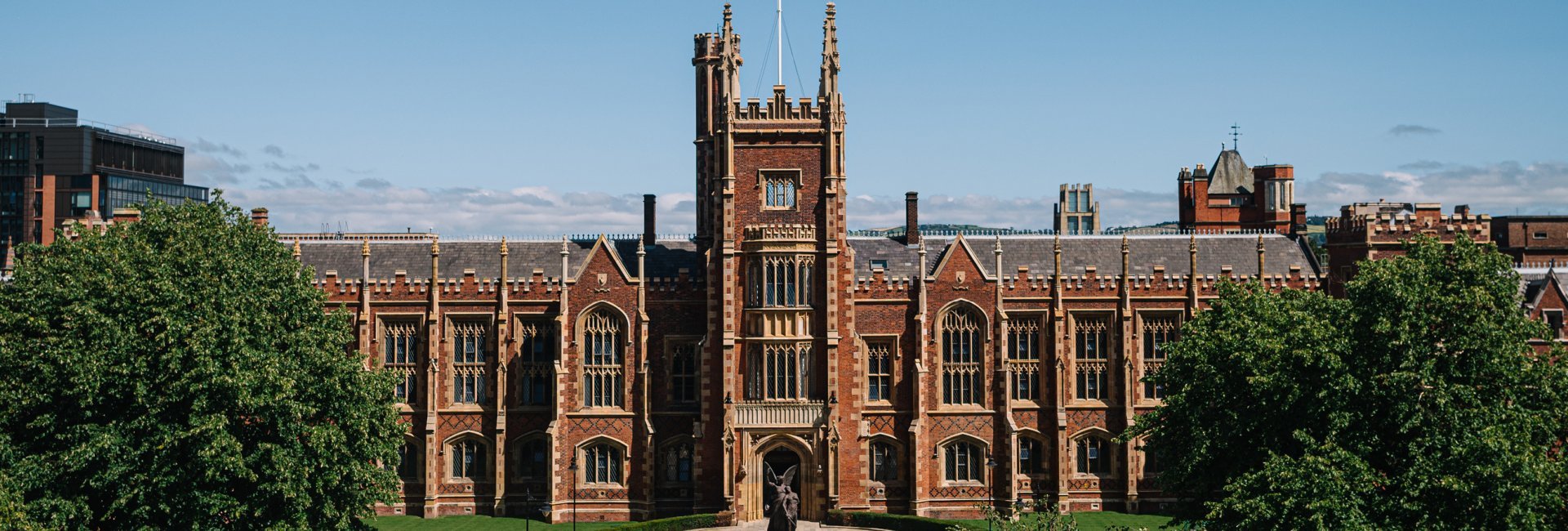
This is a fully integrated programme between Law and Irish. You will study the Law of Northern Ireland and Ireland while also studying modern language and culture.
The degree includes time spent in summer schools in the Gaeltacht which provides a unique opportunity for linguistic development. Proficiency in an additional language, significantly enhances your employability.
“The Law School at QUB is ranked 11th in the UK for Law (Complete University Guide, 2025), and ranked joint 3rd in the UK for Law Graduate prospects (Times and Sunday Times Good University Guide, 2025).”
Law (Major) with Irish highlights
Professional Accreditations
This is a Qualifying Law Degree (QLD), which means that students will be studying modules that are required for the academic stage of legal qualification. Students also have the opportunity to explore their interests in final year with elective Law modules that allow them to specialise in a particular area, or simply receive a more rounded sense of what ‘Law’ is. Many of these modules consider law and law-like interactions on a local, national and international level.
Industry Links
Law students have the unique opportunity of working with industry leaders through commercial awareness events and other negotiation exercises that offer insight into the legal practice (and services) world but also provide an enhanced skills development experience.
World Class Facilities
The £20m School at Queen’s offers students access to world-class facilities such as a fully interactive Moot Court room, a One Button Recording Studio, bookable study rooms and a wellbeing room.
Queen’s has an excellent library for Irish materials and an outstanding collection of resources relating to Ireland. The Language Centre has state-of-the-art facilities for language learning, and the IT provision more generally is excellent.
Internationally Renowned Experts
Students in the School of Law are taught by world leading experts in the areas of Law, Human Rights, Criminology and Socio-Legal Studies. Our staff have close research links with the professions, government and Civil Society.
Queen’s has world-leading experts in the history of the Irish language and literature, Irish linguistics and Gaelic names. Irish and Celtic Studies at QUB ranks 3rd in the UK for Research [Source: Complete University Guide 2025]
Student Experience
Students can join a number of student led initiatives within the school including the Law Society, the Alternative Dispute Resolution Society, the Women in Law group and the Street Law project. Other initiatives include the Global Skills Project, LawPod, Queen’s Student Law Journal, Lawyers without Borders, the student magazine ‘The Verdict’ and the Mooting Society.
Irish has a bespoke online platform for language learning called Learning Branch (this contains a range of subject-specific language tasks and mirrors content in language modules)
Strong emphasis on Irish language and culture. Students complete 3-4 hours of language per week (interactive classes based on the national syllabus for Irish). Teaching on all core and most optional modules is conducted through the medium of Irish.
The Irish student society, An Cumann Gaelach, is one of the biggest in QUB. The society is extremely active and holds a range of events and activities each year (annual festival, Irish classes, concerts, annual dinner-dance, etc.).