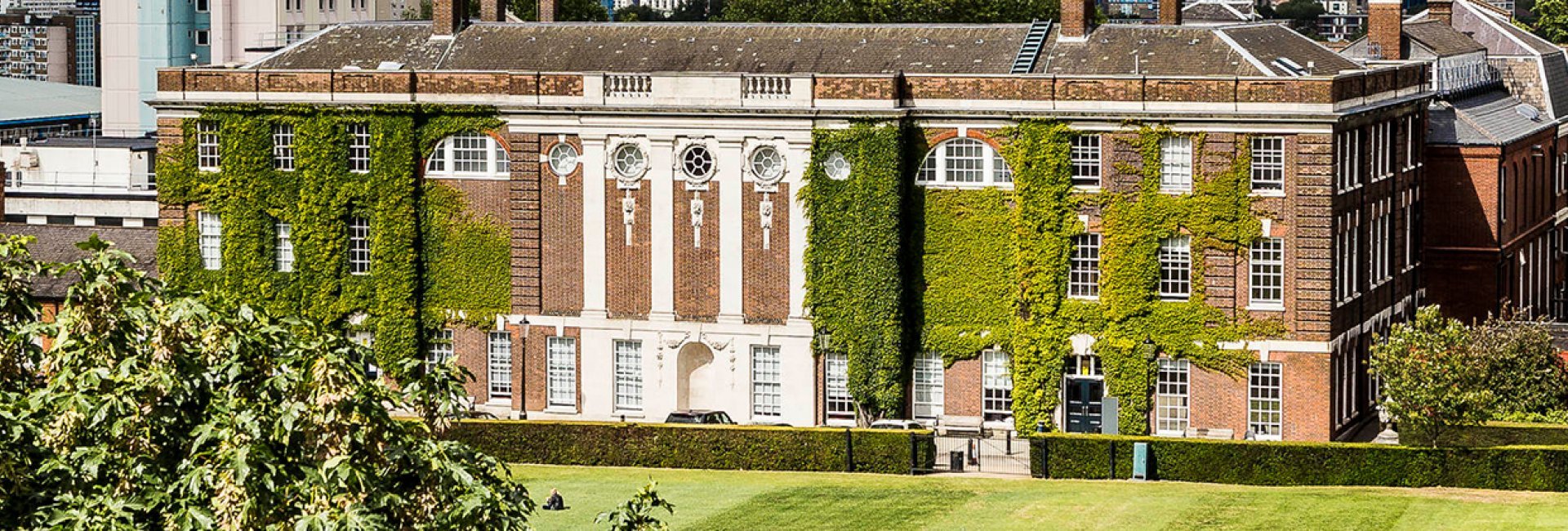
Goldsmiths, University of London - Virtual Campus Tour
25 Nov 2025, 12:00
London

This programme equips you with the core skills and knowledge required for success in the first year of your Undergraduate Degree and beyond.
Why study BA History with Politics (with Integrated Foundation Year) at Goldsmiths
If you do not have the required qualifications for degree-level study, our BA in History with Politics (with Integrated Foundation Year) offers an alternative entry route
The Foundation Year is closely aligned with our undergraduate history programmes, teaching you a foundational knowledge of the subject and helping you develop the necessary academic skills. You choose the undergraduate degree you wish to study at the point of application, but if your interests change as you progress through the foundation year you can apply to switch to a different degree programme
You will develop an understanding of the post-colonial world through a historical and historiographical survey of the British Empire from the 17th to the late 20th century
Learn about social, cultural and political themes, including industrialisation, urbanisation, politicisation, radicalism, democracy, liberalism, constitutionalism and national identity in relation to the Battle for the Ballot
You will acquire skills in historical methodology, including innovative practices such as oral history, public history, and applied history
Learn how to effectively communicate information, arguments, and analysis in written form. You will successfully deploy techniques such as source evaluation, critical judgment and referencing
Develop your ability to think critically about knowledge production and communication; look beyond the words on the page, delve into the emotional meaning of images and spoken word, and dig into the truth behind the data
Rather than focusing on chronology or strictly demarcated historical periods, combining history and politics encourages and facilitates explorations and analyses of key issues, controversies, themes, and debates.
The study, analysis and understanding of the past is as important today as it has ever been.
Understanding past societies fosters emotional intelligence and allows us to appreciate the diversity and adaptability of human life.
Understanding our pasts can help us to shape our futures and, crucially, help us shape those futures intelligently, insightfully, fairly, and with compassion, contributing towards equality, diversity and social justice.
Our innovative approaches to the study of politics, peel back the formal veneer of political parties and institutions to reveal the major ideological, economic, social, and cultural conflicts
By exploring politics in this in-depth manner, you will gain a comprehensive understanding of our world.
We cross boundaries between the traditional and the more radical understandings of political phenomena.
Politics is much more than simply what happens in parliaments, it pervades the whole of society, domestically and internationally.
Developing your academic skills
Alongside direct preparation for an undergraduate degree in History, you will take two modules with our Centre for Academic Language and Literacies (CALL). These modules will help you develop the broader academic and research skills required for undergraduate study.
You will also learn how key social and political movements of the period have influenced the world we live in today through a cross-disciplinary module: Culture and Society in Post-war Britain. This module will cover topics such as 'Windrush and Migration', 'Irish Colonisation', 'Second-wave Feminism', 'Protest and Punk' and 'South-Asian Britain'.
Year 0 (Foundation Year)
Writing Your Way: Labyrinths of Stories, Self, and Data
Collaborative Research
Culture and Society in Postwar Britain
The Battle for the Ballot
Empires, Nations and Lines on the Map: Postcolonial Perspectives on Global History
Year 1
In this year, you'll take the following compulsory modules:
Global Connections
Power, Emotions and Environment
Reading and Writing History
Historical Controversies
Academic Skills for the Social Sciences/Humanities
Year 2
Year 2 will give you the chance to broaden your intellectual horizons, and have more freedom over what you study.
You will take these compulsory modules:
History at Work
The Goldsmiths Project
You will choose 2 from the following History modules:
Communication, Propaganda and Power
Radicalism and Revolution
Race, Bodies and Empire
Environment, Disease and the Anthropocene
You will choose 2 from the following Politics modules:
US Politics and Foreign Policy
Global Governance and World Order
Modern Britain: Politics from 1979 - today
Modern Political Theory
Finally, you'll choose two modules from options provided by History. These optional modules (worth 30 credits) can be replaced by modules in another discipline at Goldsmiths.
Some of the options may include:
Art and Power
Black and British: A Critical History
Sex, Drugs and Colonial Control: Race, Vice and Deviance in the British Empire
Islam and the West
A History of Violence
Year 3
Your final year will be spent developing your specialist interests and knowledge.
You will take the following 3 compulsory modules OR one Special Subject module worth 60 credits from a list of University of London intercollegiate Group III modules.
Researching and Writing: Crafting and Presenting Your Work
Special Subject Dissertation
Future Histories: Skills for the Twenty-First Century
You will choose one special subject module worth 15 credits:
Pleasure, Power and the Raj: Leisure, Society and Social Networks in 19th Century India
OR
Global Cold War
Optional modules
You'll choose 3 (45 credits) modules from a list of History and Politics options, taking at least 30 credits of Politics modules within this total.
15 credits of optional History or Politics modules can be replaced by a module in another discipline at Goldsmiths.
Module options may include:
Witchcraft, Diabolic Possession and the Occult in Early Modern Europe
WARGAMES: Fighting, Narrating and Understanding Modern Battle
Workers of the World Unite: Marxism, Modernity and Revolution in the Twentieth Century
How Democracy Dies: the Rise of the Nazis and the German Republic, 1918-33
From Emancipations to Nations: Histories of Caribbean Decolonisation
Rebellions in Paradise: Caribbean Emancipations 1791-1914
Heresy and the Apocalypse
Please note that due to staff research commitments not all of the modules may be available every year.
You’ll be assessed by a variety of methods that broaden your academic skillset. These include coursework assignments such as essays, critical commentaries, presentations and personal reflections as well as seen examinations.
This is the equal consideration deadline. You can still apply after this date, but your application may not receive guaranteed consideration.

Goldsmiths, University of London has participated in the Teaching Excellence Framework. These ratings were awarded in 2023, for four years.
See why these ratings were awarded
What does this TEF outcome mean?
The following entry points are available for this course:
You are also required to have achieved a Level 2 qualification in GCSE English at Grade 4 or above.
For candidates who have not studied any Level 3 qualifications in the last two years, there are no formal qualifications required for admission, but you will need to demonstrate that you can benefit from the programme by undertaking an additional admissions process. This may involve an interview or the submission of a piece of writing to assess suitability to study.
We’ll pay particularly careful attention to your personal statement, which is your opportunity to demonstrate your interest in the subject you’ve applied for. Your referees are also welcome to include any relevant contextual comments around your academic achievements. We’ll look at all these things when making a decision on your application, as well as your qualifications and grades.
This section shows the range of grades that students who received offers were previously accepted on to this course with (learn more).
It is designed to support your research but does not guarantee whether you will or won't get a place.
Admissions teams consider various factors, including interviews, subject requirements, and entrance tests. Check all course entry requirements for eligibility.
We are unable to show previous accepted grades for this course. This could be because the course is new, it's a postgraduate course, there isn't enough historical data, or the provider has opted out of sharing their entry grades data for this course - learn more.
No fee information has been provided for this course
Tuition fee status depends on a number of criteria and varies according to where in the UK you will study. For further guidance on the criteria for home or overseas tuition fees, please refer to the UKCISA website.
To find out more about fees and funding, please check our undergraduate fees guidance or contact the Fees Office https://www.gold.ac.uk/ug/fees-funding/
Email:course-info@gold.ac.uk
Phone:020 7078 5300
New Cross
Lewisham
SE14 6NW
At Goldsmiths, University of London