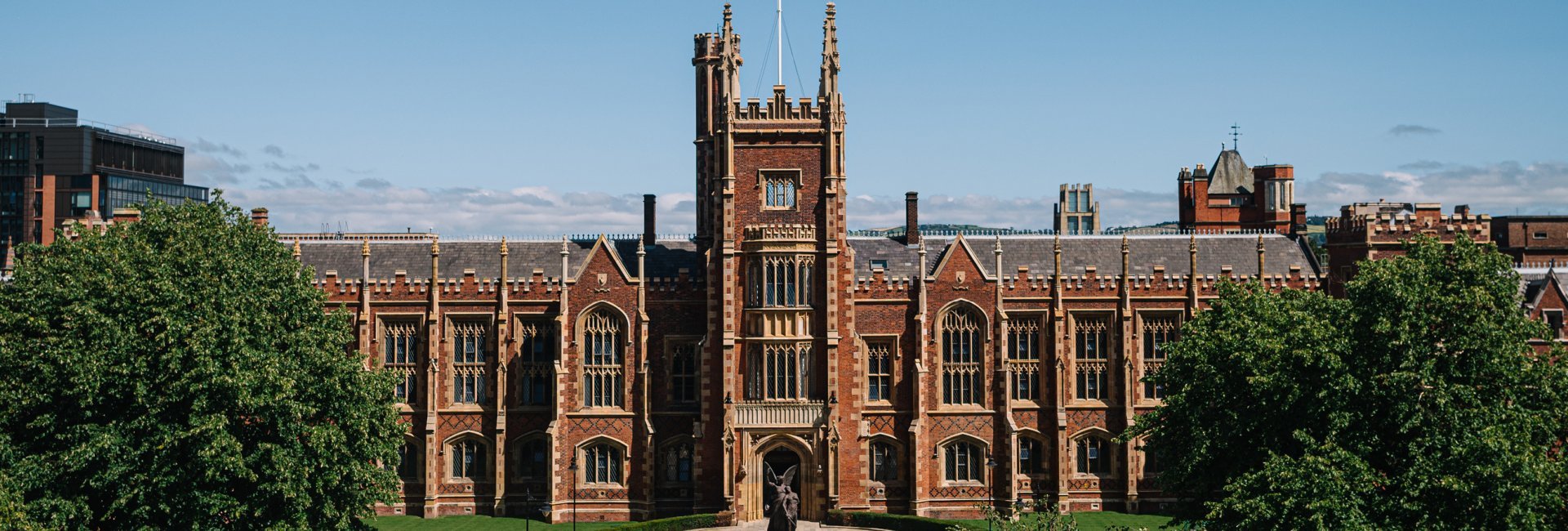
Queen's University Belfast
University Road
Belfast
BT7 1NN
Visit our website Visit our course page
Course contact details
Admissions and Access Service
Email:admissions@qub.ac.uk
Phone:028 9097 3838

Chemical Engineering uses chemistry, mathematics, biology and physics to provide an integrated approach to understanding the changes which take place in processes, from molecular to global scale, and to create methods which can change chemical or physical composition, energy content, structure, or physical state. The subject also involves the application of knowledge to the design, development and operation of plants that produce chemical and related compounds, with an emphasis on process safety and sustainability. It borders and overlaps on areas such as mechanical, electrical, and civil engineering, as well as chemistry, materials science, and biology. Degrees with a year in industry are four- or five- year programmes with a one-year industrial placement (which may be international) in the penultimate year. At Queen’s, all our programmes are accredited by the Institution of Chemical Engineers (IChemE), meaning your education will equip you with an industrially approved degree.
The following entry points are available for this course:
For information on international qualification equivalents, please check the specific information for your country at: http://www.qub.ac.uk/International/International-students/Your-Country/
In all cases where Chemistry or Physics is not offered at A-level or at Scottish Higher/Advanced Higher, applicants must have a minimum of grade B in GCSE Chemistry and Physics/grades BB in Double Award Science (not Applied), or grade B in National 5 Chemistry and Physics.
This section shows the range of grades students (with UK A-Levels or Pearson BTEC Level 3 National Extended Diplomas) who received offers were previously accepted with (learn more). It is designed to support your research but does not guarantee whether you will or won't get a place. Admissions teams consider various factors, including interviews, subject requirements, and entrance tests. Check all course entry requirements for eligibility.
Students aged 17/18 who applied to this course were offered a place.
See how students with your grades have been accepted onto this course in the past.
Operated by the Office for Students
Employment after 15 months (Most common jobs)
Go onto work and study
The number of student respondents and response rates can be important in interpreting the data – it is important to note your experience may be different from theirs. This data will be based on the subject area rather than the specific course. Read more about this data on the Discover Uni website.
| Location | Fee | Year |
|---|---|---|
| England | £9250 | Year 1 |
| Scotland | £9250 | Year 1 |
| Wales | £9250 | Year 1 |
| Channel Islands | £9250 | Year 1 |
| Northern Ireland | £4750* | Year 1 |
| Republic of Ireland | £4750* | Year 1 |
| EU | £25300 | Year 1 |
| International | £25300 | Year 1 |
* This is a provisional fee and subject to change.
Tuition fee status depends on a number of criteria and varies according to where in the UK you will study. For further guidance on the criteria for home or overseas tuition fees, please refer to the UKCISA website.
The tuition fees quoted above for NI and ROI are the 2024/25 fees and will be updated when the new fees are known. In addition, all tuition fees will be subject to an annual inflationary increase in each year of the course. Fees quoted relate to a single year of study unless explicitly stated otherwise.
Further information on Fees and Funding can be found at: https://www.qub.ac.uk/Study/Feesandfinance/.
University Road
Belfast
BT7 1NN
Visit our website Visit our course page
Email:admissions@qub.ac.uk
Phone:028 9097 3838