
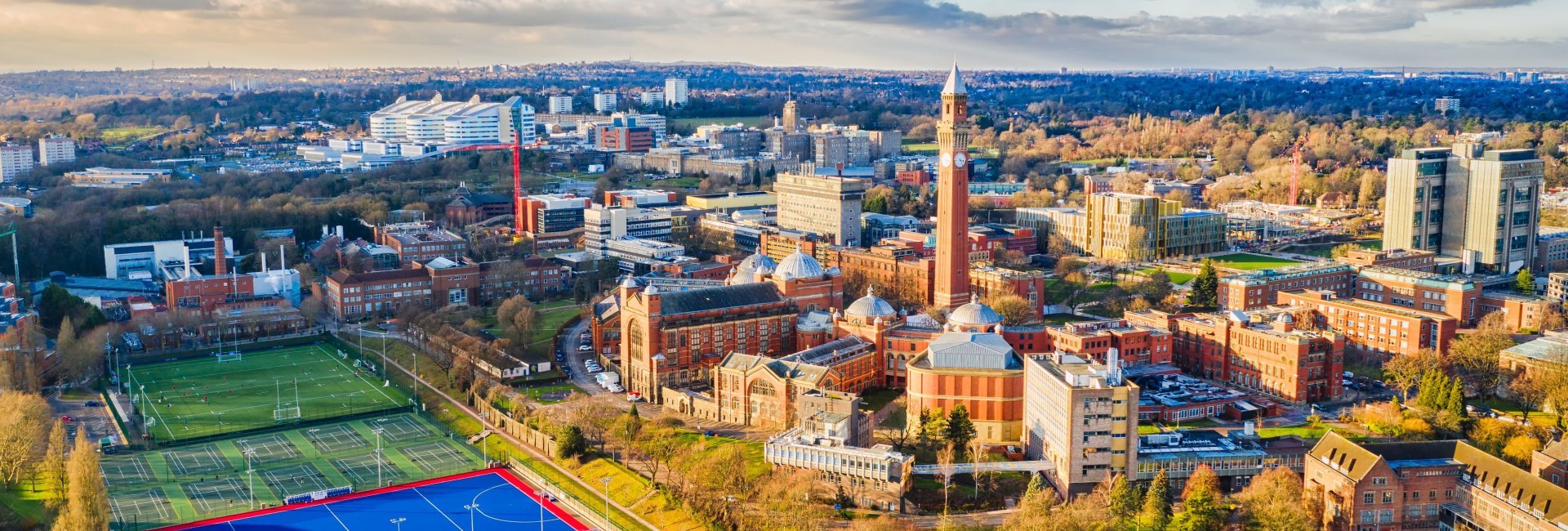
University of Birmingham - Postgraduate Open Day
18 Mar 2026, 14:00
Birmingham
Explore the evolution of our universe with MSci Theoretical Physics. From classical and quantum mechanics to the theory of relativity, you'll study advanced theoretical physics in a friendly and supportive environment.
Learn how to use the language of maths to help understand natural phenomena. Join us and build your mathematical knowledge alongside research, problem-solving, programming, teamwork and experimental skills to open the door to a range of careers.
Develop your knowledge of modern physics and the mathematical frameworks used to understand the physical world. Our theoretical physicists will help you step up to university-level physics, building your theoretical and practical skills with a firm mathematical focus.
Choose whether you want to include experimental lab work and you’ll have options for specialist topics such as nuclear physics and exoplanets. During your final year you’ll apply your knowledge to an individual project, developing high-level research skills. You’ll also deepen your understanding with advanced modules including nanophotonics and renewable energy.
Our research spaces include our own particle accelerators, the MC40 cyclotron for charged particles and HF-ADNeF, the most intense accelerator driven neutron source worldwide, as well as labs used for the construction of the detectors and electronics in experiments at the Large Hadron Collider, CERN.
As a Birmingham Physics graduate, you'll have a broad range of options for the future either working directly in a scientific environment or using transferable skills in different roles.

University of Birmingham has participated in the Teaching Excellence Framework. These ratings were awarded in 2023, for four years.
See why these ratings were awarded
What does this TEF outcome mean?
This section shows the range of grades students (with UK A-Levels or Pearson BTEC Level 3 National Extended Diplomas) who received offers were previously accepted with (learn more). It is designed to support your research but does not guarantee whether you will or won't get a place. Admissions teams consider various factors, including interviews, subject requirements, and entrance tests. Check all course entry requirements for eligibility.
Students aged 17/18 who applied to this course were offered a place.
See how students with your grades have been accepted onto this course in the past.
Operated by the Office for Students
Employment after 15 months (Most common jobs)
Go onto work and study
The number of student respondents and response rates can be important in interpreting the data – it is important to note your experience may be different from theirs. This data will be based on the subject area rather than the specific course. Read more about this data on the Discover Uni website.
Choose a specific option to see funding information.
Course options