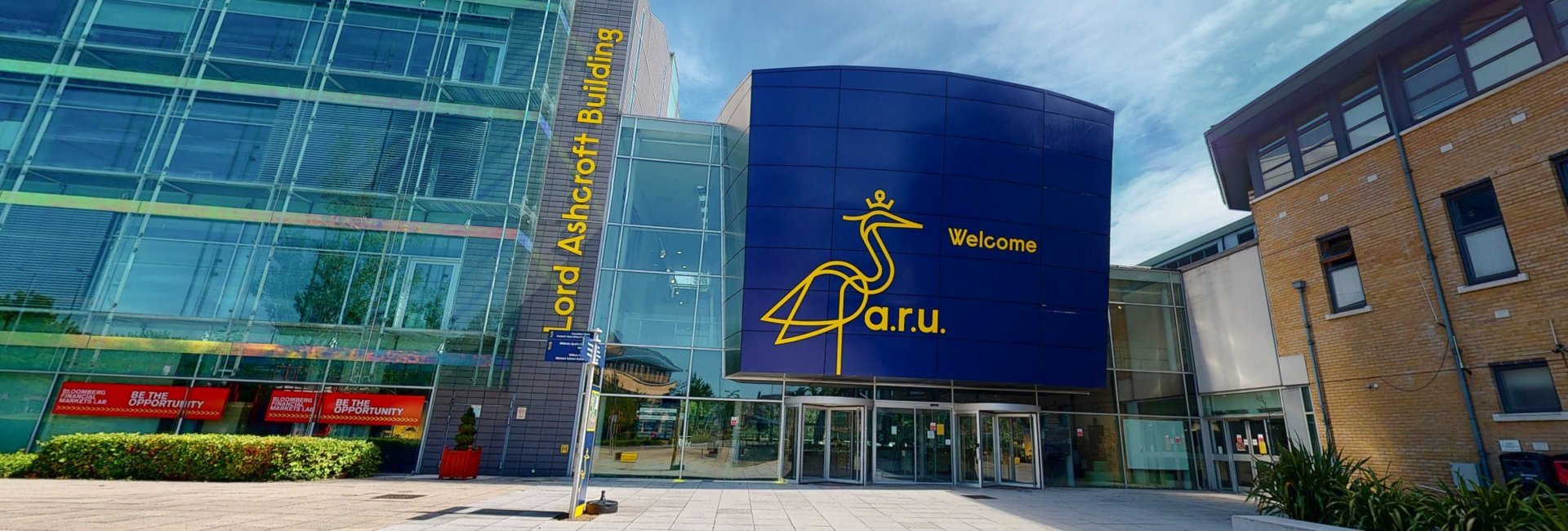
Anglia Ruskin University - Undergraduate Open Day - Cambridge
6 Jun 2026, 09:00
Cambridge

Explore the key issues and roles in film and media, focusing on the knowledge and skills you need for your future career. Get trained in all aspects of filmmaking while creating your own shorts.
Study the key issues in film, media and culture, from digital and cult media to gender and celebrity, across film, TV, social media and video games, helping you identify and focus on your own interests like journalism, filmmaking, and screenwriting.
You’ll also create your own short films in video, animation or 16mm format, and get training in all aspects of the craft, including camera operation, sound recording and editing.
Why ARU?
Join trips to galleries, exhibitions and screenings in Cambridge and London
Use our extensive industry links to make contacts, find work placements, and take part in live briefs
Enjoy full access to our film, media and other creative facilities, with training from our technical team
Prepare for many different careers in film and media including production, post-production, broadcasting, journalism, and content creation.
Be supported by a diverse team of professionally practising filmmakers, screenwriters, journalists, and academics
Choose from a variety of modules to tailor your degree to your interests and career aspirations
Careers
Screen industries employers want versatility. Our course will equip you with the wide range of skills you'll need for a career in the film and media industries.
You’ll learn to be a confident, multi-skilled practitioner, with experience in filmmaking, sound and video editing, photography and web design.
But you’ll also learn essential transferable skills, such as research, writing, teamwork, communication, problem solving, and resourcefulness – invaluable in all areas of the creative industries and other sectors.
Our degree course will give you a thorough knowledge of the theory and practice of film and media, preparing you for many related roles including film and television production and post-production, cinema and film festival management, film programming and curation, publishing, broadcasting, web design and public relations.
You might decide to stay at ARU and study for a Masters, like our MA Film and Television Production. Take advantage of our Alumni Scholarship to get 20% off your fees.
Our recent students have found internships and placements with companies such as the BBC, Cambridge Festival of Ideas, Film & Video Umbrella, Cannes Film Festival, Cambridge Film Festival, Take One magazine, Watersprite Film Festival, CBBC, ITN Productions, London Studios, MTV, New York Film Academy, Pinewood Studios, StudioCanal UK (formerly Optimum Releasing) and Sight & Sound magazine.
They’ve also taken part in live briefs with our partner organisations such as mental health charity Lifecraft, producing a series of short videos about the charity for their website and social media channels.
Facilities
You’ll have access to all of our creative facilities including:
film studio with overhead lighting, tracks, dollies and green screen
multi-camera television studio with modular set panels
full range of location kit and sound-recording equipment
editing suites with Da Vinci Resolve and the full Adobe Creative Cloud software suite
finishing suite with audio monitoring and grading panels
Aaton cameras and Steenbeck editors for 16mm film production
motion capture equipment
podcast and video capture system
HD cameras, Super8mm and 16mm film cameras
animation rostrum cameras
photography studio and colour darkrooms.
*=optional.
Year 1: Foundation in Humanities, English, Media, Social Sciences and Education.
Year 2: Film Language and Concepts; Creative Moving Image; interMEDIAcy; Introduction to Screen Media; Into ARU; Filmmaking on Film: Super 8mm ; Anglia Language Programme.
Year 3: Online Journalism; Exploded Screen; Digital Media Theory: Social Media, AI, and the Cultures of the Internet; Cult Media; Ruskin Module; Filmmaking on Film: 16mm Filmmaking *; Documentary Film Theory *; Photography *; Non-Fiction Filmmaking *; Animation *; From Script to Screen ; Anglia Language Programme.
Year 4: Creative Industries Major Project; The Cultural Politics of Celebrity; Screen Drama Production *; Experiments in Film and Moving Image *; Screenwriting: Writing and Selling the Feature Film *; Special Topics in Film Studies *; Gender and Popular Cinema *; Film Journalism *; Independent Film Practice *; Contemporary Television *; Narrative in Global Cinema ; Anglia Language Programme.
You’ll show your progress through many different methods that reflect the range of skills required by employers. Your assignments might include case studies, critical essays, screenplays, journals, film reviews and analyses, presentations, and a portfolio of practical work, as well as ‘hands on’ assignments such as internet, print and video production/commissions.
This is the equal consideration deadline. You can still apply after this date, but your application may not receive guaranteed consideration.

Anglia Ruskin University has participated in the Teaching Excellence Framework. These ratings were awarded in 2023, for four years.
See why these ratings were awarded
What does this TEF outcome mean?
The following entry points are available for this course:
5 GCSEs at grade D, or grade 3, or above and evidence of two years post-GCSE study at Level 3.
If you have achieved at least grade E in one A level, or equivalent, you are exempt from the two years post-GCSE study requirement, but you still must meet the GCSE requirements.
Applicants who do not meet the two years post GCSE study at level 3 may be considered based on their satisfactory employment history, which must be a minimum of two years full time employment supported by employer evidence and deemed appropriate by the University for meeting the course of study applied for.
| Test | Grade | Additional details |
|---|---|---|
| IELTS (Academic) | 5.5 | With minimum 5.5 in each component |
This section shows the range of grades that students who received offers were previously accepted on to this course with (learn more).
It is designed to support your research but does not guarantee whether you will or won't get a place.
Admissions teams consider various factors, including interviews, subject requirements, and entrance tests. Check all course entry requirements for eligibility.
We are unable to show previous accepted grades for this course. This could be because the course is new, it's a postgraduate course, there isn't enough historical data, or the provider has opted out of sharing their entry grades data for this course - learn more.
| Location | Fee | Year |
|---|
Tuition fee status depends on a number of criteria and varies according to where in the UK you will study. For further guidance on the criteria for home or overseas tuition fees, please refer to the UKCISA website.
https://aru.ac.uk/student-life/preparing-for-university/help-with-finances/undergraduate
https://www.aru.ac.uk/study/tuition-fees
Email:answers@aru.ac.uk
Phone:01245 683680
East Road
Cambridge
CB1 1PT
At Anglia Ruskin University