Clearing contact details
Clearing Hotline
Email:clearing@royalholloway.ac.uk
Phone:01784 772455
Course contact details
Main Contact
Email:Admissions.Enquiries@RoyalHolloway.ac.uk
Phone:01784 414944
Royal Holloway, University of London
Egham
TW20 0EX

Begin an immersive journey to understand life on Earth with our BSc Ecology and Wildlife Conservation with Integrated Foundation Year. Join the Integrated Foundation year to develop your scientific skills and confidence, ready to begin your degree.
Study Ecology and Wildlife Conservation at Royal Holloway to explore how plants and animals interact with each other and the wider environment. Gain a deeper understanding of ecological thinking so you’re ready to tackle challenges such as climate change and biodiversity loss.
The decline of multiple bee populations, with its impact on the health of flowering plants and agricultural crop yields, is just one of many threats to our world. Join our groundbreaking research team to explore issues like the wild pollinator crisis.
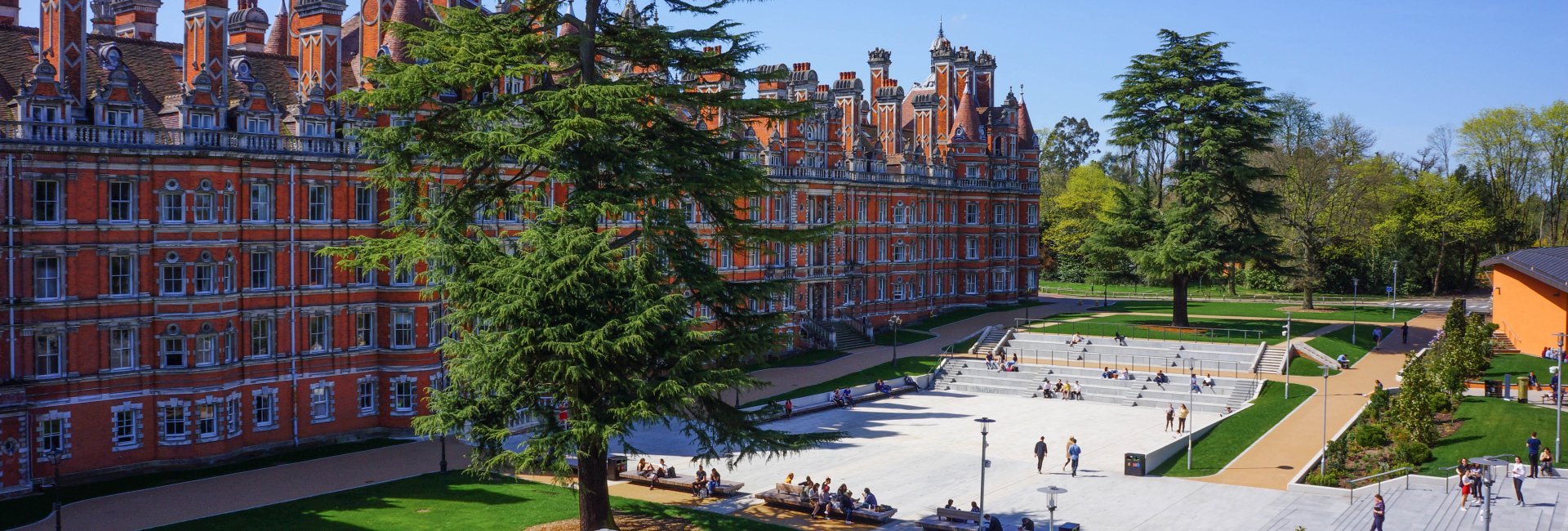
Our Egham campus is based in a 135-acre parkland estate with woodland, meadows, and watercourses. Enjoy this living lab for some of your practical projects.
Equip yourself for your future career
Investigate plant, animal, and ecosystem topics while examining vertebrate evolution, biomes and ecosystems, and genetics
Be inspired by our expert teachers with their strong research backgrounds in conservation interventions, evolutionary biology, or forest biodiversity
Boost your CV with a range of transferable skills including communication, leadership, and critical thinking
Beyond the classroom
Our course is known for its intensely practical nature. Carry out field work at nearby sites such as Windsor Great Park or Site of Special Scientific Interest Box Hill. Learn from guest speakers from Surrey Wildlife Trust. Take part in our Marine Biology field course in Scotland or the expedition to the Borneo Rainforest.
We sometimes make changes to our courses to improve your experience. If this happens, we’ll let you know as soon as possible.
We sometimes make changes to our courses to improve your experience. If this happens, we’ll let you know as soon as possible.
Core Modules
Foundation Year
Foundation Mathematics for Life Scientists
Global and Planetary Health
Foundation Life Sciences and The Environment
Foundation Practical Skills and Research (Biological Sciences)
Foundation Statistics for Life Sciences
Environmental Science for Foundation Life Sciences
Life Sciences II: Organ Systems
Year 1
Becoming a Bioscientist
Cell Biology and the Origin of Life
Genetics
Ecology and Conservation
Green Planet: Plants and Our Future
Vertebrate Evolution and Diversity
Biomes and Ecosystems
Academic Integrity
Year 2
Invertebrate Biology: Structure, Behaviour and Evolution
Food Security, Sustainability and Green Biotechnology
Plant Biotic Interactions and Ecological Networks
Practical Field Ecology
Biological Data Analysis and Interpretation
Evolution
Year 3
Individual Research Project
Conservation Science
Population and Community Ecology
Climate Change - Plants and the Environment
Optional Modules
Below is a taster of some of the exciting optional modules that students on the course could choose from during this academic year. Please be aware these do change over time, and optional modules may be withdrawn or new ones added.
Year 1
Chemistry of Life
Biology in a Changing World
Year 2
Microbiology
Animal Behaviour
Applications of Molecular Genetics in Biology
Marine Biology
Dissertation - Extended Essay
Year 3
Biology of Parasitic Diseases
Tropical Rainforest Expedition
Marine Ecology and Biodiversity
Evolutionary Ecology of Vertebrates
Extreme Animal Physiology
Circadian Biology
Seed Biology: From Molecular & Conservation Biology to Industrial Applications
In your Foundation Year, teaching methods include a mixture of lectures, practical classes and workshops, laboratory classes, individual tutorials, and supervisory sessions. Outside of the classroom you’ll undertake guided and independent practice. You will be assigned a Personal Tutor in the Department of Biological Sciences and will have regular scheduled sessions. In the Foundation Year, you’ll also be assigned a Personal Tutor in the Centre for the Development of Academic Skills (CeDAS). Assessments are varied; practical exercises, weekly problem sheets, set exercises, written examinations, laboratory reports. In addition the Foundation Year offers a full range of skills-based training.
Each year you take module worth a total of 120 credits. Most module are worth 15 credits; in the final year, your Individual Research Project is worth 30 credits.
You will attend a mixture of lectures, seminars and small-group tutorials, with class sizes that range from 6 students to 180 students. Practical classes are a major part of all first and second year module and include experiments that are integral to the subject, helping to familarise you with material and augment your understanding of key topics. These are either laboratory-based or field-based with laboratory follow-up. In your third year, you will complete an individual research project supervised by one of our academics, which may lead to you contributing to a published scientific paper. The individual research project is assessed on the basis of a written report, supervisor in-course assessment and an oral presentation.
You will be assigned a personal tutor who will provide support, guidance and advice throughout the three years of your degree course. You will also have access to the comprehensive e-learning facility Moodle, which features lecture handouts and other supporting materials including lecture slides, self-test quizzes, relevant video clips and scientific papers.
During your first and second year, continuous assessment (based on essays and reports you write during the course unit) makes up 25-30% of your course mark. The remaining 70-75% is based on written examinations. Marks from most third year lecture course units are 20-30% by continuous assessment and 70-80% by final examination. Third year assignments include a range of activities such as preparation of posters, oral presentations, creation of leaflets and podcasts, coursework essays, mock research grant applications and scientific news-and-views articles, as well as analysis of data from online repositories in mini-research projects.
The first year is formative, while outcomes of your second and third year contribute one third and two-thirds of your final degree classification respectively.
This course is available in Clearing. If you have submitted an application, you can add this course. If you haven’t sent us an application yet, you can do this until 24th September 2026.
This is the equal consideration deadline. You can still apply after this date, but your application may not receive guaranteed consideration.

Royal Holloway, University of London has participated in the Teaching Excellence Framework. These ratings were awarded in 2023, for four years.
See why these ratings were awarded
What does this TEF outcome mean?
The following entry points are available for this course:
This section shows the range of grades that students who received offers were previously accepted on to this course with (learn more).
It is designed to support your research but does not guarantee whether you will or won't get a place.
Admissions teams consider various factors, including interviews, subject requirements, and entrance tests. Check all course entry requirements for eligibility.
We are unable to show previous accepted grades for this course. This could be because the course is new, it's a postgraduate course, there isn't enough historical data, or the provider has opted out of sharing their entry grades data for this course - learn more.
This report uses your grades to show how students with similar results have done when applying to this course in the past. Sometimes, there isn’t data for every possible set of grades. When that happens, universities and colleges occasionally fill in the gaps for sets of grades that are typically accepted.
| Location | Fee | Year |
|---|
Tuition fee status depends on a number of criteria and varies according to where in the UK you will study. For further guidance on the criteria for home or overseas tuition fees, please refer to the UKCISA website.
*The tuition fee for Home (UK) undergraduates is controlled by Government regulations. This figure is the fee for the academic year 2026/27 and is shown as a guide. The fee for the academic year 2027/28 has not yet been confirmed.
**This figure is the fee for eligible EU and International students for the academic year 2026/27 and is shown as a guide. The fee for the academic year 2027/28 has not yet been confirmed.
Royal Holloway reserves the right to increase tuition fees annually for all students. For further information see fees and funding: https://www.royalholloway.ac.uk/studying-here/fees-and-funding/ and the terms and conditions: https://www.royalholloway.ac.uk/studying-here/applying/admissions-policy-and-procedures/
*** These estimated costs relate to studying this particular degree at Royal Holloway during the 2026/27 academic year and are included as a guide. Refers to specific individual items of £50 or more, and excludes accommodation, commuting, food, books/other learning materials and printing costs.
Email:clearing@royalholloway.ac.uk
Phone:01784 772455
Email:Admissions.Enquiries@RoyalHolloway.ac.uk
Phone:01784 414944
Egham
TW20 0EX
At Royal Holloway, University of London