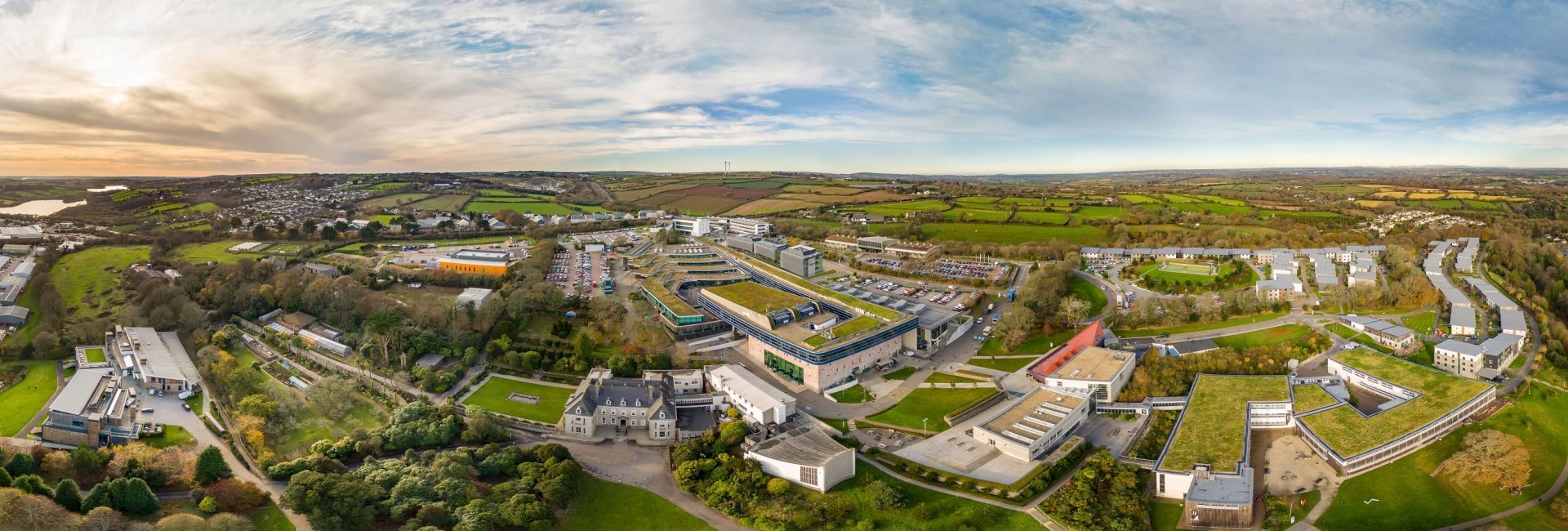
Open Day (in-person)
23 May 2026, 08:00
Falmouth
Guided by internationally published lecturers and renowned industry collaborators, you’ll become a daring, contemporary fashion image maker on our Fashion Photography course. Exploring ideas around identity, body politics, wellbeing and the environment, you’ll learn to weave impactful visual stories using a range of photographic and film approaches, as well as experimenting with immersive technologies.
Great fashion images are never made in isolation. So, you'll work closely with talent from across the creative industries. Throughout this Fashion Photography course, you'll collaborate with fashion designers, art directors, stylists, marketers and even game developers to build a visually arresting portfolio to take into industry.
Why study this course at Falmouth?
Our guest speaker programme is next level. You’ll hear from world-leading practitioners, which have previously included Ben Weller (Photographer, British Vogue), Danny Reed (Fashion Director, The Face), Ewen Spencer (Photographer, Arena Homme+) and Mathew Whitehouse (Editor, The Face magazine)
You’ll pitch your projects to industry experts and work on live briefs set by renowned industry contributors. Students have previously worked with Amy Gwatkin (Filmmaker/Photographer), Kyanisha Morgan (Fashion Stylist, Dazed Magazine) and Matthew Holroyd (Editor, Baron Magazine)
Published by the likes of Acne Studios, Beauty Papers, i-D, Re-Edition, The Face and Vogue Hommes, staff have decades of commercial expertise and the contacts that go with it
We’ll support you to explore both traditional and emerging approaches to image-making as you experiment with analogue photography, 3D modelling, VR, photogrammetry and more
Throughout this course, you’ll harness critical theory, creativity and technology to become a skilled, confident and original image maker. Working across film, photography and immersive technologies, you'll explore studio and location practices, high-end retouching, specialist editing techniques and fashion film. From catwalks to street style, we'll cover all areas of fashion. You'll learn about advertising campaigns, produce fashion imagery for clients, and create web-based work, fashion fanzines and designer lookbooks.
Year one
Working with key themes surrounding fashion image making, you’ll gain the skills and contextual knowledge needed to start making strong, competent productions. You'll develop the foundations for research methodologies, collaborative practices and professional etiquette, working towards an ethical practice. You’ll also begin to build your fashion networks and community through specific modules with fashion stylists.
Modules
Subcultures and Styles
Belonging
The Body and Ethics
The Edit
Year two
In the second year, you’ll be supported to confidently produce complex and extended photographic projects that are backed by critical theory and intellectual enquiry. Through visual practice modules, you’ll engage in alternative forms of image making that test and blur the traditional limits of fashion photography and filmmaking. You'll also start developing the professional skills you’ll need to build a successful career in the creative industries – including collaboration and exploring the relevant distribution channels for your practice.
Modules
Fashion Film
The Commercial Image
Theories
Fashion Image
Collaboration
Year three
You’ll be responsible for finding your own placement, with support from the employability team. Choosing this option will enhance your industry experience and skills while studying.
How you’ll study during your professional placement
You’ll spend time working in a professional context, as part of a business or organisation. This can be in one role, or up to three, and must be for a minimum of 24 weeks.
You’ll develop in-demand workplace skills, deepen your insight into industry and grow your network of contacts, all of which could help you get ahead in your career after graduation.
Throughout this year, you’ll develop a portfolio of work that includes critical self-reflection on what has been learned from the experience. You’ll be required to evidence your experiences, the skills you’ve learned and your professional growth.
Year four
Your final year is all about preparing for your transition from student to industry professional. Working towards the submission of a dissertation (or equivalent) and Final Major Project, you’ll further develop your unique vision as you work with selected global clients on professional briefs, building relationships with casting directors, location scouts, stylists, and creative directors.
Modules
The Client Brief
Investigations
Final Major Project
Professional Futures, Industry Ambitions
As part of our process of continuous improvement, we routinely review course content to ensure that all our students benefit from a high-quality and rewarding academic experience. As such, there may be some changes made to your course which are not immediately reflected in the content displayed on our website. Any students affected will be informed of any changes made directly.
Continuous assessment of visual, verbal and written assignments.
Portfolio submissions, support work and online presence.
Final-year portfolio.
The following entry points are available for this course:
If English is not your first language, you will need to demonstrate English language skills that are sufficiently developed for successful completion of your studies. We accept a range of recognised English language qualifications that are equivalent to the International English Language Testing System (IELTS) Academic minimum score of 6.0 overall, with a minimum of 5.5 in Reading, Writing, Speaking and Listening. Through the award of international scholarships, we aim to support academic enrichment by encouraging diversity and excellence at Falmouth. For details of our international scholarships, and how to apply for them, please visit our website at www.falmouth.ac.uk
At Falmouth, we recognise excellence in many forms, and we see the whole you.
Our diverse community is creative, innovative and entrepreneurial.
We recognise that these qualities aren’t always shown in academic grades alone. That’s why, while many of our applicants achieve high academic grades, we also welcome those who can demonstrate their potential through an exceptional portfolio or performance.
At a minimum, we typically require the equivalent of 64 UCAS Tariff points for undergraduate courses where we can review a portfolio or audition, or a minimum of 96 UCAS points for those courses that do not require a portfolio or audition. For our Integrated Foundation Year courses, we typically require a minimum of 32 UCAS points for courses where we can review a portfolio or audition, or 64 UCAS points for those that do not require a portfolio or audition.
To support this approach, during a friendly conversation with our academic team, we’ll consider your ideas, your creative output and your ambition to ensure you’ll thrive at Falmouth.
If you are able to demonstrate relevant, current, equivalent experience instead of formal qualifications, we encourage you to apply. Please contact our Applicant Services team before applying, for advice regarding your individual experience and eligibility.
If you are an international applicant and require a Student visa to study in the UK, you must have a recognised English language test approved and vouched for by the University at the appropriate level. You can see what we accept on our website https://www.falmouth.ac.uk/study/international/english-language-requirements Our Applicant Services team can help you with any general questions you may have about study visas or suitable language tests. For more specific advice, we recommend you also consult UKCISA http://www.ukcisa.org.uk/
Find out more about qualification requirements for this course.
View our list of accepted English language tests and qualifications using the link below https://www.falmouth.ac.uk/study/international/english-language-requirements
At Falmouth University, we take a rounded approach to admissions. Instead of focusing on criteria like grades alone, we operate a contextual admissions policy, where we look at you as a person: your talents, your experiences and your potential. Every offer we make is shaped around you and your circumstances, and our conditional offers are always intended to be realistic and achievable.
This section shows the range of grades students (with UK A-Levels or Pearson BTEC Level 3 National Extended Diplomas) who received offers were previously accepted with (learn more). It is designed to support your research but does not guarantee whether you will or won't get a place. Admissions teams consider various factors, including interviews, subject requirements, and entrance tests. Check all course entry requirements for eligibility.
We are unable to show previous accepted grades for this course. This could be because the course is new, it's a postgraduate course, there isn't enough historical data, or the provider has opted out of sharing their entry grades data for this course - learn more.
No fee information has been provided for this course
Tuition fee status depends on a number of criteria and varies according to where in the UK you will study. For further guidance on the criteria for home or overseas tuition fees, please refer to the UKCISA website.
No additional fees or cost information has been supplied for this course, please contact the provider directly.
Woodlane
Falmouth
TR11 4RH
Visit our website Visit our course page
Email:applicantservices@falmouth.ac.uk
Phone:01326 213730
At Falmouth University