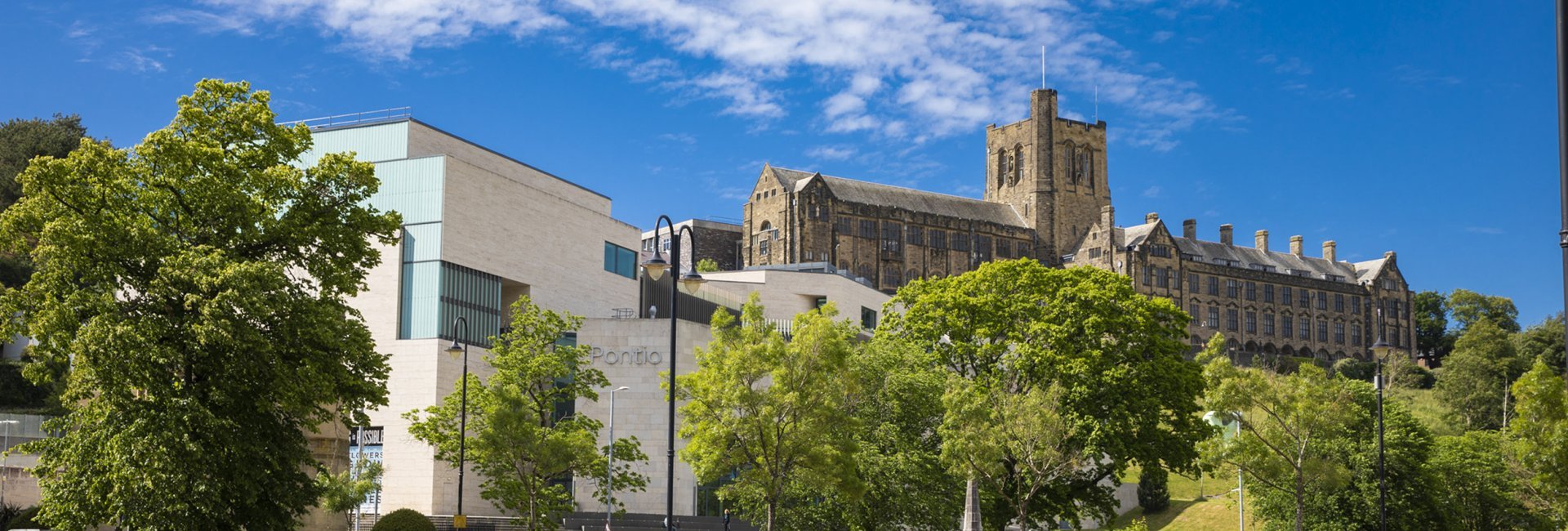
Bangor University Open Day
4 Jul 2026, 07:45
Bangor

Studying Conservation with Forestry prepares you to tackle the greatest environmental challenges of our time – climate change, loss of biodiversity, and deforestation.
Forests are the most biodiverse of all terrestrial ecosystems and contain the vast majority of the world’s species. Providing food, shelter, drainage, medicine, raw materials, and supporting the livelihoods of millions of people worldwide, they cover an estimated 30% of the Earth’s land surface, account for 50% of plant productivity, and store up to 45% of the world’s carbon.
Accredited by the Institute of Chartered Foresters (ICF), this degree will give you a deeper, science led, understanding of the biodiversity of forests and woodlands and their role in reducing the impacts of human activities, including climate change. You will focus on the principles of biological conservation, forest ecology, forest ecosystem function, and the management of forests across the globe to meet conservation objectives.
Studying in a fantastic location for field trips and projects near Eryri National Park Authority, you also have access to the 82 hectares of woodlands, many semi natural, and farmland we own at the University’s Henfaes Research Centre. The Centre, also a Defra study farm and part of the Global Farm Platform, hosts a range of forestry and land-use research experiments that provide excellent learning resources.
Our extensive local, national, and international networks and active research programmes allow us to deliver high quality teaching which addresses cutting-edge issues, from investigating the role of trees on African livelihoods to biodiversity assessments in the Caribbean montane forests and climate change assessments the Amazon rainforest.
A wide choice of optional modules in topics allows you to tailor your studies to your interests, specialising in areas such as land use change and conservation, renewable energy, or environmental issues. Your final-year research project provides further flexibility and has led to students focusing on forest soils, mycorrhizal fungi, forest hydrology, forest ecology, monitoring of conservation outcomes.
We run local and optional international field courses which enable you to see the conflict between land use for economic production and conservation and biodiversity outcomes. We visit a wide range of forest and woodland ecosystems along with other terrestrial habitats with management spanning production, restoration and conservation objectives. You can also attend a tropical conservation field course in Madagascar to learn about the causes of biodiversity loss.
As the longest standing Forestry department in the UK, Bangor University is one of only three universities across the UK training foresters to degree level. We place particular emphasis on developing your practical, interpersonal, professional, technical, analytical, and problem-solving skills to prepare you for whatever and wherever your career takes you. Our world-renowned research and strong industry links provide opportunities to hear about and see for yourself how theoretical aspects of forestry, environmental science and conservation are applied in practice.
‘Placement Year’ and 'International Experience Year’ options are available for this course. You will have the opportunity to fully consider these options when you have started your course at Bangor and can make an application for a transfer onto such a pathway at the appropriate time. You can find more information about these options on our website and if you have any questions, please get in touch.
If you don’t have the required qualifications for this degree-level course or are looking to re-enter education after time away from study, then a Foundation Year Programme might be the right choice for you. Please see Environmental Science (with Foundation Year) F90F.
For details of the modular structure, please see the course description on Bangor University's website.
The following entry points are available for this course:
Discover what it's like to study Conservation with Forestry at Bangor University: insights on the course, making friends, personal statement tips, uni prep, and recommended books, podcasts, and videos.

Including grade C in a science subject at A2 level (e.g. Biology, Geography, Geology, Environmental Sciences/Studies, Chemistry, Physics, Maths, Economics, Statistics, Psychology). Key Skills and General Studies not accepted.
In a relevant subject (e.g. Countryside Management, Applied Science, Forestry & Arboriculture, or Animal Management). Similar subject areas considered on a case-by-case basis.
In a Science/Environmental-based course.
Minimum of 5 Scottish Highers - some subject specific grades/Advanced Highers may be required.
Including H5 in a Science subject.
We will accept this qualification in conjunction with other level 3 qualifications.
Points can include a relevant Extended Project (EPQ) but must include a minimum 2 full A-levels, or equivalent. Please contact us for more information.
In Applied Science or Laboratory Skills (other subject areas considered on a case-by-case basis).
T Level qualifications are accepted on a case by case basis.
We allow you flexibility in meeting our entry requirements and accept a broad range of qualifications. We are happy to accept combinations of the qualifications listed above, as well as alternative Level 3 qualifications such as City & Guilds, Access and Cambridge Technical Diplomas. We also welcome applications from mature learners and/or those with other qualifications are considered on individual merit. If you cannot find the qualifications that you are studying (or have completed) listed above, please contact us for advice: applicantservices@bangor.ac.uk
If you don't think you'll meet the entry requirements specified, you may be able to gain entry to this course via a Foundation Year route. Please see: Environmental Science with Foundation Year (UCAS Code: F90F).
International Candidates: school leaving qualifications that are equivalent to A levels/Level 3 and/or college diplomas are accepted from countries worldwide (subject to minimum English Language requirements), details at: www.bangor.ac.uk/international/applying/entryrequirements
For the most up-to-date information on acceptable English Language proficiency qualifications, please visit our webpage below.https://www.bangor.ac.uk/international/future/englishlanguage
Bangor University is committed to widening participation in Higher Education (HE) and accepts students from a broad range of backgrounds.
To support students into Higher Education, we use a number of indicators to identify students who may be at a disadvantage in their ability to access Higher Education, in order to provide additional support.
Our admissions process involves assessing the entire application to make an assessment based on your grades and individual circumstances.
This section shows the range of grades that students who received offers were previously accepted on to this course with (learn more).
It is designed to support your research but does not guarantee whether you will or won't get a place.
Admissions teams consider various factors, including interviews, subject requirements, and entrance tests. Check all course entry requirements for eligibility.
We are unable to show previous accepted grades for this course. This could be because the course is new, it's a postgraduate course, there isn't enough historical data, or the provider has opted out of sharing their entry grades data for this course - learn more.
| Location | Fee | Year |
|---|
Tuition fee status depends on a number of criteria and varies according to where in the UK you will study. For further guidance on the criteria for home or overseas tuition fees, please refer to the UKCISA website.
Tuition fees and scholarship information for Home applicants can be found here:
https://www.bangor.ac.uk/studentfinance/new-undergraduates
Tuition fees and scholarship information for International applicants can be found here:
https://www.bangor.ac.uk/international/tuition
Email:admissions@bangor.ac.uk
Phone:01248 383717
Bangor (Wales)
LL57 2DG
At Bangor University