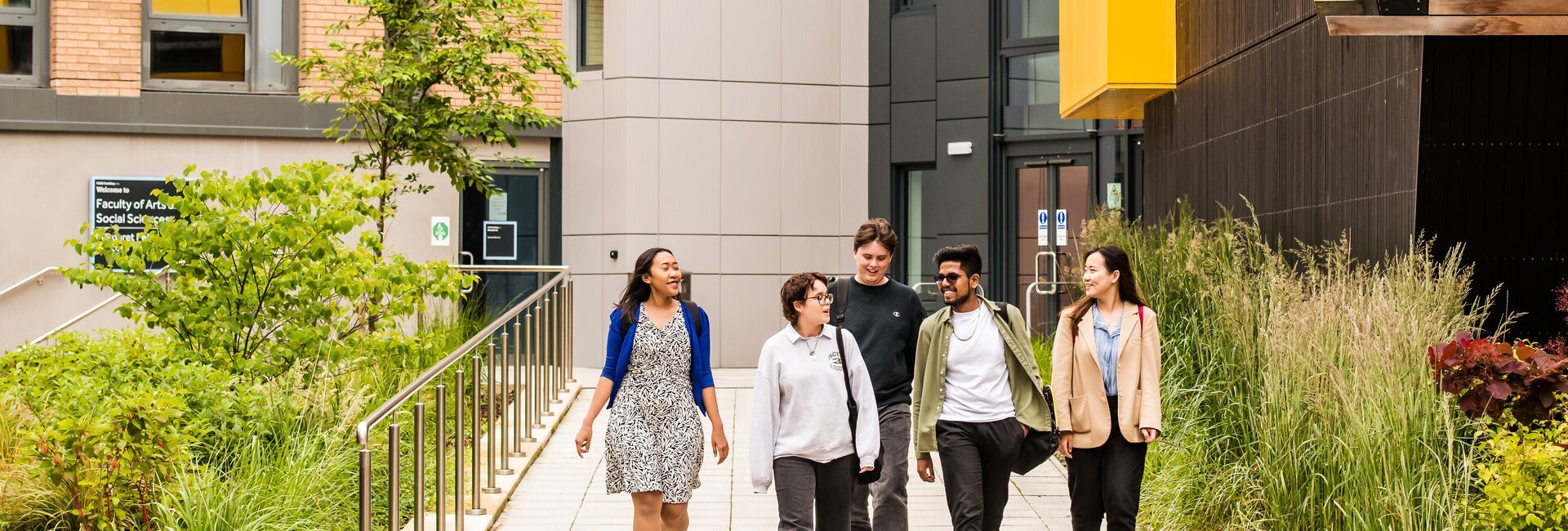
Lancaster University undergraduate open day
27 Jun 2026, 08:00
Lancaster

Mathematics forms the foundations of all technology and computing. This intrinsic link provides you with limitless opportunities to experiment and innovate, giving you the power to revolutionise business, healthcare, the government, and beyond.
By combining the study of Mathematics with Computer Science, you will gain the specialist skills and knowledge needed to excel in this field. You will develop invaluable insight into key concepts and systems in to tackle the biggest challenges of today - artificial intelligence, machine learning, data management, and cyber security and risks – and understand the mathematical concept and processes behind them.
What to expect
Our four-year MSci Hons Mathematics with Computer Science degree begins by guiding you through the mathematical concepts and methods that sit at the foundation of both disciplines. From multivariable calculus, probability and statistics, to logic, proofs, and theorems. Alongside this, you will be introduced to software development and the fundamentals of computer science, where you will gain essential technical knowledge and interdisciplinary skills.
Progressing into Year 2, through a range of core and optional modules, you will start to delve deeper into topics across both disciplines, and these include human-computer interaction, software design, advanced linear algebra, AI, cryptography, languages and compilation, security and risk, and stochastic processes. As part of this, you will apply your learning in group projects inspired by real-world challenges. For example, past students have demonstrated their software skills by developing a playable computer game.
In Year 3 is where you start to develop your interests through a wide choice of optional modules, customising your degree to suit your career ambitions.
Master’s-level training
You can advance your degree in Year 4 by studying Master’s modules and undertaking a major research project. This project will be supervised by an active researcher or undertaken as part of a collaborative industry project.
Personal development
You will develop valuable transferable skills such as data analysis, problem-solving and quantitative reasoning, all of which make you highly desirable to future employers. Your practical skills gained in programming, software design and testing prepare you for applications in the real world. These skills combined skills are honed by working in collaboration with fellow students, ruminating on theories and testing them out, delivering presentations and communicating your research results.
A supportive community
To help you transition from A-level to degree-level study, the School of Mathematical Sciences hosts weekly workshops, problem-solving classes, and one-to-one sessions. If you wish to engage with mathematics beyond that, the MathSoc hosts a weekly Maths Cafe that includes access to academic support and a casual space to chat with other students. You will also benefit from being a part of our School of Computing and Communications with access to societies such as LUHack and Women++@InfoLab. Academics also run daily support sessions in the FAST Hub.
3 things our mathematics and computer science students want you to know:
The multidisciplinary nature of the degree and its industry-led approach opens doors to many different career paths, such as roles in data science, architecture, consultancy, software engineering, and video game development
There’s lots of great spaces to work in, like the InfoLab Sky Lounge or the Science & Technology labs. As well as access to cutting-edge equipment and facilities that are only available for computing students
Both Mathematics and Computer Science are incredibly collaborative disciplines. You will bounce ideas around with experts, or with students from all years. The PhD community has been right where we are, asking the same questions, and there’s even opportunities to talk with them and learn from them
This is the equal consideration deadline. You can still apply after this date, but your application may not receive guaranteed consideration.

Lancaster University has participated in the Teaching Excellence Framework. These ratings were awarded in 2023, for four years.
See why these ratings were awarded
What does this TEF outcome mean?
The following entry points are available for this course:
Discover what it's like to study Mathematics with Computer Science at Lancaster University: insights on the course, making friends, personal statement tips, uni prep, and recommended books, podcasts, and videos.

This should include Mathematics grade A or Further Mathematics grade A. The overall offer grades will be lowered to AAA for applicants who achieve both Mathematics and Further Mathematics at grades AA.
Considered on a case-by-case basis. Our typical entry requirement would be 45 Level 3 credits at Distinction, but you would need to have evidence that you had the equivalent of A level Mathematics grade A.
with 17 points from the best 3 HL subjects including 6 in Mathematics HL (either analysis and approaches or applications and interpretations)
considered alongside A level Mathematics grade A on a case-by-case basis
Only considered alongside A level Mathematics grade A
We accept the Advanced Skills Baccalaureate Wales in place of one A level, or equivalent qualification, as long as any subject requirements are met.
We are happy to admit applicants on the basis of five Highers, but where we require a specific subject at A level, we will typically require an Advanced Higher in that subject. If you do not meet the grade requirement through Highers alone, we will consider a combination of Highers and Advanced Highers in separate subjects. Please contact our Admissions team for more information.
English Language grade 4/C.
We will also look at your overall GCSE profile when considering your application as a whole.
We do have flexibility when considering GCSE requirements. Please visit our website for more details.
You can find full details of our entry requirements and the application process on our website. https://www.lancaster.ac.uk/study/undergraduate/how-to-apply/
| Test | Grade | Additional details |
|---|---|---|
| IELTS (Academic) | 6 | with at least 5.5 in each element |
| Cambridge English Advanced | Level B2 | 169 overall with at least 162 in each element |
| Cambridge English Proficiency | Level C1 | 169 overall with at least 162 in each element |
| PTE Academic | 50 | with at least 42 in each element |
| TOEFL (iBT) | 77 | with at least 18 in Reading, 17 in Listening, 17 in Speaking, and 20 in Writing. For tests taken after 21 January 2026, we require 4 overall with at least 4 in each element. |
| Trinity ISE | Merit | ISE II with a minimum of Merit in each element |
https://www.lancaster.ac.uk/study/entry-requirements/undergraduate-english-requirements/
At Lancaster, we are committed to widening access to higher education for all. As part of this we take a holistic approach to reviewing applications, taking into account exceptional circumstances and potential as much as we can. We run a Contextual Offer Scheme which incorporates a reduced grade offer for applicants that meet our eligibility criteria. For more information on the scheme, and other widening participation activity such as the Lancaster Access Programme, please visit our website.
We accept a wide range of international qualifications. If your qualification is not listed here, please see our website for more information, or contact our Admissions team for advice. https://www.lancaster.ac.uk/study/entry-requirements/undergraduate-qualifications/
This section shows the range of grades that students who received offers were previously accepted on to this course with (learn more).
It is designed to support your research but does not guarantee whether you will or won't get a place.
Admissions teams consider various factors, including interviews, subject requirements, and entrance tests. Check all course entry requirements for eligibility.
We are unable to show previous accepted grades for this course. This could be because the course is new, it's a postgraduate course, there isn't enough historical data, or the provider has opted out of sharing their entry grades data for this course - learn more.
No fee information has been provided for this course
Tuition fee status depends on a number of criteria and varies according to where in the UK you will study. For further guidance on the criteria for home or overseas tuition fees, please refer to the UKCISA website.
For information about fees and funding please visit www.lancaster.ac.uk/fees.
Email:ugadmissions@lancaster.ac.uk
Phone:01524 592028
Bailrigg
Lancaster
LA1 4YW
At Lancaster University