Course contact details
Main Contact
Email:Admissions.Enquiries@RoyalHolloway.ac.uk
Phone:01784 414944
Royal Holloway, University of London
Egham
TW20 0EX

BA Music and Theatre at Royal Holloway combines two major complementary performing arts. This joint degree will prepare you for a career in areas such as acting, music, broadcasting, stage management, or arts administration.
You’ll be studying at one of the largest Drama and Theatre departments in the world. And our Music department is the only one in the country to hold a prestigious Regius Professorship.
Be inspired by our team’s experience in contemporary British theatre, theatre history, and dance and physical theatre. And benefit from their expertise spanning traditional, modern, and world music.
As well as exploring issues in history, sociology, ethnology, and philosophy, you’ll also gain practical skills in composition, music technology, and performance.
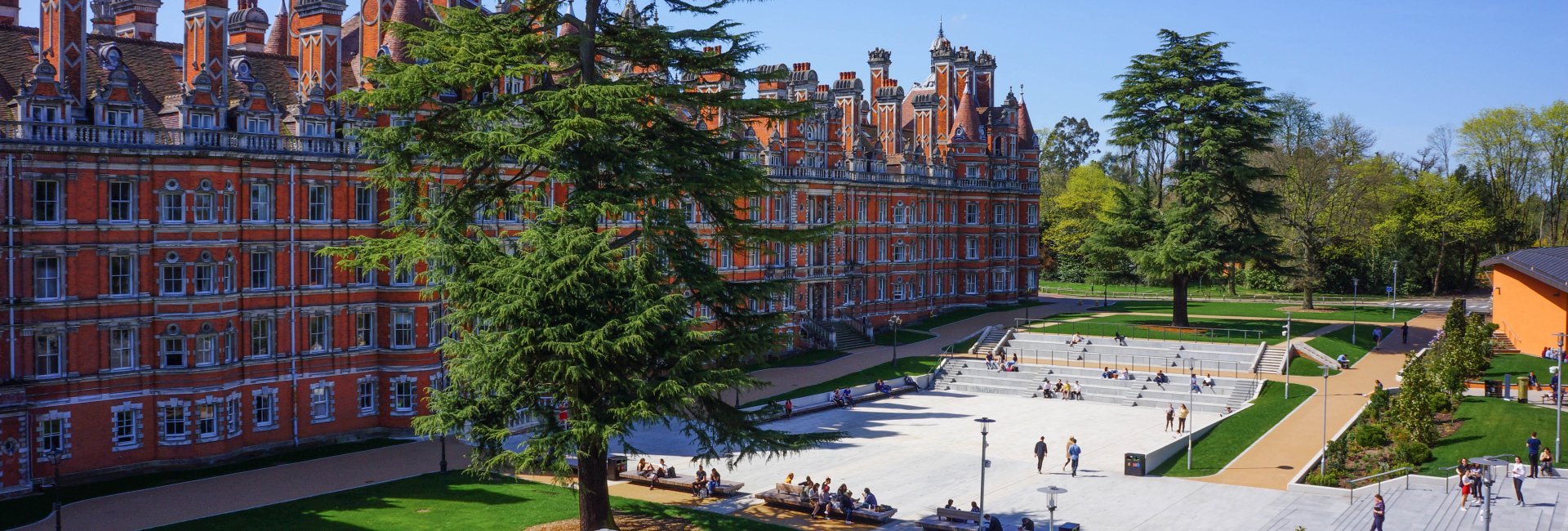
Enjoy the buzz and creativity of our campus community
Get involved and work creatively in both musical theatre and pop
Join Student Workshop, the Drama department’s student society, or one of our many music ensembles
Spend time exploring a variety of subjects from composition techniques to making musical theatre. Become an informed theatre goer. Increase your confidence as a performer. And gain knowledge of the industry as a whole to see where you might like to make your future.
We sometimes make changes to our courses to improve your experience. If this happens, we’ll let you know as soon as possible.
You will take the following modules in Drama:
Theatre and Performance Making 1
Theatre and Text 1
Below is a taster of some of the exciting optional modules that students on the course could choose from during this academic year. Please be aware these do change over time, and optional modules may be withdrawn or new ones added.
Optional modules in Music may include:
Theory and Analysis
Fundamentals of Music Theory
Creative Composition Techniques
Practical Composition Skills
A Very Short History of Music
Introduction to Historical Musicology
Introduction to World Music
Contemporary Debates in Music
Solo Performance
Creative Ensemble Performance
Theatre and Performance Making: Devising
Theatre and Performance Making: Theatre Directing
Theatre and Performance Making: Acting for Camera
Theatre and Performance Making: Dance and Theatre
Theatre and Performance Making: Scenography
Theatre and Text: Staging the Real
Theatre and Text: Decoding debbie tucker green
Shakespeare, Ecology and Performance
Theatre and Culture: Theatre for Young Audiences
Theatre and Culture: Cultures of Memory
Dancing Bodies, Global Culture
Theatre and Ideas: Ideas of Gender and Sexuality
Theatre and Ideas: The Idea of Tragedy
Theatre and Ideas: The Idea of Adaptation
Theatre and Ideas: The Idea of the Musical
Theatre and Ideas: The Idea of Acting
Theatre and Ideas: The Idea of Money
Theatre and Ideas: The Idea of Casting
Studies in Music Analysis
Studies in Composition
Studies in Music History
Studies in Ethnomusicology
Studies in Music, Media and Technology
Practical Performance I
Solo Performance
Ensemble Performance
Composition Portfolio
Practical and Creative Orchestration
Practical Conducting (Choral and Orchestral)
Composing with Technology 1
Introduction to Jazz: Theory, Practice and Contexts
Popular Music and Musicians in Post-War Britain and North America
Korean Percussion Performance
Practical Ethics
Musical Aesthetics
Mozart's Operas
Issues in Sound, Music and the Moving Image
Intercultural Performance: Theory and Practice
Music and Society in Purcell's London
Contemporary Music Performance
Music, Power and Politics
Ideas of German Music from Mozart to Henze
Music and Gender
Hearing the Orient: Critical and Practical Approaches to the Middle East
Love, Gender and Sexuality
Race Relations in Theatre, Film and Television
Shakespeare
Naturalist Theatre in Context
Creative Learning and Theatre
Physical Theatre
Shakespeare on Camera
The Actor's Voice
Actor Training in a Globalised World
Group Project
Final Year Project - Special Study
Final Year Project - Dissertation
Taught Dissertation
Solo Performance
Ensemble Performance
Composition Portfolio
Practical and Creative Orchestration
Practical Conducting (Choral and Orchestral)
Composing with Technology 1
Introduction to Jazz: Theory, Practice and Contexts
Popular Music and Musicians in Post-War Britain and North America
Korean Percussion Performance
Practical Ethics
Musical Aesthetics
Mozart's Operas
Issues in Sound, Music and the Moving Image
Intercultural Performance: Theory and Practice
Music and Society in Purcell's London
Contemporary Music Performance
Music, Power and Politics
Ideas of German Music from Mozart to Henze
Music and Gender
Hearing the Orient: Critical and Practical Approaches to the Middle East
Practical Performance 2
Composing with Technology 2
Special Study: Dissertation
Special Study: Theory and Analysis
Special Study: Solo Performance
Special Study: Composition
The course has a modular structure, whereby students take 12 course units at the rate of four per year. Some course units are compulsory, while others are elective, thereby offering flexibility and some choice.
You will be taught through a combination of lectures, seminar/workshops, and for Drama, presentation of your research and practical experimentation, with or without written texts. For Music, you will also have vocal or instrumental lessons. IT applications are used to explore many aspects of the subject, and we support your capability in this area through an Information Technology Skills course. You will also have the opportunity to take part in a wide variety of musical and performance activities supported by the departments, including performances by orchestras, choirs and other ensembles. Private study and preparation are essential parts of every course, and you will have access to many online resources and the University’s comprehensive e-learning facility, Moodle.
You will also take a study skills course during your first year, designed to equip you with and enhance the writing skills you will need to be successful in your degree. This course does not count towards your final degree award but you are required to pass it to progress to your second year.
All undergraduate degree courses at Royal Holloway are based on the course unit system. This system provides an effective and flexible approach to study, while ensuring that our degrees have a coherent and developmental structure.
Assessment methods match the course content. For most Drama course units, you will be assessed on two pieces of work, one of which is usually an essay, while the other might be an assignment such as a seminar presentation or a performance. You will sometimes be assessed as part of a group, and a portfolio of practical work.
This is the equal consideration deadline. You can still apply after this date, but your application may not receive guaranteed consideration.

Royal Holloway, University of London has participated in the Teaching Excellence Framework. These ratings were awarded in 2023, for four years.
See why these ratings were awarded
What does this TEF outcome mean?
The following entry points are available for this course:
Combinations of qualifications will be considered on an individual basis, please contact us on admissions.enquiries@rhul.ac.uk to discuss your situation.
At Royal Holloway, we know every student approaches university with different experiences and backgrounds. We look at each application individually, and different factors can affect the exact offer a student receives. For instance, our contextual offer scheme means students from disadvantaged socio-economic background can receive a different offer. For full details please see our website.
Learn more on the Royal Holloway, University of London website
This section shows the range of grades that students who received offers were previously accepted on to this course with (learn more).
It is designed to support your research but does not guarantee whether you will or won't get a place.
Admissions teams consider various factors, including interviews, subject requirements, and entrance tests. Check all course entry requirements for eligibility.
We are unable to show previous accepted grades for this course. This could be because the course is new, it's a postgraduate course, there isn't enough historical data, or the provider has opted out of sharing their entry grades data for this course - learn more.
This report uses your grades to show how students with similar results have done when applying to this course in the past. Sometimes, there isn’t data for every possible set of grades. When that happens, universities and colleges occasionally fill in the gaps for sets of grades that are typically accepted.
| Location | Fee | Year |
|---|---|---|
| EU & International | £28500* | |
| England, Scotland, Wales, Northern Ireland & Channel Islands | £9790* |
* This is a provisional fee and subject to change.
Tuition fee status depends on a number of criteria and varies according to where in the UK you will study. For further guidance on the criteria for home or overseas tuition fees, please refer to the UKCISA website.
Other essential costs: Students are recommended to purchase a laptop before starting their course, to assist with their studies. The optional residential field courses incur an extra fee.
*The tuition fee for Home (UK) undergraduates is controlled by Government regulations. This figure is the fee for the academic year 2026/27 and is shown as a guide. The fee for the academic year 2027/28 has not yet been confirmed.
*This figure is the fee for EU and international students starting a degree in the academic year 2026/27 and is shown as a guide. The fee for the academic year 2027/28 has not yet been confirmed.
Royal Holloway reserves the right to increase tuition fees annually for all students. For further information see fees and funding: https://www.royalholloway.ac.uk/studying-here/fees-and-funding/
https://www.royalholloway.ac.uk/studyhere/undergraduate/feesandfunding/bursariesandscholarships/home.aspx
Email:Admissions.Enquiries@RoyalHolloway.ac.uk
Phone:01784 414944
Egham
TW20 0EX
At Royal Holloway, University of London