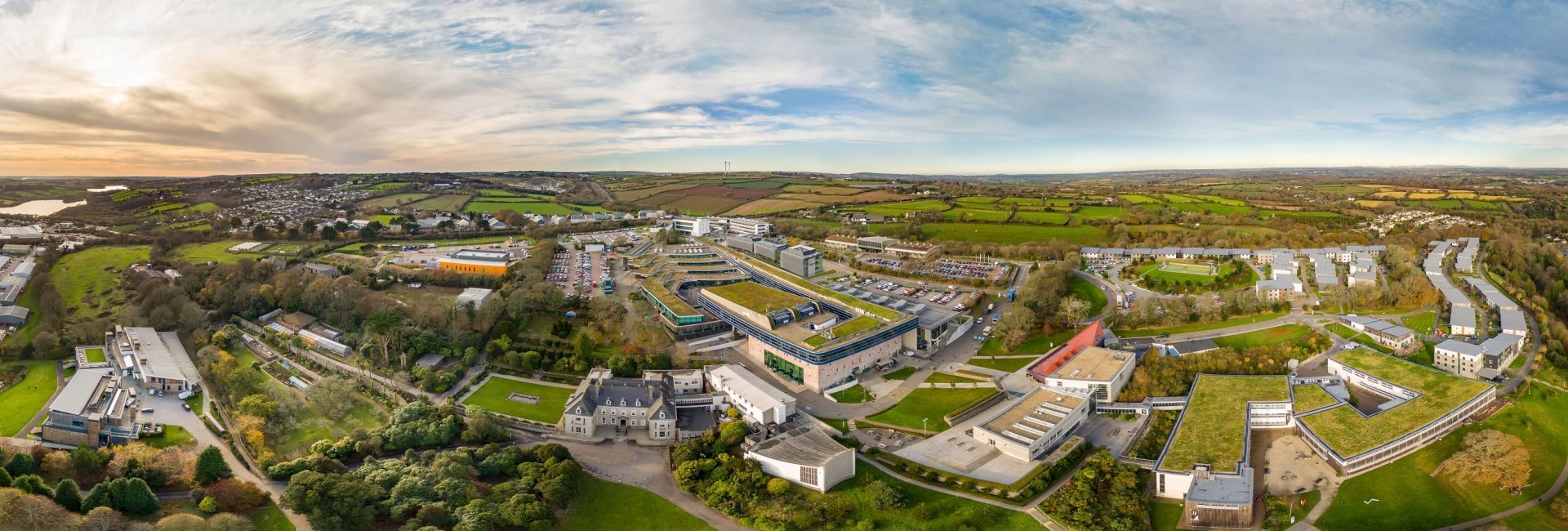
Open Day (in-person)
23 May 2026, 08:00
Falmouth
Develop your skills by entering the creative industries on an Integrated Foundation Year degree.
If you’re interested in taking on a new subject that you’ve not had the opportunity to study in depth before, or have been out of education for a while, then our Integrated Foundation Year courses might be for you. These four-year courses include an introductory year to help you build the core skills needed for specialist degree-level study.
This is a chance for you to let your imagination run wild and explore your creativity, expand your professional skills and develop enhanced subject knowledge in the domain you want to study. We’ll help nurture your expertise in problem solving, risk-taking, designing and making as you develop your abilities through five core modules.
After your foundation year, you’ll have a deeper knowledge of your subject, a clear understanding of your strengths, a developed practical and technical skill set and the confidence to excel in your chosen degree subject when you join other students for the rest of your course.
Redefine the world around you as an adaptable, articulate, graphic designer.
Graphic Design is one of the most versatile visual disciplines, embracing words and pictures, form and structure, time and space. It’s also one of the most powerful; touching everything from the clothes we wear, the political ideas we believe in, and the way we shape the future of our planet. Good design thrives by looking for new ways to tell both familiar and emerging stories; it’s in clever ideas and beautifully executed outcomes, hand-drawn scribbles, and digital masterpieces.
Our Graphic Design degree is evolving alongside the ever-changing design industry and the world around us. Now, more than ever, we are looking for purpose-driven thinkers who can respond to human-centred communication problems, and create genuine, positive outcomes with lasting impact. By studying Graphic Design at Falmouth, you'll gain the expertise to address complex design challenges and emerge as a forward-thinking visual communicator.
You will:
Develop technical, design thinking and production skills in your chosen specialism.
Learn teamwork, leadership and project management skills through a variety of learning environments.
Develop critical thinking and creative problem-solving skills through the development of unique and innovative projects.
Complete your chosen degree over a four-year period.
Be part of a thriving and immersive studio community that embraces innovation, champions risk-taking, and encourages creative collaboration.
Consider the mechanisms through which graphic design can highlight or disrupt problems in society, directly challenging the nature of the discipline and defining your own set of beliefs.
Explore and question the process of design, visual language, storytelling, and craft – utilising both traditional and cutting-edge tools and technologies to support your ideas.
Gain expertise in branding, typography, content creation, UX/UI, and digital media, preparing you for the diverse demands of the design industry.
Learn in one of the most unique locations in the world, at an independent art-specialist institution, where we nurture a deep connection with people, place, and planet.
Work on human-centred projects developed by staff, leading industry practitioners, international competition schemes, and through your own enquiry – shaping the outcomes into a career-launching portfolio.
Participate in key industry events, our optional study trips, and attend guest lectures from industry leaders, ex-students, and our award-winning staff.
Explore graphic design as a tool for positive change, responding to environmental, ethical, and moral challenges, building together for your future.
With design process and clever thinking at its heart, the course explores how meaningful, creative ideas can be made. With its formidable connection to industry, award-winning graduates, and integration of theory and practice, you’ll be challenged to think holistically, responsibly, and differently. You’ll look ‘at’ the world around you, rather than be caught up in it.
Foundation Year:
In your foundation year, you'll study five core modules: three short modules in the first study block and two in the second (one short, one long). These are all designed to help you explore the foundational elements of both creative practice and your chosen specialism. You'll gain relevant technical skills, learn to experiment and take risks, develop an understanding of professional practice, have opportunities to work across disciplines and collaborate with other students on live project briefs.
After your foundation year, you'll have a deeper knowledge of your subject, a clear understanding of your strengths, a developed practical and technical skillset and the confidence to excel in your chosen degree subject when you join other students for the rest of your course.
Modules:
Explore
Technique
Apply
Industry
Launch
Year one
During your first year, you’ll be encouraged to explore, experiment and question new creative processes and practices, through both thinking and making. This will deepen your understanding of the breadth of the subject and will begin to shape the future of your unique creative journey. You’ll be part of a supportive and innovative studio culture, where together you’ll learn to grow your skills, develop multiple ideas, and embrace creative risk.
A variety of briefs, workshops, lectures, and presentations will introduce you to design process, visual language, collaboration, and storytelling.
Modules
Design is?
Design from
Design beyond
Design with
Year two
In your second year, practical, hands-on thinking is re-considered in the light of historical, theoretical, and critical points-of-view. You will consider the process, craft (including the role of evolving technologies), and context of graphic design in much greater depth. You’ll also explore the role of designer as translator, disruptor, collaborator and facilitator.
Briefs, workshops, lectures, and presentations are complimented by in-depth learning about experience design, brands and consumer culture, typography and information hierarchy, the ethics and responsibility of design practice, design for society and teamwork.
In exploring these themes, you’ll also be encouraged to consider opposing perspectives to the accepted norms, and to wrestle with the tension these areas of design can create.
Modules
Design for
Design against
Design towards
Design with
Year three
In your final year, you’ll select (or write) a variety of projects that continue to test and challenge your emerging areas of interest, culminating in a final portfolio of design work. These projects will allow you to build on core skills and reflect critically on your individual strengths – while still exploring alternative models of practice that help define a design future beyond your degree. They will also turn your thinking into highly ‘graphic’ outcomes, utilising the best technologies for each idea and celebrating your skills as an all-round practitioner.
You’ll begin the year with a variety of workshops that encourage you to consolidate your practice, explore possible design futures, take on a leadership role as a collaborator, and finally culminate your studies – defining what you believe ‘Design is…!
Modules
Design as
Design works
Design is!
Design with
As part of our process of continuous improvement, we routinely review course content to ensure that all our students benefit from a high-quality and rewarding academic experience. As such, there may be some changes made to your course which are not immediately reflected in the content displayed on our website.
Foundation Year:
Foundation Year assessments are 100% coursework based.
Assessment will take place at the end of each module, and you'll get feedback and evaluation throughout the year. You'll be assessed through visual, verbal and written assignments, including your portfolio and a reflective journal. In your foundation year all assessments are pass/fail to encourage students to take risks and engage with the feedback provided.
Progressing in your specialism
Students studying on courses with an Integrated Foundation Year must successfully complete and pass all foundation modules before they can progress to the next stage of their course.
Your specialism
Opportunities for ongoing feedback & review happen weekly (normally every 2–3 days), with both staff and other students.
The work you submit is normally ‘graphic’ (i.e. visual in nature) but also will include some written and physical elements.
Sketchbook & development work is as valuable as the traditional ‘outcome’.
Your work is assessed in response to a variety of design briefs & workshops.
It is assessed against a ‘design orientated’ criteria shaped by the course team and informed by the best of industry practice.
Formal assessment occurs after each module (normally twice yearly).
In year three, you’ll exhibit your work for assessment as part of a final-year show.
The following entry points are available for this course:
If English is not your first language, you will need to demonstrate English language skills that are sufficiently developed for successful completion of your studies. We accept a range of recognised English language qualifications that are equivalent to the International English Language Testing System (IELTS) Academic minimum score of 6.0 overall, with a minimum of 5.5 in Reading, Writing, Speaking and Listening. Through the award of international scholarships, we aim to support academic enrichment by encouraging diversity and excellence at Falmouth. For details of our international scholarships, and how to apply for them, please visit our website at www.falmouth.ac.uk
At Falmouth, we recognise excellence in many forms, and we see the whole you.
Our diverse community is creative, innovative and entrepreneurial.
We recognise that these qualities aren’t always shown in academic grades alone. That’s why, while many of our applicants achieve high academic grades, we also welcome those who can demonstrate their potential through an exceptional portfolio or performance.
At a minimum, we typically require the equivalent of 64 UCAS Tariff points for undergraduate courses where we can review a portfolio or audition, or a minimum of 96 UCAS points for those courses that do not require a portfolio or audition. For our Integrated Foundation Year courses, we typically require a minimum of 32 UCAS points for courses where we can review a portfolio or audition, or 64 UCAS points for those that do not require a portfolio or audition.
To support this approach, during a friendly conversation with our academic team, we’ll consider your ideas, your creative output and your ambition to ensure you’ll thrive at Falmouth.
If you are able to demonstrate relevant, current, equivalent experience instead of formal qualifications, we encourage you to apply. Please contact our Applicant Services team before applying, for advice regarding your individual experience and eligibility.
If you are an international applicant and require a Student visa to study in the UK, you must have a recognised English language test approved and vouched for by the University at the appropriate level. You can see what we accept on our website https://www.falmouth.ac.uk/study/international/english-language-requirements Our Applicant Services team can help you with any general questions you may have about study visas or suitable language tests. For more specific advice, we recommend you also consult UKCISA http://www.ukcisa.org.uk/
Find out more about qualification requirements for this course.
View our list of accepted English language tests and qualifications using the link below https://www.falmouth.ac.uk/study/international/english-language-requirements
At Falmouth University, we take a rounded approach to admissions. Instead of focusing on criteria like grades alone, we operate a contextual admissions policy, where we look at you as a person: your talents, your experiences and your potential. Every offer we make is shaped around you and your circumstances, and our conditional offers are always intended to be realistic and achievable.
This section shows the range of grades students (with UK A-Levels or Pearson BTEC Level 3 National Extended Diplomas) who received offers were previously accepted with (learn more). It is designed to support your research but does not guarantee whether you will or won't get a place. Admissions teams consider various factors, including interviews, subject requirements, and entrance tests. Check all course entry requirements for eligibility.
Students aged 17/18 who applied to this course were offered a place.
See how students with your grades have been accepted onto this course in the past.
Operated by the Office for Students
Employment after 15 months (Most common jobs)
Go onto work and study
The number of student respondents and response rates can be important in interpreting the data – it is important to note your experience may be different from theirs. This data will be based on the subject area rather than the specific course. Read more about this data on the Discover Uni website.
No fee information has been provided for this course
Tuition fee status depends on a number of criteria and varies according to where in the UK you will study. For further guidance on the criteria for home or overseas tuition fees, please refer to the UKCISA website.
No additional fees or cost information has been supplied for this course, please contact the provider directly.
Woodlane
Falmouth
TR11 4RH
Visit our website Visit our course page
Email:applicantservices@falmouth.ac.uk
Phone:01326 213730