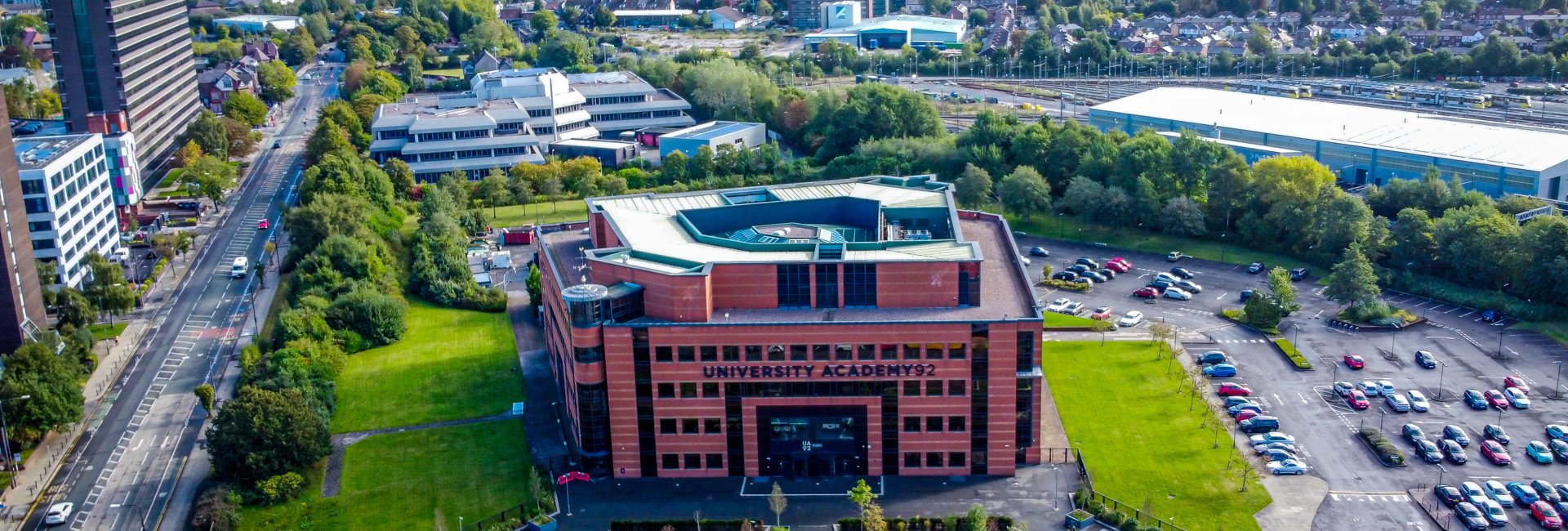
Course contact details
Student Futures Team
Email:futures@ua92.ac.uk
Phone:0161 507 1992
University Academy 92 (UA92)
UA92 Campus
Talbot Road
Trafford
Manchester
M16 0PA

This accelerated course covers the same content as our standard BSc, just in two years instead of three. Beginning with the basics of anatomy, physiology, and psychology, you’ll go on to cover the important role of nutrition and discover the fascinating world of biomechanics.
Using the newest technologies, you’ll develop your practical skills, explore athletic development approaches, and understand how to coach, support, and guide individuals towards their goals.
UA92 partnerships will help create exciting opportunities for you with big sporting names like Manchester United and Lancashire Cricket Club, so you’re ready to hit the ground running!
If you’re looking for a fast-track Sports and Exercise Science course in Manchester, check out our 2-year accelerated BSc (Hons) Sports and Exercise Science degree and unlock your greatness at UA92.
An accelerated Sports and Exercise Science degree will give you the scientific skillset and technical understanding to get ahead in a wide range of sports, fitness and health careers.
Whether you’re keen to become a sports scientist, a personal trainer, a physiologist, an applied discipline specific practitioner or want to go on to further research or study, UA92 is the perfect springboard for success.
Alongside your course modules, you will engage with the 92 Programme, which is built into every degree and tailored to each subject area.
Engaging with the 92 Programme is a requirement for all students and will count towards your overall grade.
Through taught sessions, immersive experiences and coaching, you will build confidence, resilience, wellness, self-reflection and professionalism, skills designed to support your future success.
Module 1- Introduction to Human anatomy and Physiology
This module introduces you to the anatomy and physiology of the body’s major systems, including the skeletal, muscular, cardiovascular, and respiratory systems. You’ll learn how these systems respond to exercise, and how this knowledge applies to sport, education, and physical activity. Through practical workshops and applied tasks, you’ll develop the skills to collect, analyse, and interpret physiological data.
Module 2- Introduction to Biomechanics
This module introduces you to the science of biomechanics – the study of human movement. You’ll uncover the principles behind motion, forces, and technique, while also gaining hands-on experience with data collection and analysis. From Newton’s laws to movement screening, you’ll build a strong foundation to understand and improve performance in sport, exercise, and health.
Module 3- Introduction to Sports and Exercise Psychology
This module introduces you to the psychological principles that shape sport, exercise, and physical activity. You’ll explore topics such as motivation, confidence, stress, behaviour change, and the benefits of physical activity for wellbeing. Through practical tasks and applied case studies, you’ll learn how psychology supports performance, participation, and health.
Module 4- Developing Active Lifestyles
This module introduces you to the key principles behind creating and sustaining healthy, active lifestyles. You’ll explore how physical activity supports both physical and mental wellbeing, learn the fundamentals of movement skills, and discover how to inspire lifelong participation in sport and exercise. With a strong focus on physical literacy, you’ll see how active living can help people thrive in education, sport, and everyday life.
Module 1- Applied Biomechanics
Turn movement science into practice! This module takes your biomechanics knowledge further, focusing on collecting, analysing, and interpreting real-world movement data. You’ll use specialist equipment and techniques to explore human motion and apply your findings across sport, health, education, and physical activity settings. By connecting theory to practice, you’ll learn how to evaluate performance, support learning, and make evidence-based recommendations
Module 2- Applied Research Practice
Develop the skills to turn ideas into evidence! This module equips you with the knowledge and tools to plan, design, and evaluate research in sport, exercise, education, and health settings. You’ll learn how to critically review literature, design projects, manage data responsibly, and address ethical considerations. By working on a feasibility study, you’ll gain practical experience in preparing for independent research while sharpening your analytical and critical thinking skills.
Module 3- Physiological and Nutritional Demands of the Human Body
Explore the physiological and nutritional demands placed on the human body during rest, exercise, and recovery. You’ll investigate how the cardiovascular and respiratory systems adapt to different modes, durations, and intensities of activity, and discover the vital role nutrition plays in supporting performance and health. Through laboratory-based testing and client-focused tasks, you’ll develop the skills to analyse data and translate scientific knowledge into practical recommendations.
Module 4- Sport and Exercise Psychology
Build on your understanding of psychological principles by exploring how they influence sport, exercise, health, and education. You’ll examine stress, motivation, team dynamics, and behaviour change, while also developing applied skills such as needs analysis, assessment, and intervention design. By connecting theory with practice, you’ll learn how to support athletes and participants in improving performance, wellbeing, and long-term engagement in physical activity.
(Elective module)Module 1- Applied Multi-Disciplinary Practices
Bring disciplines together for holistic impact. This module prepares you to work across multiple fields by exploring the bio-psycho-social, technical, and tactical needs of participants in education, health, sport, and physical activity settings. You’ll engage with holistic development models, learn how multi-disciplinary teams collaborate, and design evidence-based strategies to meet diverse needs. Through applied tasks, you’ll sharpen your ability to integrate knowledge and work effectively with others to solve complex challenges.
(Elective module) Health and Exercise Promotion
Design strategies that change lives. This module brings health promotion theory into practice, equipping you to design evidence-based strategies that encourage healthier lifestyles. You’ll explore behaviour change models, public health policies, and the role of digital technologies in shaping interventions for diverse populations. By applying the biopsychosocial model, you’ll learn how to plan sustainable and impactful health and exercise promotion strategies tailored to real-world needs.
(Elective module) Motor Learning and Skill Acquisition
Explore how people learn and master movement. This module develops your understanding of motor learning and control theories, with a focus on how skills are acquired and refined. You’ll critically evaluate concepts of skill acquisition, analyse performance data, and design interventions that enhance movement and performance across sport, exercise, health, and education settings. By combining theory with applied practice, you’ll learn how to optimise strategies that improve learning and skill execution.
(Elective Module) Strength and Conditioning
Develop the science and practice of performance training. This module equips you with the theoretical knowledge and applied skills needed to plan, deliver, and evaluate strength and conditioning programmes. You’ll explore evidence-based principles, learn to coach movement patterns safely and effectively, and design tailored programmes that enhance physical performance. With a strong focus on industry standards, you’ll gain insights and experiences that prepare you for professional accreditation or careers in coaching, performance, and applied sport science.
(Elective Module) Strategy for School Sport and P.E
Change the future of school sport and physical education. This module empowers you to explore the strategic role of PE and school sport in society. You’ll learn how to design impactful programmes, engage with stakeholders, and understand the broader responsibilities of educators beyond the classroom.
Module 4: Independent Research Project
Take charge of your own research journey. This concluding module gives you the opportunity to design and deliver an independent project in an area of your choice within sport, exercise, health, or education. Whether you choose a dissertation, action research, work-based project, or another format, you’ll apply the skills gained throughout your degree to investigate a real-world issue with practical impact. With the support of an academic supervisor, you’ll manage every stage, from proposal and data collection to analysis, reporting, and reflection.

University Academy 92 (UA92) has participated in the Teaching Excellence Framework. These ratings were awarded in 2023, for four years.
See why these ratings were awarded
What does this TEF outcome mean?
This course may be available at alternative locations, please check if other course options are available.
Course optionsIn addition to meeting the academic criteria, if your first language isn't English, you will be asked for a recognised English Language qualification. Acceptable English Language Qualifications and required grades can be found below. IELTS Academic (UKVI Approved) - 6.5 with no score lower than 5.5 IELTS Academic (Other centres) - 6.5 with no score lower than 5.5 ToEFL IBT - 87 overall, minimum of 17 in listening, 18 in reading, 17 in speaking and 20 in writing ToEFL IBT Special Home Edition - 87 overall, minimum of 17 in listening, 18 in reading, 17 in speaking and 20 in writing Cambridge English: Advanced CAE - 176 overall with at least 162 in each element Cambridge English: Proficiency (CPE) - 176 overall with at least 162 in each element PTE - 59 with no score lower than 59 LanguageCert English Language - B2 Communicator with 39 in each skill area Common European Framework - B2 International Baccalaureate (IB) Standard Level English Language Syllabus - Grade 5 or above International Baccalaureate (IB) Higher Level English Language Syllabus - Grade 4 or above Trinity College London – Integrated Skills in English - ISE II - Pass GCSE/ IGCSE/ O Level English - Grade C/4 If you are an international student, in order to obtain a student visa, you will be required to demonstrate that you have the correct level of English language competency to study in the UK.
This section shows the range of grades that students who received offers were previously accepted on to this course with (learn more).
It is designed to support your research but does not guarantee whether you will or won't get a place.
Admissions teams consider various factors, including interviews, subject requirements, and entrance tests. Check all course entry requirements for eligibility.
This course may have Historical entry grades data available, please select a course option to view.
Course optionsThis report uses your grades to show how students with similar results have done when applying to this course in the past. Sometimes, there isn’t data for every possible set of grades. When that happens, universities and colleges occasionally fill in the gaps for sets of grades that are typically accepted.
| Location | Fee | Year |
|---|---|---|
| England, Scotland, Wales & Northern Ireland | £11750 | |
| EU & International | £25447 |
Tuition fee status depends on a number of criteria and varies according to where in the UK you will study. For further guidance on the criteria for home or overseas tuition fees, please refer to the UKCISA website.
UA92 will review tuition fees each year. For UK students if Parliament permits an increase in tuition fees, UA92, along with other HEIs in England, may increase fees each year using RPI-X, subject to the maximum fee limits set out in regulations
Email:futures@ua92.ac.uk
Phone:0161 507 1992
UA92 Campus
Talbot Road
Trafford
Manchester
M16 0PA
At University Academy 92 (UA92)