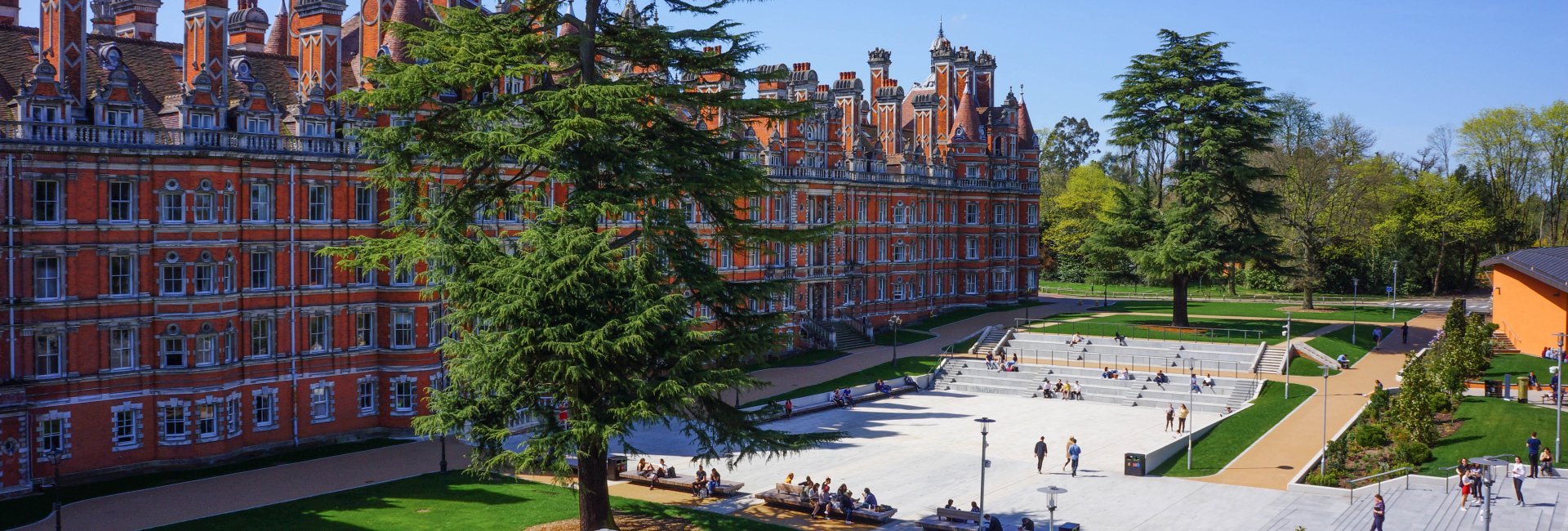
Royal Holloway, University of London - Postgraduate Open Morning (Egham campus)
13 Jun 2026, 08:00
Egham

This course is available to Home (UK) students and International students who meet the English Language requirements.
Our Integrated Foundation Year for science is a thorough, skills-building course that will give you everything you need to start your study of BSc Mathematics with confidence. Engineering, Physical, Computational and Mathematical sciences underpin modern technological society and can help us provide answers to fundamental questions. Our Foundation Year sets you up so that you’re ready to take on those questions - providing you with opportunities to gain knowledge and understanding of how to get started in studying the sciences at university, including your chosen degree subject. Learning from friendly, expert tutors, you’ll explore modules designed to provide familiarity with Mathematics and computation – the language of modern science and technology, and key for success in science, technology and engineering. Once you have completed your Foundation year, you will normally progress onto the full degree course, BSc Mathematics. There may also be flexibility to move onto a degree in another department (see end of section, below). Mathematics is in everything: we use it in every aspect of our lives – from managing household finances and investments to working at the cutting edge of digital communications, engineering, aviation, satellite navigation, medical science, weather forecasting, psychology, sociology, insurance, or the financial markets of the global economy. It is one of the oldest academic disciplines and yet it sits at the heart of our 21st century lives.Our flagship BSc course brings the beauty and breadth of mathematics to life, inviting you to delve deep into the world of abstract structures and ideas, whilst also equipping you with the practical skills and experience that will set you apart in the world of work. Guided by experts in the field, you will receive a thorough grounding in the key methods and concepts that underpin our subject, with the flexibility to tailor your studies in years 2 and 3, thanks to the courses modular structure. Our broad curriculum is influenced by the department’s world-class research activities. We are renowned for our work in pure mathematics, information security, statistics and theoretical physics, and our BSc course spans pure and applied mathematics, statistical analysis, financial mathematics, the mathematics of information, and more. We also offer an array of postgraduate opportunities, and provided you make good progress in year 1 you will have the option of transferring onto our four-year masters course to help take your mathematics to a higher level, particularly if you want to pursue a career in industry or research. It might also be possible to transfer sideways into the second year of one of our other undergraduate mathematics courses.On successful completion of your Foundation Year, you may be able to choose an alternative pathway which could include a degree from one of the other departments offering a Foundation Year within the School of Engineering, Physical and Mathematical Sciences. If you'd like to do this, you may take your Foundation Year Individual Project in one of these other departments. The degree course you choose to take after progression is likely to depend on the individual project you select during the foundation year. Please note however that you must take 'Foundation Skills (Mathematics)' and your individual project in the Department of Mathematics if you wish to join a full degree course in Mathematics.Our flexible degree programmes enable you to apply to take a Placement Year, which can be spent studying abroad, working or carrying out voluntary work. You can even do all three if you want to (minimum of three months each)! To recognise the importance of this additional skills development and university experience, your Placement Year will be formally recognised on your degree certificate and will contribute to your overall result
Foundation Programming
Foundation Physical Sciences I
Foundation Mathematics I
Foundation Physical Sciences II
Engineering Society
Foundation Mathematics II
Introduction to Geometry
Introduction to Applied Mathematics
Statistical Methods 1
Calculus I
Calculus II
Introduction to Pure Mathematics
Linear Algebra I
Real Analysis I
Probability Theory
Scientific Programming
Linear Algebra II
Below is a taster of some of the exciting optional modules that students on the course could choose from during this academic year. Please be aware these do change over time, and optional modules may be withdrawn or new ones added.
Vector Calculus
Statistical Methods 2
Probability Theory
Ordinary Differential Equations and Fourier Analysis
Ring Theory
Mathematics Project
Mathematics in the Classroom
Number Theory
Quantum Theory 1
Non-Linear Dynamic Systems
Combinatorics
Cipher Systems
Group Theory
Topology
Group Theory
Markov Chains and Applications
Introduction to Optimisation
Inference
Financial Mathematics I
Financial Mathematics II
Game Theory
Quantum Information and Coding
In your Foundation Year, teaching methods include a mixture of lectures, practical classes and workshops, laboratory classes, individual tutorials, and supervisory sessions. Outside of the classroom you’ll undertake guided and independent practice. You will be assigned a Personal Tutor in the Department of Mathematics and will have regular scheduled sessions. In the Foundation Year, you’ll also be assigned a Personal Tutor in the Centre for the Development of Academic Skills (CeDAS). Assessments are varied; practical exercises, weekly problem sheets, set exercises, written examinations, laboratory reports, scientific poster preparation and presentation. In addition the Foundation Year offers a full range of skills-based training and also the opportunity to take a micro-placement to enhance your employability.
Once you progress onto your full degree course, it has a flexible, modular structure and you will take a total of 12 course units at a rate of four, 30-credit modules per year. In addition to our compulsory core modules, you will be free to choose between a number of optional courses. Some contribute 15 credits to your overall award while others contribute the full 30.
We continue to use a variety of teaching methods and there is a strong focus on small group teaching in the department. You will attend 12 to 15 hours of formal teaching in a typical week, including lectures, tutorials, problem-solving workshops and practical sessions in statistics and computational mathematics. You will also be expected to work on worksheets, revision and project work outside of these times. In year 2, teaching will mainly be delivered through lectures and workshops and in year 3, mostly through relatively small group lectures.
Our courses are mostly examined by written exams taken in the summer term, but some of our statistics and computational courses also have project components and between 10% and 30% of your final mark for each core module in year 1 will come from coursework. Some of the first year modules also include tests that contribute 10% of the final mark. In the first term of year 2 you will work in small groups to prepare a report and an oral presentation on a mathematical topic of your choice, which will contribute to one of your core module grades. CV writing skills are also embedded into that course. In year 3 there are two optional courses which are examined solely by a project and presentation.
This is the equal consideration deadline. You can still apply after this date, but your application may not receive guaranteed consideration.

Royal Holloway, University of London has participated in the Teaching Excellence Framework. These ratings were awarded in 2023, for four years.
See why these ratings were awarded
What does this TEF outcome mean?
The following entry points are available for this course:
Including C in Mathematics
Including C in Maths
GCSE Maths at Grade 4 (C)
GCSE English Language at grade 4 (C)
Merit Merit plus A-Level grade C in Maths
24 points overall including 4 HL Maths: Analysis & Approaches or 5 HL Maths: Applications & Interpretation
Including H4 in Maths
Merit plus A-Level grades CD including C in Maths
Requirements are as for A-levels where one non-subject-specified A-level can be replaced by the same grade in the Welsh Baccalaureate- Advanced Skills Challenge Certificate
Combinations of qualifications will be considered on an individual basis, please contact us at admissions.enquiries@rhul.ac.uk to discuss your situation
At Royal Holloway, we know every student approaches university with different experiences and backgrounds. We look at each application individually, and different factors can affect the exact offer a student receives. For instance, our contextual offer scheme means students from disadvantaged socio-economic background can receive a different offer. For full details please see our website.
Learn more on the Royal Holloway, University of London website
This section shows the range of grades that students who received offers were previously accepted on to this course with (learn more).
It is designed to support your research but does not guarantee whether you will or won't get a place.
Admissions teams consider various factors, including interviews, subject requirements, and entrance tests. Check all course entry requirements for eligibility.
We are unable to show previous accepted grades for this course. This could be because the course is new, it's a postgraduate course, there isn't enough historical data, or the provider has opted out of sharing their entry grades data for this course - learn more.
| Location | Fee | Year |
|---|---|---|
| EU & International | £28500* | |
| England, Scotland, Wales, Northern Ireland & Channel Islands | £9790* |
* This is a provisional fee and subject to change.
Tuition fee status depends on a number of criteria and varies according to where in the UK you will study. For further guidance on the criteria for home or overseas tuition fees, please refer to the UKCISA website.
Other essential costs: Students are recommended to purchase a laptop before starting their course, to assist with their studies. The optional residential field courses incur an extra fee.
*The tuition fee for Home (UK) undergraduates is controlled by Government regulations. This figure is the fee for the academic year 2026/27 and is shown as a guide. The fee for the academic year 2027/28 has not yet been confirmed.
*This figure is the fee for EU and international students starting a degree in the academic year 2026/27 and is shown as a guide. The fee for the academic year 2027/28 has not yet been confirmed.
Royal Holloway reserves the right to increase tuition fees annually for all students. For further information see fees and funding: https://www.royalholloway.ac.uk/studying-here/fees-and-funding/
Email:Admissions.Enquiries@RoyalHolloway.ac.uk
Phone:01784 414944
Egham
TW20 0EX
At Royal Holloway, University of London