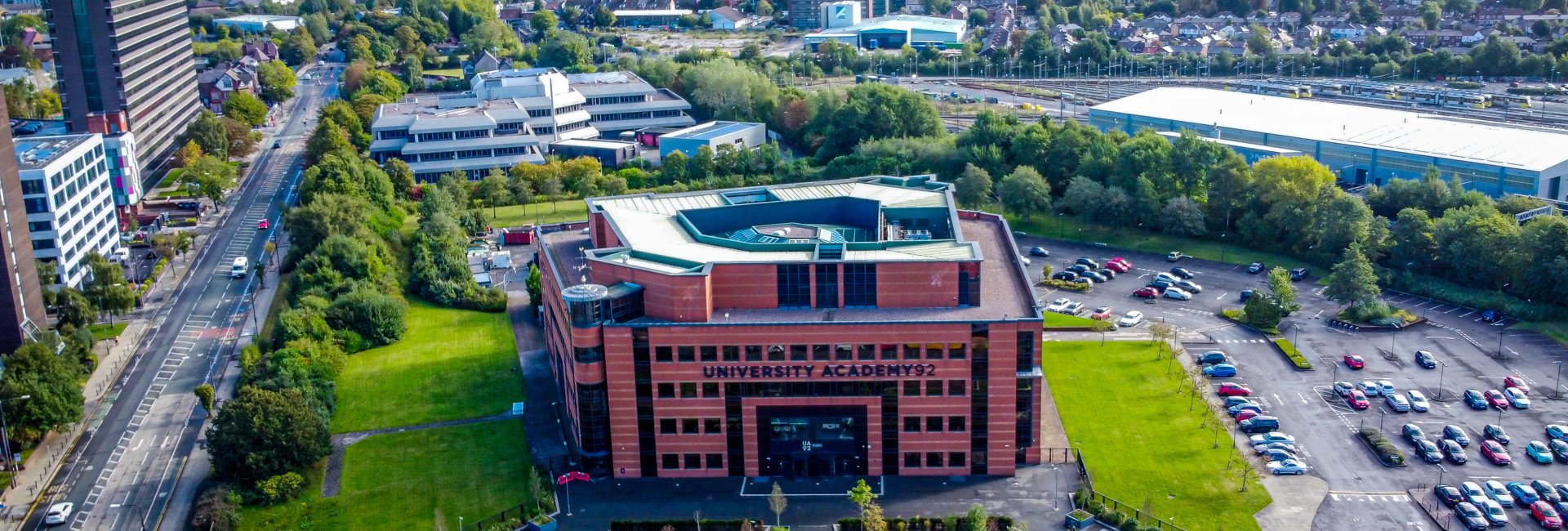
Course contact details
Student Futures Team
Email:futures@ua92.ac.uk
Phone:0161 507 1992
University Academy 92 (UA92)
UA92 Campus
Talbot Road
Trafford
Manchester
M16 0PA

Get stuck in from day one, learning through an energetic combination of real-life scenarios, projects and fieldwork, as well as hands-on experience with specialist equipment and facilities. A strong focus on practical coaching skills and techniques, informed by coaching science, development and analysis theories, will help you identify strengths and get the best out of individuals and teams of all abilities.
During the three-year Sports Coaching degree, you’ll explore approaches to coaching children and adults across community, development, performance and educational settings. You’ll understand how to identify and support individual needs and talents and learn how to motivate pupils, clients, or athletes towards achieving different goals.
We’ll help get you up to speed on contemporary issues in sport and introduce you to different working environments available to a coach, so you’re warmed up for the varied world of sports coaching.
If you’re looking for a sports coaching degree in Manchester, check out our Sports Coaching degree and unlock your greatness at UA92.
With a BSc in Sports Coaching, you’ll be primed and ready to help others to gain confidence, stay motivated and smash their goals. Sports coaches can work in a wide variety of settings, including talent development, community settings, education, local authority via a multi-sport approach, or the fitness and leisure industry.
Alongside your course modules, you will engage with the 92 Programme, which is built into every degree and tailored to each subject area.
Engaging with the 92 Programme is a requirement for all students and will count towards your overall grade.
Through taught sessions, immersive experiences and coaching, you will build confidence, resilience, wellness, self-reflection and professionalism, skills designed to support your future success.
Module 1: Introduction to Sports and Exercise Psychology
Sports and exercise psychology helps you understand how your thoughts, feelings, and motivations affect your sporting performance and/or enjoyment of physical activity. You'll dive into the world of psychology itself and its position as an evidence-based science. This lays the foundation for understanding how these principles apply to individuals and groups across education, physical activity, health and sport settings.
Module 2: Introduction to Coaching Pedagogy and Practice
This hands-on module is your chance to plan, deliver, and reflect on real coaching sessions, in line with industry standards and supporting frameworks. That's not all - inclusivity is key, so you'll learn how to make your coaching sessions welcoming and effective for everyone. You’ll also have an opportunity to discuss and explore different teaching and coaching theories and practices with your peers and qualified practitioners.
Module 3: DevelopingCoaching Active Lifestyles
Motivate and inspire people of all ages and backgrounds to embrace a life-long active lifestyle. Learn how to develop activities and programmes that are inclusive, engaging, and promote long-term healthy participation in physical activity and sport. Advocate for the importance of physical activity in promoting individual and community well-being, across a range of ages and in various populations, including those with additional needs.
Module 4: Introduction to Session Design
Learn how to develop effective coaching sessions that are engaging, fun, safe, and ethically suitable for a diverse range of populations. Following a person-centred approach, you will learn to understand your participants needs and their learning processes and development. This will enable you to plan sessions that will maximise the participants development across different settings.
Module 1: Sports and Exercise Psychology
In this module you will dive further into the world of sport and exercise psychology. You'll level up your understanding by exploring key theoretical concepts in more depth, such as behaviour change. As a result, you’ll be able to help participants identify and address any psychological barriers, across education, physical activity, health, and sport settings, which might be holding them back. They’ll also be opportunity to develop your applied practitioner skills.
Module 2: Science and Practice of Coaching
Learn how to holistically develop your coaching toolbox to meet the needs of different social groups across education, physical activity, health and sport settings. Specifically, you’ll begin to explore how participants biological, psychological and social influences can impact development. You’ll gain an understanding of relevant theories and participant development models in order to cater for individual and group needs. This will enable you to design effective coaching strategies and interventions to help others reach their goals.
Module 3: Analysis of Performance
Coaches use performance analysis to inform their decisions. It helps to understand what’s working and what factors are giving the best results. You’ll learn to become an informed observer, spotting strengths, weaknesses and opportunities for improvement. You’ll learn how to use data and visual analysis tools to track progress, identify trends, evidence proposed strategies and present insights back to specific populations and key stakeholders.
Module 4: Professional Development of Coaching 1
This module focuses on career preparedness. You’ll get regular hands-on insights and experiences to help you fine tune your coaching skills, with support and feedback from industry experts. Reflect on how you’ve grown, define your strengths and identify how you want to continue to grow and develop. This self-discovery will help you forge your coaching identity so you are confident and prepared to enter the sports coaching industry or equivalent.
Module 1: Strength and Conditioning
This module is delivered through a number of interactive sessions, where you will develop your strength and conditioning knowledge and apply your skills in line with industry standards. Specifically, you will plan, organise and deliver a range of strength and conditioning (S&C) practices to clients, with lots of opportunities to hone your practitioner skills. This will prepare you for future opportunities, whether that’s in the workplace, research project, independent study, vocational qualifications or post-graduate study in this area.
Module 2: Professional Development of Coaching 2
Continue your professional development in preparation for a career in education, physical activity, health and/or sport coaching settings. In this industry-focused module, you will learn how objective setting and goals will help you to become an employable graduate. You'll regularly evaluate your own experiences, asking yourself questions like: What kind of impact do I want to make? How can I keep learning and growing throughout my career? As a result, you'll be able to assess your strengths, interests, and goals more clearly, increasing your likelihood of success and employability. This, combined with regular opportunities to enhance your CV, will help ensure you are well-placed to enter a career path that truly excites you.
Module 3: Contemporary Issues in Sport
Learn how to apply research techniques and real-world experiences to solve problems in your chosen field. Dive into contemporary issues in your area and build your own arguments based on real evidence. You'll learn to analyse qualitative and quantitative research and use them to back up your theories. You'll also hone your skills in making clear, persuasive arguments that will inform decision making.
Module 4: Final Project
You will complete a final project to demonstrate your academic experience, knowledge, and skills. This project is an opportunity to apply what you have learned to a real-world problem or challenge.

University Academy 92 (UA92) has participated in the Teaching Excellence Framework. These ratings were awarded in 2023, for four years.
See why these ratings were awarded
What does this TEF outcome mean?
This course may be available at alternative locations, please check if other course options are available.
Course optionsIn addition to meeting the academic criteria, if your first language isn't English, you will be asked for a recognised English Language qualification. Acceptable English Language Qualifications and required grades can be found below. IELTS Academic (UKVI Approved) - 6.5 with no score lower than 5.5 IELTS Academic (Other centres) - 6.5 with no score lower than 5.5 ToEFL IBT - 87 overall, minimum of 17 in listening, 18 in reading, 17 in speaking and 20 in writing ToEFL IBT Special Home Edition - 87 overall, minimum of 17 in listening, 18 in reading, 17 in speaking and 20 in writing Cambridge English: Advanced CAE - 176 overall with at least 162 in each element Cambridge English: Proficiency (CPE) - 176 overall with at least 162 in each element PTE - 59 with no score lower than 59 LanguageCert English Language - B2 Communicator with 39 in each skill area Common European Framework - B2 International Baccalaureate (IB) Standard Level English Language Syllabus - Grade 5 or above International Baccalaureate (IB) Higher Level English Language Syllabus - Grade 4 or above Trinity College London – Integrated Skills in English - ISE II - Pass GCSE/ IGCSE/ O Level English - Grade C/4 If you are an international student, in order to obtain a student visa, you will be required to demonstrate that you have the correct level of English language competency to study in the UK.
This section shows the range of grades that students who received offers were previously accepted on to this course with (learn more).
It is designed to support your research but does not guarantee whether you will or won't get a place.
Admissions teams consider various factors, including interviews, subject requirements, and entrance tests. Check all course entry requirements for eligibility.
This course may have Historical entry grades data available, please select a course option to view.
Course optionsThis report uses your grades to show how students with similar results have done when applying to this course in the past. Sometimes, there isn’t data for every possible set of grades. When that happens, universities and colleges occasionally fill in the gaps for sets of grades that are typically accepted.
| Location | Fee | Year |
|---|---|---|
| England, Scotland, Wales & Northern Ireland | £9790 | |
| EU & International | £17728 |
Tuition fee status depends on a number of criteria and varies according to where in the UK you will study. For further guidance on the criteria for home or overseas tuition fees, please refer to the UKCISA website.
UA92 will review tuition fees each year. For UK students if Parliament permits an increase in tuition fees, UA92, along with other HEIs in England, may increase fees each year using RPI-X, subject to the maximum fee limits set out in regulations
Email:futures@ua92.ac.uk
Phone:0161 507 1992
UA92 Campus
Talbot Road
Trafford
Manchester
M16 0PA
At University Academy 92 (UA92)