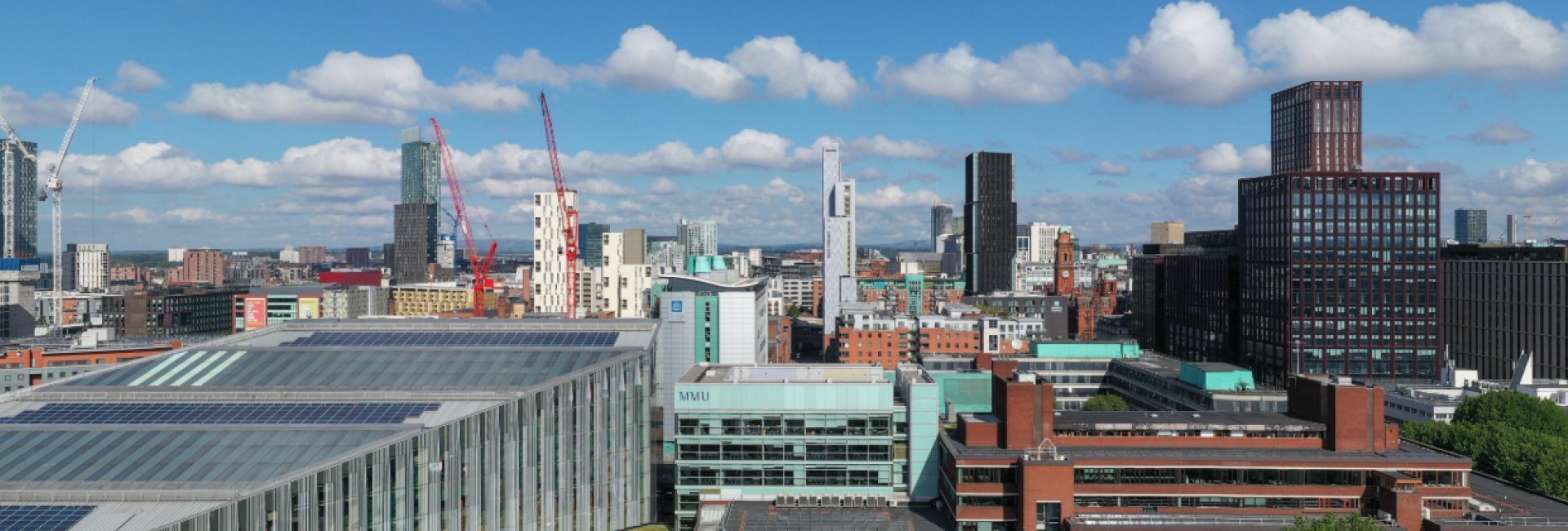
Manchester Metropolitan University - Undergraduate Open Day
17 Jun 2026, 08:30
Manchester

Our integrated masters will set you on the path to an exciting career in the rapidly evolving world of electrical and electronic engineering. This degree will provide you with the specialist knowledge and expertise required for a professional career in electrical and electronic engineering. With project based learning in all years, including live industry-led projects, you will develop the transferable skills and the multi-disciplinary awareness so highly prized by industry.
You’ll start off by exploring the fundamental theories of engineering science and applied mathematics, as well as learning practical and project skills. Then, through the study of analogue and digital electronics, electrical power systems, control, computing, and communications, you will begin to develop your scientific and analytical skills. Every year throughout your studies at Manchester Met, you will have the chance to get involved with projects rooted in our research with potential employers and research teams – giving you valuable experience for your career development.
Much of your learning will take place through projects, reflecting the multidisciplinary world of work. In these projects, set by academic colleagues and industry contacts, you’ll learn what it takes to come up with creative solutions to current engineering problems. You’ll get feedback and advice directly from industry insiders, giving you the chance to find out exactly what it takes to impress a potential future employer.
FEATURES AND BENEFITS
Manchester Metropolitan University is ranked 5th in the UK for Electrical and Electronic Engineering (The Guardian University Rankings 2025).
100% of our research impact in Engineering is world-leading or internationally excellent — and 75% is at the highest 4* level. (REF 2021).
This degree is accredited by the Institution of Engineering and Technology (IET) on behalf of the Engineering Council.
The five-year placement route offers the opportunity to spend your third year working on a placement with a relevant employer – gaining the skills and experience that can boost your career prospects.
We’ve invested over £115 million to transform the way we teach and the way our students learn. The new Dalton building is equipped with dynamic learning spaces, world-class teaching and research facilities and collaborative study zones. This means you’ll graduate with the skills and experiences employers look for.
Tackle real challenges from the world of engineering. Every year, we invite industrial and academic colleagues to set live projects that challenge our students to devise innovative solutions to current problems.
Showcase your engineering and design skills in extra-curricular group projects like the Formula Student racing car competition or the Engineering For People Design Challenge.
Get fully trained on how to use our workshops, laboratories and specialist engineering software.
You will have access to regular online video support, which provides additional explanation and guidance on a range of topics, from coursework and exam paper guidance to software tutorials.
This course includes the same modules during the first and second year as our BEng degree in electrical and electronic engineering, and the same first-year modules as our MEng and BEng degrees in mechanical engineering and BEng degree in biomedical engineering, so you may be able to transfer between courses.
This is the equal consideration deadline. You can still apply after this date, but your application may not receive guaranteed consideration.

Manchester Metropolitan University has participated in the Teaching Excellence Framework. These ratings were awarded in 2023, for four years.
See why these ratings were awarded
What does this TEF outcome mean?
The following entry points are available for this course:
Grades BBC or equivalent, to include A level Mathematics or Further Mathematics.
Pearson BTEC Level 3 National Extended Diploma (1080) in Engineering
Pass Access to HE Diploma in Engineering or Science with a minimum score of 112 UCAS Tariff points.
To include HL 5 in Mathematics AND HL 4 or SL 5 in English.
GCSE grade C/4 in English Language or Level 2 Functional Skills English
and
GCSE grade C/4 in Mathematics or Level 2 Functional Skills Mathematics
The level 2 requirements may also be met through the level 3 course requirements for the course; please contact the University directly if you require further information.
At Manchester Met, our mission is to recruit ambitious students from all backgrounds and to inspire and support them to achieve their potential. Where applicants with WP flags receive an offer but don’t quite meet conditions, we may be able to look again at these applications. Where we are unable to offer a place on a chosen course, we may seek to make an alternative offer. For further information please click the link below.
Learn more on the Manchester Metropolitan University website
This section shows the range of grades that students who received offers were previously accepted on to this course with (learn more).
It is designed to support your research but does not guarantee whether you will or won't get a place.
Admissions teams consider various factors, including interviews, subject requirements, and entrance tests. Check all course entry requirements for eligibility.
We are unable to show previous accepted grades for this course. This could be because the course is new, it's a postgraduate course, there isn't enough historical data, or the provider has opted out of sharing their entry grades data for this course - learn more.
Subject Spotlights give you the chance to try a higher education course before you apply. Delivered by the lecturers themselves you will gain insight into what it's like to study the course and give your personal statement a boost.

No fee information has been provided for this course
Tuition fee status depends on a number of criteria and varies according to where in the UK you will study. For further guidance on the criteria for home or overseas tuition fees, please refer to the UKCISA website.
No additional fees or cost information has been supplied for this course, please contact the provider directly.
Email:courses@mmu.ac.uk
Phone:0161 247 69 69
All Saints Building
All Saints
Manchester
M15 6BH
At Manchester Metropolitan University