Course contact details
Our friendly, helpful Admissions team
Email:admissions@newman.ac.uk
Phone:0121 387 4506
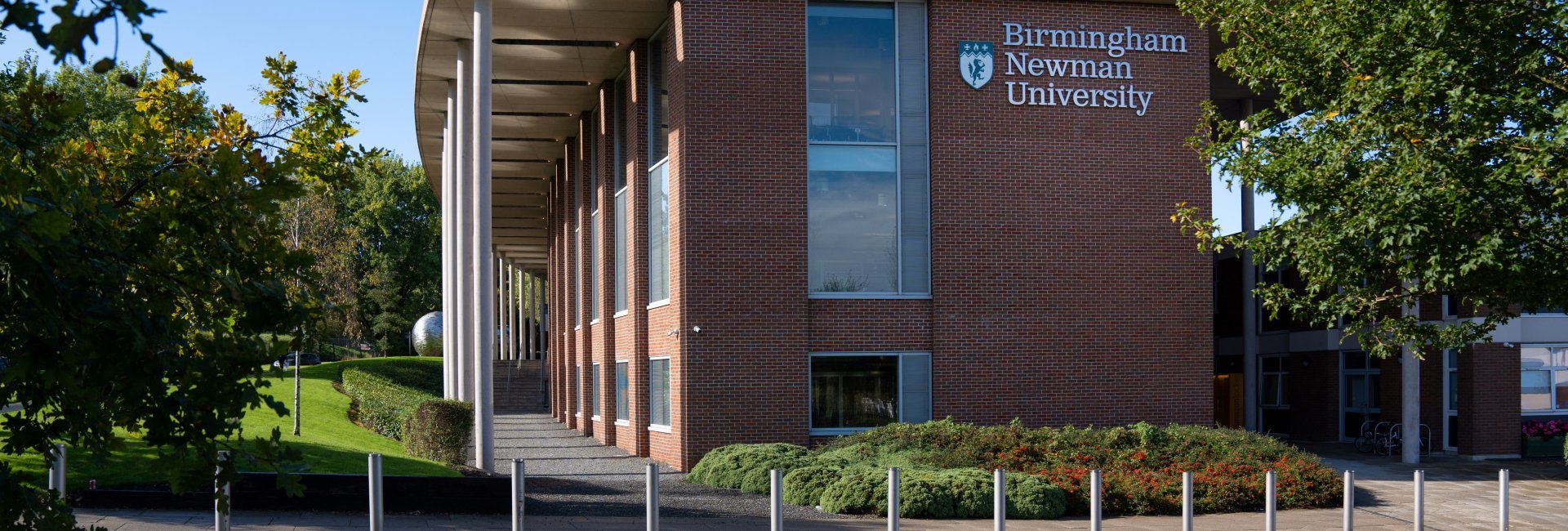
Birmingham Newman University
Genners Lane
Bartley Green
Birmingham
B32 3NT

The BSc (Hons) Business and Law with Sandwich Year programme bridges the gap between two vital disciplines, giving you a dual understanding of business management and legal frameworks. You’ll study contract law, corporate law, and employment law alongside core business subjects like finance, management, and strategy. This combination is ideal for those looking to pursue careers in corporate governance, compliance, or legal consultancy within businesses. Through case studies, moot courts, and work placements, you’ll gain practical experience in applying legal knowledge to real-world business situations. With the guidance of experienced academics and legal professionals, this degree will provide you with a competitive edge in the complex and highly regulated business environment.
Studying the BSc (Hons) Business and Law at Birmingham Newman University offers a unique opportunity to explore how legal frameworks and commercial strategy shape the modern workplace. Whether you are preparing for a career in legal services, corporate governance or business consultancy, the course helps you develop the insight and judgement needed to make informed, ethical decisions and lead with confidence. With a strong emphasis on applied learning and professional development, you will graduate ready to contribute meaningfully in a range of business and legal contexts.
Legal and commercial principles are deeply interconnected, and this course helps you understand how they influence organisational success. You will study a blend of business and legal subjects, including strategy, finance, marketing, contract law, employment law and corporate regulation. These areas are explored through case studies, debates and applied projects that challenge you to think critically and respond to real-world scenarios. The course encourages a practical, reflective approach, helping you apply your learning effectively in professional settings.
Please refer to the Birmingham Newman University website for details.
Please refer to the Birmingham Newman University website for details.
This is the equal consideration deadline. You can still apply after this date, but your application may not receive guaranteed consideration.

Birmingham Newman University has participated in the Teaching Excellence Framework. These ratings were awarded in 2023, for four years.
See why these ratings were awarded
What does this TEF outcome mean?
The following entry points are available for this course:
This section shows the range of grades that students who received offers were previously accepted on to this course with (learn more).
It is designed to support your research but does not guarantee whether you will or won't get a place.
Admissions teams consider various factors, including interviews, subject requirements, and entrance tests. Check all course entry requirements for eligibility.
We are unable to show previous accepted grades for this course. This could be because the course is new, it's a postgraduate course, there isn't enough historical data, or the provider has opted out of sharing their entry grades data for this course - learn more.
This report uses your grades to show how students with similar results have done when applying to this course in the past. Sometimes, there isn’t data for every possible set of grades. When that happens, universities and colleges occasionally fill in the gaps for sets of grades that are typically accepted.
| Location | Fee | Year |
|---|---|---|
| England, Scotland, Wales, Northern Ireland, Channel Islands & Republic of Ireland | TBC |
Tuition fee status depends on a number of criteria and varies according to where in the UK you will study. For further guidance on the criteria for home or overseas tuition fees, please refer to the UKCISA website.
The University will review tuition fees and increase fees in line with any inflationary uplift as determined by the UK Government, if permitted by law or government policy, on enrolment and in subsequent years of your course, where applicable. It is anticipated that such increases would be linked to RPI (the Retail Price Index excluding mortgage interest payments.
Email:admissions@newman.ac.uk
Phone:0121 387 4506
Genners Lane
Bartley Green
Birmingham
B32 3NT
At Birmingham Newman University