Skip navigation
You are viewing our beta course page.

Dance & Choreography

Course details
  • BA (Hons)
  • 3 Years
  • Full-time
  • 14/09/2026
  • Undergraduate
Course location
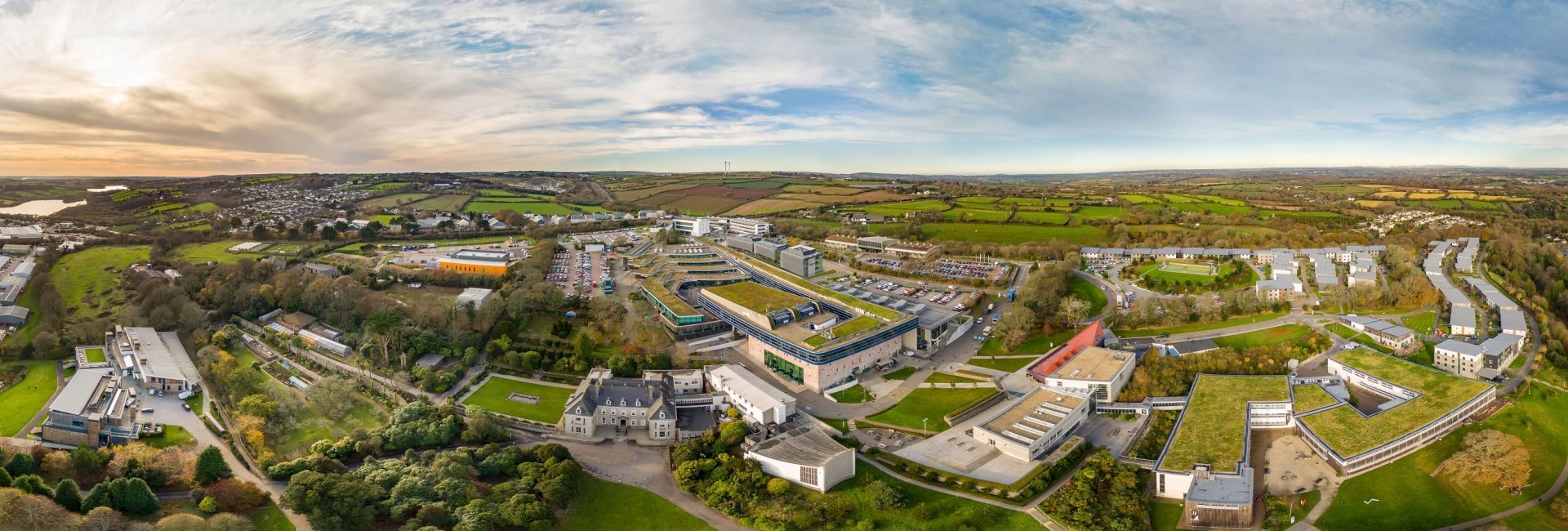
Penryn Campus

Course summary

Start your next creative adventure in dance and choreography.

With a focus on creativity and collaboration, you’ll emerge from this course as a technically skilled dancer and an experimental choreographer.

On this Dance & Choreography degree you’ll be given the freedom to develop your own ideas and style, creating your own performances from day one while training in our exceptional, state-of-the-art dance studios under guidance from experienced industry professionals.

You’ll be immersed in an inspirational, creative community, benefiting from Falmouth’s interdisciplinary culture. You’ll be surrounded by other artists in a department buzzing with performers, musicians, filmmakers, theatre designers and more. You're encouraged to be proactive and collaborate with students from a range of disciplines; expanding your skillset, knowledge and sense of creative identity while establishing your own innovative approach to dance and movement, ready for a career in performance, communities or allied professions.

This is a course ideally suited to those who want to build their physical skills and technique as a dancer, alongside developing a distinctive choreographic voice as a curious, independent dance artist.

You will:
Study on one of the only degrees of its kind, placing equal weight on nurturing your individual choreographic voice and developing technical dance skills from day one
You’ll be challenged to imagine new futures for dance by developing projects in collaboration with musicians, illustrators, fashion designers, photographers, filmmakers or game developers as well responding to contemporary issues such as social justice, health, climate change or activism
Build industry links through workshops, guest lectures and visits from internationally renowned practitioners – previous guests have included Company Chameleon, Theo Clinkard, Ayesha Fazal and Honorary Fellow Julie Felix MBE
Benefit from our year-round performance programme, which attracts top dance, theatre and music performers such as Protein Dance, Thick and Tight, Lea Anderson and Aakash Odedra
Learn to utilise our extensive range of technical sound, lighting and recording equipment, to enabling you to realise your own production ideas and visions

Modules

Our course structure, teaching and professional-standard facilities provide you with time and space to develop physical, technical and critical capabilities. On this dance degree, you'll receive a thorough grounding in dance techniques and develop your own innovative performance and choreographic practice. There will be collaboration and cross-disciplinary working opportunities and chances to connect with wider communities from the dance industry. This dance and choreography degree will enable you to explore your own interests in dance and prepare you to make creative contributions to a range of professional arts contexts within which dance plays a vital role. We think about dance and choreography 'outside the box’, with opportunities to explore site-specific and digital creation as well as studio-based work. Our students frequently work on projects with other students in our Fashion & Textiles Institute, School of Film & Television and on student-led activities including drawing/painting collaborations. Many students also take part in or lead societies across musical theatre, dance and sport.

Year one
Your first year provides a solid grounding in the skills and techniques used in dance performance and choreography. Modules provide you with a focused, physically-centred experience. In addition to regular body-work classes during which there is a focus on grounding a safe and sustainable dance practice, you are encouraged to explore and challenge your ideas of performance and choreography through studio practice (individual and group work), lectures and seminars. Your bodywork classes include contemporary dance and a range of supporting styles and approaches, such as Pilates, yoga, flow, ballet and, improvisation.

Year one also provides the opportunity to engage with site-based dance in a variety of settings and locations, and to develop strategies for making connections between practice and theory in preparation for year two.

Modules
Contemporary Techniques & Improvisation 1
Performance & Choreographic Practices
Embodied Learning: Theories & Practices
Contemporary Techniques & Improvisation 2
Dance Cultures, Histories & Practices
Site-Based Practices

Year two
Your second year involves directed, supervised and self-generated dance and performance projects. Building on the intensive physical training in your first year, you will continue to develop your technical and skills training through applied techniques, while developing your knowledge and experiences in choreography and performance and its cross-disciplinary contexts.

You will attend to your potential as a change-maker and contributor to the wider field of dance and engaged practices through considerations of your sustainable dance future. You will also develop your writing skills through critical evaluation of social, historical and/or political dance contexts.

Modules
Applied Techniques 1
Performance & Choreographic Skills
Dance Futures
Applied Techniques 2
Researching Dance: Theories & Contexts
Cross-Disciplinary Practices

Year three
In your final year, you'll undertake two major research projects (including practical and written work) both of which focus on your chosen areas of interest. Throughout the year, you'll advance your physical training and creative, choreographic skills. This culminates in a professional practice project, in which you'll collaborate to produce, market, choreograph and perform an original work for public performance – mirroring professional practice.

Modules
Advanced Technique 1
Independent Research Project
Advanced Technique 2
Professional Practice Project

As part of our process of continuous improvement, we routinely review course content to ensure that all our students benefit from a high-quality and rewarding academic experience. There may be some changes made to your course which are not immediately reflected in the content displayed on our website. Any students affected will be informed of any changes made directly.

Assessment method

Assessments for this course are 100% coursework and performance-based, with no exams.

Students are assessed either through class observations, individual submissions, solo or ensemble performances, or written submissions/essays.

When work is being viewed within an ensemble performance, tutors assess your personal demonstration of the skills outlined in the learning outcomes, and you are given an individual mark.

How to apply

Apply by
14 January

This is the deadline for applications to be completed and sent for this course. If the university or college still has places available you can apply after this date, but your application is not guaranteed to be considered.

Application codes

Course code:
W511
Institution code:
F33
Campus name:
Penryn Campus
Campus Code:
P

Points of entry

The following entry points are available for this course:

  • Year 1
  • Year 2
  • Year 3

International applicants

If English is not your first language, you will need to demonstrate English language skills that are sufficiently developed for successful completion of your studies. We accept a range of recognised English language qualifications that are equivalent to the International English Language Testing System (IELTS) Academic minimum score of 6.0 overall, with a minimum of 5.5 in Reading, Writing, Speaking and Listening. Through the award of international scholarships, we aim to support academic enrichment by encouraging diversity and excellence at Falmouth. For details of our international scholarships, and how to apply for them, please visit our website at www.falmouth.ac.uk

Open days

Entry requirements

Qualification requirements

UCAS Tariff - 64 points

A level

We welcome A Levels in a wide range of subjects, especially in those relevant to the course for which you apply.

Pearson BTEC Level 3 National Extended Diploma (first teaching from September 2016)

We accept BTEC Extended Diplomas in a wide range of subjects, especially those relevant to the course you are applying to.

Access to HE Diploma

60 credits (with a minimum of 45 credits achieved at level 3) in a relevant subject.

Pearson BTEC Level 3 National Diploma (first teaching from September 2016)

Acceptable when combined with other qualifications

Pearson BTEC Level 3 National Foundation Diploma (first teaching from September 2016)

Acceptable when combined with other qualifications

Pearson BTEC Level 3 National Certificate (first teaching from September 2016)

Acceptable when combined with other qualifications

Pearson BTEC Extended Diploma (QCF)

We accept BTEC Extended Diplomas in a wide range of subjects, especially those relevant to the course you are applying to.

Pearson BTEC Subsidiary Diploma (QCF)

Accepted with other qualifications

International Baccalaureate Diploma Programme - 24 points

WJEC Level 3 Advanced Skills Baccalaureate Wales

Acceptable with UCAS tariff points from the Supporting Qualifications

Welsh Baccalaureate - Advanced Skills Challenge Certificate (last awarded Summer 2024)

Acceptable with UCAS tariff points from the Supporting Qualifications

Extended Project

Acceptable when combined with other qualifications

Cambridge International Pre-U Certificate - Principal

Accepted

OCR Cambridge Technical Extended Diploma

Accepted

T Level - P

At Falmouth, we recognise excellence in many forms, and we see the whole you.

Our diverse community is creative, innovative and entrepreneurial.

We recognise that these qualities aren’t always shown in academic grades alone. That’s why, while many of our applicants achieve high academic grades, we also welcome those who can demonstrate their potential through an exceptional portfolio or performance.

At a minimum, we typically require the equivalent of 64 UCAS Tariff points for undergraduate courses where we can review a portfolio or audition, or a minimum of 96 UCAS points for those courses that do not require a portfolio or audition. For our Integrated Foundation Year courses, we typically require a minimum of 32 UCAS points for courses where we can review a portfolio or audition, or 64 UCAS points for those that do not require a portfolio or audition.

To support this approach, during a friendly conversation with our academic team, we’ll consider your ideas, your creative output and your ambition to ensure you’ll thrive at Falmouth.

If you are able to demonstrate relevant, current, equivalent experience instead of formal qualifications, we encourage you to apply. Please contact our Applicant Services team before applying, for advice regarding your individual experience and eligibility.

If you are an international applicant and require a Student visa to study in the UK, you must have a recognised English language test approved and vouched for by the University at the appropriate level. You can see what we accept on our website https://www.falmouth.ac.uk/study/international/english-language-requirements Our Applicant Services team can help you with any general questions you may have about study visas or suitable language tests. For more specific advice, we recommend you also consult UKCISA http://www.ukcisa.org.uk/

Find out more about qualification requirements for this course.

Additional entry requirements

Interview
Audition

English language requirements

If English is not your first language, you will need to demonstrate English language skills that are sufficiently developed for successful completion of your studies. We accept a range of recognised English language qualifications that are equivalent to the International English Language Testing System (IELTS) Academic minimum score of 6.0 overall, with a minimum of 5.5 in Reading, Writing, Speaking and Listening

View our list of accepted English language tests and qualifications using the link below https://www.falmouth.ac.uk/study/international/english-language-requirements

Contextual admissions

Universities and colleges consider more than grades when assessing applications and may make offers based on a range of criteria. Learn more about contextual offers.

At Falmouth University, we take a rounded approach to admissions. Instead of focusing on criteria like grades alone, we operate a contextual admissions policy, where we look at you as a person: your talents, your experiences and your potential. Every offer we make is shaped around you and your circumstances, and our conditional offers are always intended to be realistic and achievable.

Learn more on the Falmouth University website

Historical entry grades data BETA

This section shows the range of grades students (with UK A-Levels or Pearson BTEC Level 3 National Extended Diplomas) who received offers were previously accepted with (learn more). It is designed to support your research but does not guarantee whether you will or won't get a place. Admissions teams consider various factors, including interviews, subject requirements, and entrance tests. Check all course entry requirements for eligibility.

Not enough data available

We are unable to show previous accepted grades for this course. This could be because the course is new, it's a postgraduate course, there isn't enough historical data, or the provider has opted out of sharing their entry grades data for this course - learn more.

Fees and funding

Tuition fees

No fee information has been provided for this course

Tuition fee status depends on a number of criteria and varies according to where in the UK you will study. For further guidance on the criteria for home or overseas tuition fees, please refer to the UKCISA website.

Additional fee information

No additional fees or cost information has been supplied for this course, please contact the provider directly.

Like this page