Course contact details
Undergraduate Admissions
Email:ugadmissions@southampton.ac.uk
Phone:023 8059 4732
University of Southampton
Highfield
Southampton
SO17 1BJ

Summary
Chemistry is at the centre of solving the world’s biggest challenges. From human health to climate change, it helps us understand and improve the world around us.
On this course, you will explore the science behind these challenges while developing the skills to make a real impact. You will study topics that spark your curiosity, from sustainable chemistry and chemical biology to computational chemistry, where chemistry meets digital innovation.
Your learning is shaped by research. At Southampton, you will be taught by academics whose discoveries are changing fields from clean energy to disease treatment, bringing the latest thinking into your lectures and labs.
This is a degree that opens doors. Whether you choose to become a professional chemist or apply your skills in another sector, you will graduate ready to take your next step.
Key features of the course
Learn in industry-standard labs. Work in modern, refurbished laboratories equipped with advanced technology such as benchtop NMR and IR spectrometers and X-ray diffractometers.
Gain hands-on experience. Design and carry out your own experiments, analysing samples using the same equipment found in industry and research labs.
Focus on sustainability. Incorporate green chemistry practices into your lab work, reflecting how the industry is evolving.
Be part of cutting-edge research. Learn from academics advancing areas such as battery technology, drug design and disease modelling, and work with their research teams during advanced practicals.
Shape your future. Develop skills that open pathways into careers in science and beyond, including finance, management, law and teaching.
Student support
Your Personal Academic Tutor will support you throughout your time at Southampton, offering guidance on your studies and helping you navigate your academic and personal development.
You will be part of a supportive Chemistry community, where the department becomes your space to study, connect and collaborate.
Further information
This course is accredited by the Royal Society of Chemistry (RSC), supporting your progression to professional recognition.
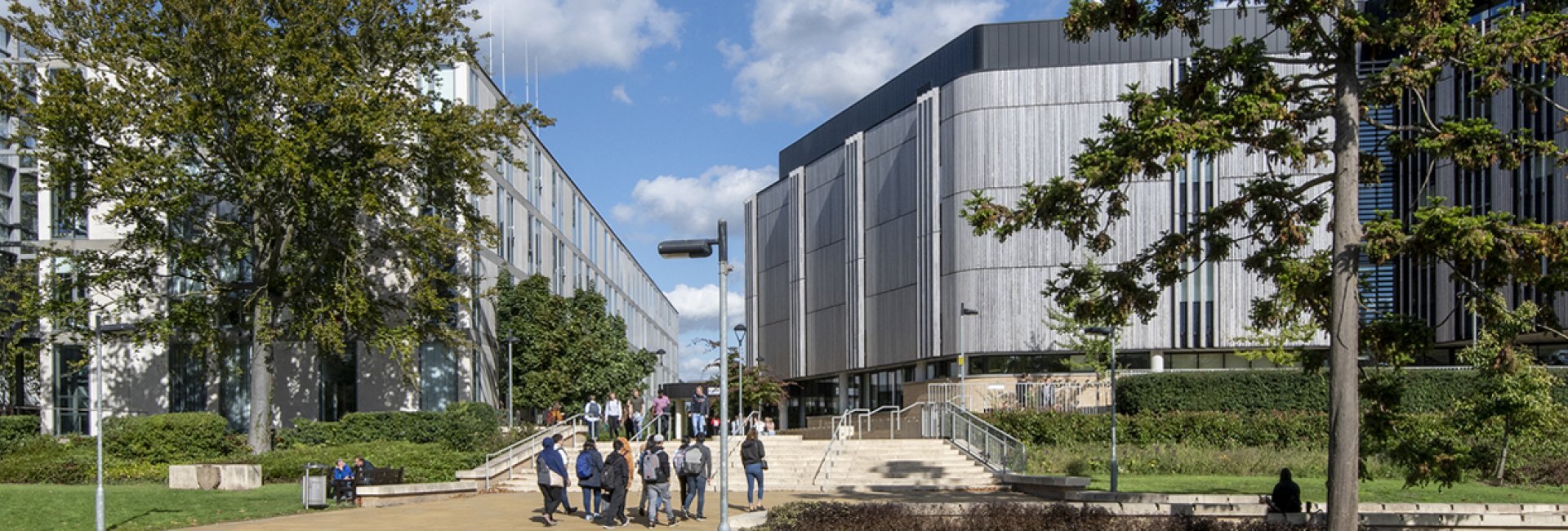
You will be based at Highfield Campus, the heart of the University, with access to teaching spaces, social areas and facilities that support both your studies and student life.
Core modules in the first and second year are shared across all of our chemistry degrees. This makes it possible to transfer if you decide you’d like to do the MChem or one of the placement degrees. Depending on your optional module choices or level of maths study, there’s also the possibility of moving to one of our specialist MChem courses.
The year one and two core modules cover the fundamentals of organic, inorganic and physical chemistry, as well as laboratory skills. In the first year you’ll also take a chemistry skills module that develops your mathematical and analytical chemistry skills.
In years two and three you can personalise your learning by choosing from a wide range of optional modules. Topics include:
• environmental chemistry
• programming
• biochemistry
• global sustainability
• cell biology and physiology
In year three you’ll choose advanced practical projects linked to real research being carried out by one of our academics. Our extensive research portfolio means you’ll have a wealth of topics to choose from.
There are written examinations at the end of each semester to test your knowledge and understanding of material presented in the lectures and workshops. Many modules also have coursework components that feed into module marks as well. The coursework can take on a variety of forms from analysing data, to working through problem sets. The practical work is continuously assessed primarily through written reports.
A written literature review related to research areas of interest is assessed. Alongside these summative assessments are several formative pieces of work where feedback can be provided to allow for continuous improvement of your chemistry skills.
Professionally accredited courses provide industry-wide recognition of the quality of your qualification.
This is the equal consideration deadline. You can still apply after this date, but your application may not receive guaranteed consideration.

University of Southampton has participated in the Teaching Excellence Framework. These ratings were awarded in 2023, for four years.
See why these ratings were awarded
What does this TEF outcome mean?
The following entry points are available for this course:
If you are not sure that your qualifications meet the requirements of this course please contact our Admissions Teams. https://www.southampton.ac.uk/chemistry/undergraduate/courses/f100_bsc_chemistry.page?#entry_requirements ____________________
| Test | Grade | Additional details |
|---|---|---|
| IELTS (Academic) | 6.5 | with no component below 6.0 |
All programmes at the University of Southampton are taught and assessed in the medium of English (other than those in modern foreign languages). Therefore, all applicants must demonstrate they possess at least a minimum standard of English language proficiency.https://www.southampton.ac.uk/studentadmin/admissions/admissions-policies/language.page
Most of the students who previously enrolled on this course joined us with grades lower than our published entry criteria. After receiving their grades, we carefully considered each students’ individual circumstances before confirming their place on their chosen course. We encourage everyone with the potential to succeed to apply, regardless of their background. Applicants who qualify for contextual admissions will be made an offer lower than the typical offer for that programme.
This section shows the range of grades that students who received offers were previously accepted on to this course with (learn more).
It is designed to support your research but does not guarantee whether you will or won't get a place.
Admissions teams consider various factors, including interviews, subject requirements, and entrance tests. Check all course entry requirements for eligibility.
We are unable to show previous accepted grades for this course. This could be because the course is new, it's a postgraduate course, there isn't enough historical data, or the provider has opted out of sharing their entry grades data for this course - learn more.
This report uses your grades to show how students with similar results have done when applying to this course in the past. Sometimes, there isn’t data for every possible set of grades. When that happens, universities and colleges occasionally fill in the gaps for sets of grades that are typically accepted.
| Location | Fee | Year |
|---|---|---|
| England, Scotland, Wales, Northern Ireland, Channel Islands & Republic of Ireland | £10050 | |
| EU & International | TBC |
Tuition fee status depends on a number of criteria and varies according to where in the UK you will study. For further guidance on the criteria for home or overseas tuition fees, please refer to the UKCISA website.
Please see our website for further details and updates regarding tuition fees.
We anticipate that international tuition fee levels for 2027 entry will be confirmed in August 2026.
Email:ugadmissions@southampton.ac.uk
Phone:023 8059 4732
Highfield
Southampton
SO17 1BJ
At University of Southampton