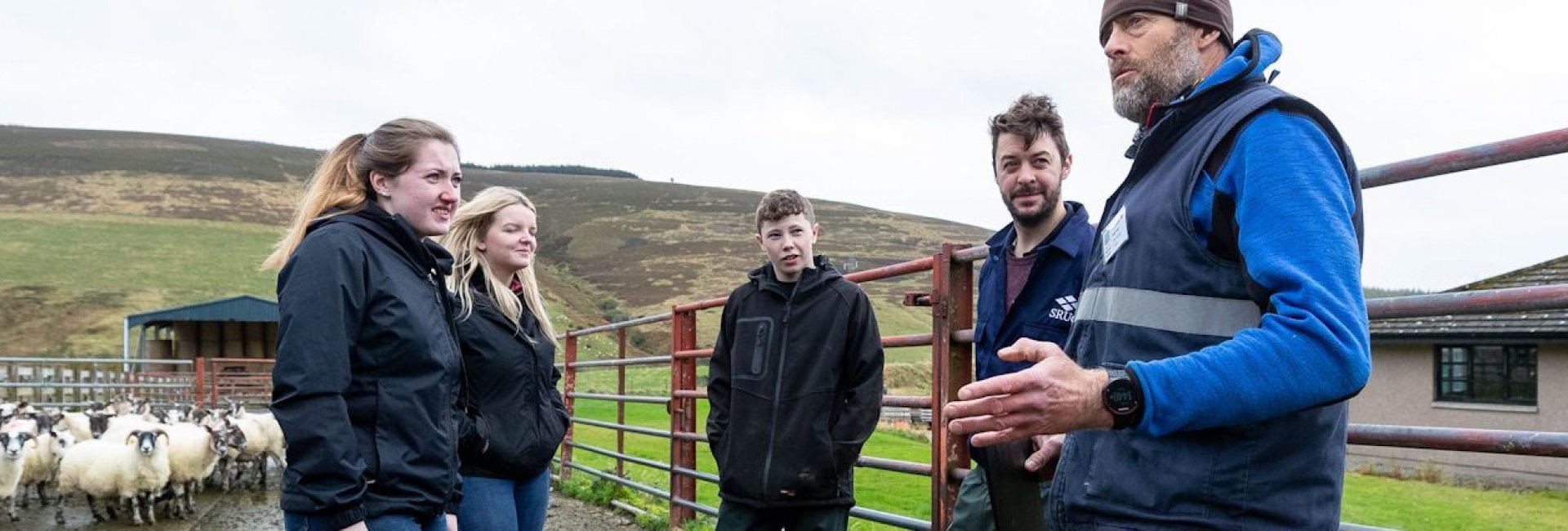
SRUC Elmwood Open Day
28 Mar 2026, 10:00
Cupar

The BSc (Hons) in Horticulture (Plantsmanship) has been designed specifically to deliver skilled horticultural practitioners who understand the interdisciplinary nature of the sector and their position within it. The programme is unique in that it is the only undergraduate horticulture degree programme to be offered in Scotland.
SRUC’s unique partnership with the Royal Botanic Garden Edinburgh (RBGE) enhances course delivery of the ‘plantsmanship’ stream by being a high-profile advocate for plant biodiversity and conservation research and outreach work. This partnership adds immense value to the stream due to their respected presence and the immersive learning experience it provides.
The programme takes a blended learning approach, using a variety of learning and teaching activities both on campus and via our Virtual Learning Environment (VLE), Moodle, as appropriate to the subject and level of study. In years one and two, the focus is on developing underpinning academic skills, practical confidence and peer learning communities. The programme is therefore primarily campus-based theory and practical activities, supported by online live classes and independent studies within the VLE. Classroom learning will support active learning and encourage collaboration. The third and fourth years of the programme focus more on independent learning, allowing for personalised foci on areas that are of interest. A higher proportion of theoretical learning will take place either live online or within the VLE and supported by practical and interactive activities on campus. Classroom activities will include simulation-based and inquiry-based learning, applying theoretical knowledge to real-world challenges.
On successful completion of this programme students will be able to:
Advance equality of opportunity and value diversity of ideas, cultures and approaches in horticulture
Design and implement horticultural research whilst selecting appropriate frameworks, and collect, analyse and present data to make inference from the study
Value the interrelationships between society and plant biodiversity in cultivated and natural landscapes using an interdisciplinary approach
Practice ethical professionalism and autonomy in a variety of professional settings, reflecting on own personal and professional development, and adapting practice as appropriate
Formulate solutions to sector challenges by adopting an enterprising mindset
Advocate for plant and allied biodiversity and its application in horticulture in the face of environmental change
At the end of each academic year, students will be invited to attend and participate in the ‘Plant and Soil Sciences Student Conference’. This provides an opportunity for students in years two, three and four of their studies to showcase the range and breadth of research that has been carried out. The academic staff will decide on the keynote speaker, and this will be someone who has demonstrated exceptional dedication to their studies.
By studying this BSc (Hons) in Horticulture (Plantsmanship), you can expect to study the following modules as part of the course:
Plant Taxonomy - The module aims to introduce the principles of plant taxonomy, highlight contemporary methods, and provide an understanding of the taxonomic procedures applied in horticulture.
Conservation horticulture - The module aims to explain the principles of conservation horticulture, investigate the competencies required by conservation practitioners and highlight conservation projects and initiatives.
Public garden leadership - The module aims to examine leadership roles in public gardens, review contemporary challenges for public garden leaders and evaluate the competencies required for leadership.
Plant Humanities: plants and people - This module explores the many relationships between plants and people from crop domestication through medicinal practices to, symbolism and belief across diverse cultures
Environmental horticulture - The aim of this module is to develop your knowledge of environmental horticulture by analysing plant-based solutions that are crucial for addressing today’s environmental issues. Using critical thinking, you will consider the impact various plant-based technologies have on society, the environment, and the economy to ultimately encourage environmental responsibility and awareness
Agents for change - This module aims to empower you to become an agent of change within your subject’s sector. You will gain knowledge of current legislation that is appropriate to your sector and be able to make recommendations for new policies, programmes and initiatives to bring about positive change in local and/or global contexts.
The assessment approach for the BSc (Hons) in Horticulture (Plantsmanship) has been designed to provide opportunities to develop the competencies required to become skilled horticultural practitioners. It uses a variety of assessment approaches to develop a range of skills, knowledge and professional behaviours and to ensure the inclusivity of different learning approaches. All assessments within the programme are designed to be authentic; incorporating realistic objectives that are reflective of industry activities. The authenticity of the assessments will foster innovation and creativity skills that are necessary to grow and modernise the horticulture sector upon graduation.
Students will develop scientific writing skills by completing assessments that include scientific literature, research activities, case studies, and projects. To complement this, effective communication skills will be developed through group projects, presentations, and multimedia content creation. Students will also develop research and statistical analyses skills using real-life data sets from projects that are embedded into the programme.
Personalised learner journeys are championed by providing opportunities for students to select from a range of topics for an assessment, or by providing different methods of completing assessments. For example, by creating an instructional video of a laboratory skill or by writing a standard operating procedure. Typically, students will be encouraged to select the option that will challenge them the most, rather than defaulting to what seems simplest. Reflective practice is at the forefront of the programme’s ethos and will be fostered through the use of portfolios, reflection tasks based on personal objectives, or by reflecting on the feedback that has been received by the assessor.
We believe that this assessment approach will fulfil the programme learning outcomes and our programme promise: “to provide an immersive learning experience to get you ready today, for the sector tomorrow”.
The following entry points are available for this course:
SRUC has a long tradition of welcoming students from outside the UK to study with us, and we find they greatly enhance the learning experience of other students and their unique viewpoint and carried life experiences. International student rules and regulations are set by national governments. For the most up to date guidance, please visit our website – www.sruc.ac.uk
Guidance on English Language requirements https://www.sruc.ac.uk/courses-training/student-support/international-students/study-requirements-for-international-students/
This section shows the range of grades students (with UK A-Levels or Pearson BTEC Level 3 National Extended Diplomas) who received offers were previously accepted with (learn more). It is designed to support your research but does not guarantee whether you will or won't get a place. Admissions teams consider various factors, including interviews, subject requirements, and entrance tests. Check all course entry requirements for eligibility.
We are unable to show previous accepted grades for this course. This could be because the course is new, it's a postgraduate course, there isn't enough historical data, or the provider has opted out of sharing their entry grades data for this course - learn more.
Operated by the Office for Students
Employment after 15 months (Most common jobs)
Go onto work and study
The number of student respondents and response rates can be important in interpreting the data – it is important to note your experience may be different from theirs. This data will be based on the subject area rather than the specific course. Read more about this data on the Discover Uni website.
| Location | Fee | Year |
|---|---|---|
| England | £9790 | Year 1 |
| Northern Ireland | £9790 | Year 1 |
| Wales | £9790 | Year 1 |
| Channel Islands | £9790 | Year 1 |
| Republic of Ireland | £9790 | Year 1 |
| Scotland | £1820 | Year 1 |
| EU | £17000 | Year 1 |
| International | £17000 | Year 1 |
Tuition fee status depends on a number of criteria and varies according to where in the UK you will study. For further guidance on the criteria for home or overseas tuition fees, please refer to the UKCISA website.
No additional fees or cost information has been supplied for this course, please contact the provider directly.
SRUC Edinburgh
West Mains Road
Edinburgh
EH9 3JG
Visit our website Visit our course page
Email:study@sruc.ac.uk
Phone:0800 269 453
Email:admissions@sruc.ac.uk
Phone:0131 535 4480