Course contact details
Main Contact
Email:Admissions.Enquiries@RoyalHolloway.ac.uk
Phone:01784 414944
Royal Holloway, University of London
Egham
TW20 0EX

Choosing this course enables you to combine the study of Comparative Literature and Culture (75% of the course) with History of Art and Visual Culture (25%).
Comparative Literature and Culture (CLC) offers you the opportunity to study global literature as well as to explore film, philosophy and visual arts. CLC combines a fascinating breadth of material with a focus on contexts – places, periods, and genres – to explore how key cultural shifts transform how we see, represent, and make sense of our changing world. CLC at Royal Holloway is a unique and intellectually stimulating degree which will develop you as a culturally-aware, creative and adaptable thinker.
We’ve developed this degree so that you can tailor it to suit your own evolving interests, choosing from our exceptionally wide range of fascinating options, ranging across continents and centuries, from antiquity to the present day, novels and poetry to philosophy, cinema and art. We will read, watch, and compare from Ancient Greece to contemporary New York, from Cuba to Korea, from epics to crime fiction, and from tragedy to the avant-garde. CLC enables you to study texts originally written in many languages, all translated into English.
If you have a passion for the visual arts, History of Art and Visual Culture will give you the skills to read, interpret and analyse images and artefacts across cultures. You will benefit from the research expertise of staff in the School of Modern Languages, Literatures and Cultures, engaging in the key phases in the development of the history of art and visual culture of Europe and Latin America, equipping you with the skills You can take courses on key historical skills and take options that combine the study of art history with that of photography, film and other media, ranging from medieval times to contemporary visual culture.
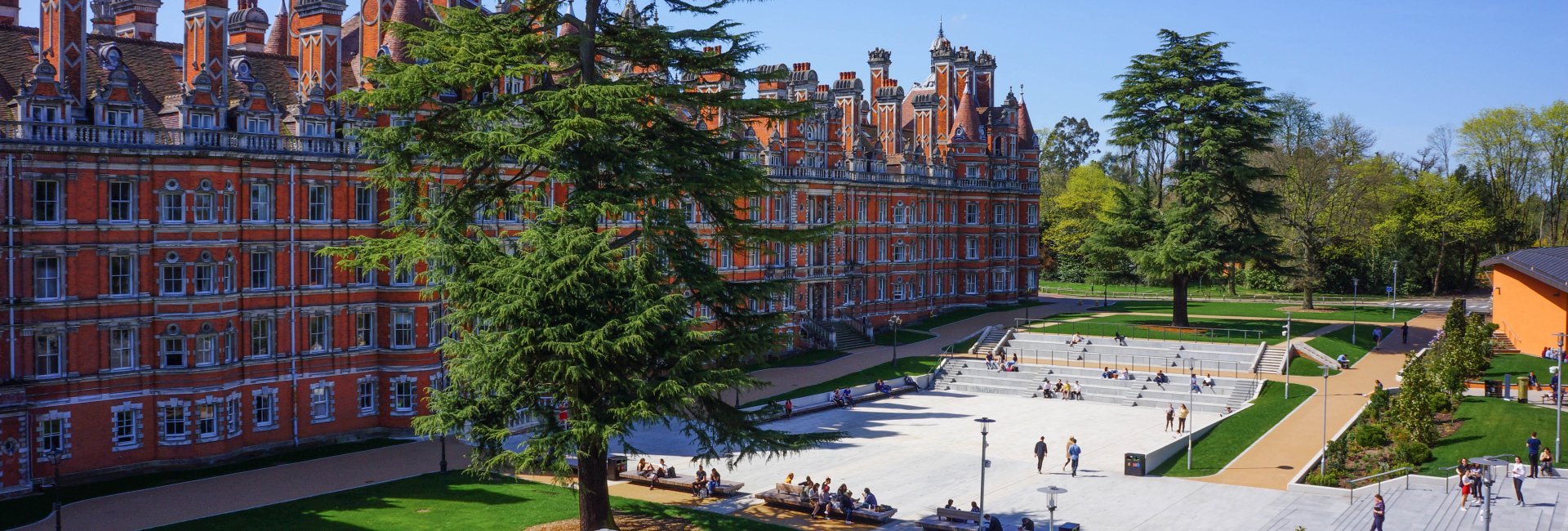
Make use of Royal Holloway’s exceptional collection of Victorian Art housed in the Founder’s Picture Gallery
Choose options in Visual Culture from across the School of Modern Languages, Literatures and Cultures
Reading Texts: Criticism for Comparative Literature
Visual Arts 1: Artists and their Materials
International Film 1: Contexts and Practices
The Birth of Film
Histories of Representation
Critical Worlds: Theory for Comparative Literature and Culture
International Film 2: Readings and Representations
Visual Arts II: Genre and Movements
Transnationalism, Diaspora and Globalisation in Contemporary Film: Dissertation
Visual Arts Dissertation
Below is a taster of some of the exciting optional modules that students on the course could choose from during this academic year. Please be aware these do change over time, and optional modules may be withdrawn or new ones added.
Key French Texts: The Individual and Society
The Visual Image in French Culture and Society
Introduction to German Studies
International Film 1: Contexts and Practices
Reading Texts: Criticism for Comparative Literature
Tales of the City: Introduction to Thematic Analysis
The Birth of Film
Strange Encounters: Texts and Contexts in Modern German Culture
Dante, Petrarch, Boccaccio and their Heritage
Discovery, Subversion and Destruction in the Hispanic Worlds Visual Arts 1: Artists and their Materials
Journeys of Identity
Histories of Representation
Critical Worlds: Theory for Comparative Literature and Culture
International Film 2: Readings and Representations
Visual Arts II: Genre and Movements
Writing Romance and Desire
Cinema in France
Death, Desire, Decline: Thomas Mann and Franz Kafka
Postwar Italian Cinema: the Auteur Tradition
Art and Literature in Renaissance Florence
Belonging and the Self in Contemporary German Fiction and Film
Fake News, Gossip, and the Pursuit of Truth: From Renaissance Newsletters to Online Journalism
Deceit, Desire and the Self: Literature of the Spanish Golden Age
Seducing the Nation: Spanish Film 1940s to 1980s
Conflict in Latin American Literature
21st-century World Food Fictions: Feeding Interdisciplinary Understandings of Identity Constructs
World Literatures: Texts and Identities in Motion
Tongues of Exile: Exophonic and Translingual Literature
21st-century World Food Fictions: Feeding Interdisciplinary Understandings of Identity Constructs
From Aestheticism to the Avant-Garde
Transnationalism, Diaspora and Globalisation in Contemporary Film: Dissertation
Comparative Literature and Culture: Comparative Dissertation
Text and Image in France: from Cubism to the Present
Blindness and Vision in French Culture
Villains and Villainy in Early Modern French Theatre
Redefining the Erotic in Contemporary French Literature and Film
Narrative and Identity: The German Novel from the 18th to the 21st Century
National Socialism and the Third Reich in German Film and Visual Culture from 1933 to the Present
Art and Literature in Renaissance Florence
Seducing the Nation: Spanish Film 1940s to 1980s
Deceit, Desire and the Self: Literature of the Spanish Golden Age
Conflict in Latin American Literature
Fake News, Gossip, and the Pursuit of Truth: From Renaissance Newsletters to Online Journalism
The course has a modular structure. Some modules are compulsory while others are elective thereby offering flexibility and choice.
Our teaching combines a majority of seminars and small group work as well as role play and conversational activities, with some lectures. Private study and preparation are essential parts of every course, and you will have access to many online resources such as Powerpoint slideshows, copies of selected primary and secondary texts, audiovisual materials, class and seminar preparation aids, links to relevant external sites, quizzes and grammar and essay writing guidance, and the University’s comprehensive e-learning facility, Moodle. When you start with us, you are assigned a Personal Tutor to support you academically and personally and who holds regular surgery hours at least twice weekly.
Assessment is by a mixture of coursework and end-of-year examination in varying proportions, depending on the course units you take. Coursework includes essays, language exercises, translations and reports. Oral presentations and computer-based tests are used in some course units to assess grammar and comprehension skills. You can, to some extent, choose course units which suit your own assessment preferences. The first year is foundational and marks do not count towards your final degree. The second year, year abroad and final year marks do count, with more importance being given to the final year marks in order to reward progress and achievement.
You will take a study skills course during your first year, designed to equip you with and enhance the writing skills you will need to be successful in your degree. This course does not count towards your final degree award but you are required to pass it to progress to your second year.
This is the equal consideration deadline. You can still apply after this date, but your application may not receive guaranteed consideration.

Royal Holloway, University of London has participated in the Teaching Excellence Framework. These ratings were awarded in 2023, for four years.
See why these ratings were awarded
What does this TEF outcome mean?
The following entry points are available for this course:
Combinations of qualifications will be considered on an individual basis, please contact us on admissions.enquiries@rhul.ac.uk to discuss your situation
At Royal Holloway, we know every student approaches university with different experiences and backgrounds. We look at each application individually, and different factors can affect the exact offer a student receives. For instance, our contextual offer scheme means students from disadvantaged socio-economic background can receive a different offer. For full details please see our website.
Learn more on the Royal Holloway, University of London website
This section shows the range of grades that students who received offers were previously accepted on to this course with (learn more).
It is designed to support your research but does not guarantee whether you will or won't get a place.
Admissions teams consider various factors, including interviews, subject requirements, and entrance tests. Check all course entry requirements for eligibility.
We are unable to show previous accepted grades for this course. This could be because the course is new, it's a postgraduate course, there isn't enough historical data, or the provider has opted out of sharing their entry grades data for this course - learn more.
This report uses your grades to show how students with similar results have done when applying to this course in the past. Sometimes, there isn’t data for every possible set of grades. When that happens, universities and colleges occasionally fill in the gaps for sets of grades that are typically accepted.
| Location | Fee | Year |
|---|---|---|
| EU & International | £26800* | |
| England, Scotland, Wales, Northern Ireland & Channel Islands | £9790* |
* This is a provisional fee and subject to change.
Tuition fee status depends on a number of criteria and varies according to where in the UK you will study. For further guidance on the criteria for home or overseas tuition fees, please refer to the UKCISA website.
Other essential costs: Students are recommended to purchase a laptop before starting their course, to assist with their studies. The optional residential field courses incur an extra fee.
*The tuition fee for Home (UK) undergraduates is controlled by Government regulations. This figure is the fee for the academic year 2026/27 and is shown as a guide. The fee for the academic year 2027/28 has not yet been confirmed.
*This figure is the fee for EU and international students starting a degree in the academic year 2026/27 and is shown as a guide. The fee for the academic year 2027/28 has not yet been confirmed.
Royal Holloway reserves the right to increase tuition fees annually for all students. For further information see fees and funding: https://www.royalholloway.ac.uk/studying-here/fees-and-funding/
https://www.royalholloway.ac.uk/studyhere/undergraduate/feesandfunding/bursariesandscholarships/home.aspx
Email:Admissions.Enquiries@RoyalHolloway.ac.uk
Phone:01784 414944
Egham
TW20 0EX
At Royal Holloway, University of London