Course contact details
Main Contact
Email:admissions@rcs.ac.uk
Phone:0141 332 4101
Fax: 0141 332 8901
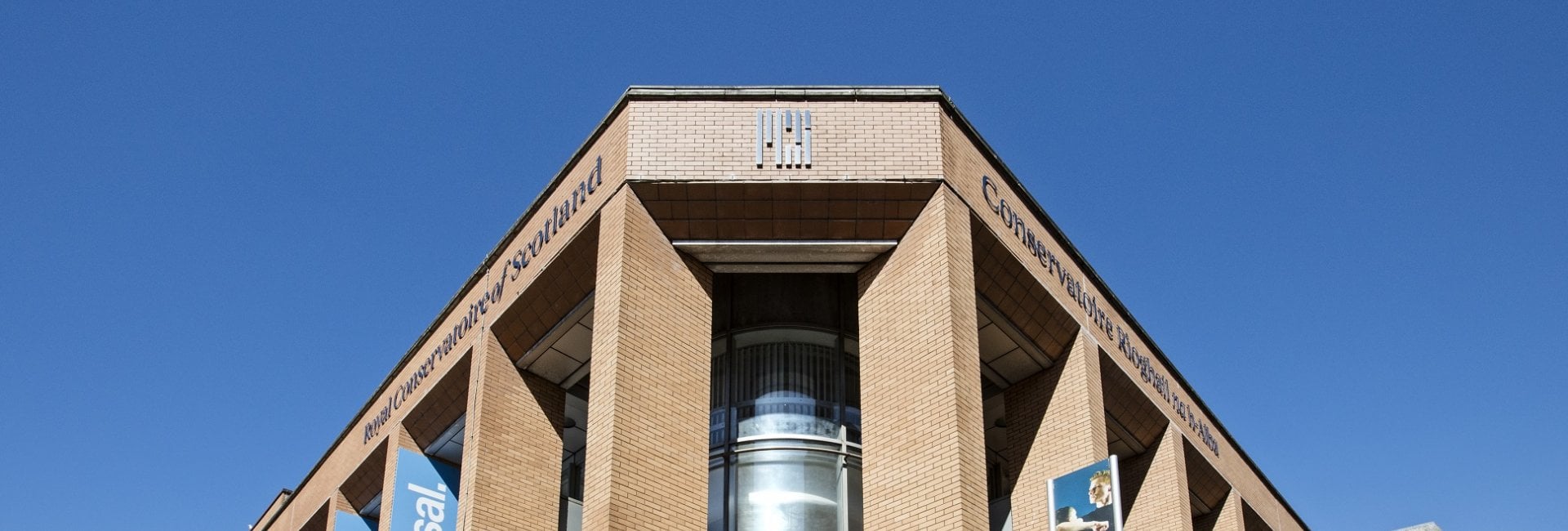
Royal Conservatoire of Scotland
100 Renfrew Street
Glasgow
G2 3DB

Bachelor of Education (Music) with Honours is a vocational programme for musicians who aspire to teach music in schools. You will be enrolled in one of the most highly regarded routes into classroom music teaching in Scotland, qualifying you for both primary and secondary school teaching. The degree provides integrated school placements in all four years of study.
In this programme, you will study aspects of teacher education in developing your skillsets for effective classroom practice and preparation for school experience. With a focus on professionalism, practitioner enquiry and career-long professional learning, you will develop a personal educator identity.
You will undertake intensive music studies focusing on creativity, performance and collaboration. You will develop your skills and knowledge in musicianship, musicology, technology, piano and classroom instruments.
With school placements in every year of study, you will have the opportunity to embed learning and develop the practical application of skills through teaching practice.
Following graduation, you will qualify for Provisional Registration with the General Teaching Council for Scotland (GTCS). All eligible graduates are guaranteed a probationary year of classroom teaching in a Scottish school. GTCS standards are recognised in the UK and internationally, with many of our former students working in Scotland or abroad after graduation.
During the application and audition process, you must select which instrument(s) you wish to specialise in for the duration of your course. On this course, you can choose from the following options:
For all courses, you must select at least one specialism from the 'primary' list. For those studying primary/secondary pathways, two instruments may be selected – one from the 'primary' list and one from the 'secondary' list. Joint pathway students may select any two instruments from either list.
Year 1 - Developing as a Teacher:
Professional Studies will focus on developing as a teacher, exploring learning and teaching in the primary school, and key issues about how children learn, and teacher professionalism.
Your school placement will be in a primary school where you will learn how to plan and develop lessons to support learning within the school context and develop a wider awareness of education.
We provide a solid foundation in performance, ensemble playing, composition and arranging, collaboration, music technology and the exploration of musical contexts.
Year 2 - Developing the Whole Child:
In Professional Studies, the focus moves towards child development, health and wellbeing and inclusive education.
Your school experience will be in a secondary school where you will focus on Broad General Education (BGE) in the Music department and the wider school.
Music studies will focus on broadening knowledge and deepening understanding through collaborative and creative practice, to develop as a musician and support your work as a classroom practitioner, including building awareness and experiencing global musical contexts.
Year 3 - Assessment, Education and Society:
Professional Studies in year three will explore assessment, education and society and the cross-cutting educational themes which influence learning and teaching. You will begin to consider the role of practitioner enquiry and reflective practice in the development of your teacher identity and capacity for career-long learning.
School experience will focus on secondary three and four and the transition from Broad General Education into the Senior Phase and towards National Qualifications.
In music studies, you will have core studies in composition for film and studio collaboration. You will choose additional electives from a list of modules such as performance, musicology, composition folio, additional support for learning, primary music, instrumental music teaching, accompaniment studies, conducting, arranging, additional performance study, etc.
Year 4 - The Enquiring Professional:
Professional Studies in year four will support you to implement a small-scale, action-research project in your classroom, with a focus on analysing the impact of a pedagogical intervention, uniting theory and practice.
In your final year, the focus of the placement will be the senior phase. You will spend an extended period in a secondary school fully embedding the GTCS Standard for Provisional Registration into your practice to join the Teacher Induction Scheme (TIS) as a Newly Qualified Teacher (NQT).
You will combine your knowledge, skills and school experiences to date, making connections between your studies at RCS and career-long professional learning.
You will have core studies in composition and composition for film, with a particular focus on the teaching of these areas, along with other electives from the elective catalogue, some of which build on year 3 electives.
https://www.rcs.ac.uk/courses/bachelor-of-education-music-hons/#programme-structure
Please see our website for more information.
Professionally accredited courses provide industry-wide recognition of the quality of your qualification.
The following entry points are available for this course:
The General Teaching Council for Scotland sets the minimum entry requirements with regard to the qualifications in English and Maths and may change these requirements. Normally several years’ notice is given impending any changes.
It is the responsibility of the applicants to be aware of the current minimum requirements. We offer a flexible approach to students taking Higher over more than one academic year and/or who achieve their qualifications in more than one sitting.
More information about the GTCS entry requirements, including accepted alternatives to the Maths and English requirements, can be found in the GTCS Memorandum on Entry Requirements. https://www.rcs.ac.uk/study/how-to-apply/
| Test | Grade | Additional details |
|---|---|---|
| IELTS (Academic) | 6 | 6.0 with no component below 5.5 |
| TOEFL (iBT) | 80 | Overall score of 80, with minimum scores of: Reading – 18, Listening – 17, Speaking – 20, Writing – 17 |
| PTE Academic | 59 | Overall score of 59 with a minimum of 59 in all components (reading, listening, speaking, writing) |
| Cambridge English Advanced | Overall score of 169 with a minimum of 162 in all components | |
| Cambridge English Proficiency | Overall score of 169 with a minimum of 162 in all components |
https://www.rcs.ac.uk/study/international-students/english-requirements/
In the event of a successful assessment, applicants may be invited for a further interview prior to being made an offer.
Remote assessment recordings may be accepted in the event that you cannot attend an assessment in person.
| Location | On-time Fee |
|---|---|
| RCS (Glasgow) | £35 |
| Online | £35 |
| Location | On-time Fee |
|---|---|
| RCS (Glasgow) | Not Applicable |
| Online | Not Applicable |
All applicants need to complete an Acceptd account profile and application regardless of which location you choose, this is part of the audition process (https://app.getacceptd.com/rcs) and needs to be completed once your UCAS application has been submitted. All live in-person auditions will be scheduled through the Acceptd platform. If you don't have an acceptd application, we won't be able to audition you. Applicants submitting performance recordings via our Acceptd platform, may be asked to a follow-up live online interview with the department you are applying for. We will continue to offer online auditions to international applicants and those who are unable to attend in-person due to exceptional circumstances. For the best audition experience, we would encourage all UK applicants to attend in person. For more information on what to prepare for the audition, please see our website - https://www.rcs.ac.uk/courses/bachelor-of-education-music-hons/
| Location | Fee | Year |
|---|---|---|
| England, Wales, Northern Ireland, Channel Islands & Republic of Ireland | £9790* | |
| Scotland | £1820* | |
| EU & International | £29786* |
* This is a provisional fee and subject to change.
Tuition fee status depends on a number of criteria and varies according to where in the UK you will study. For further guidance on the criteria for home or overseas tuition fees, please refer to the UKCISA website.
Please note, all new students are required to pay associated programme cost related fees at the start of their studies.
For more information on fees, funding and Scholarship, please see our website.
There are currently no RCS scholarships available for our Education programme. More information can be found about funding on our degree pages: https://www.rcs.ac.uk/courses/bachelor-of-education-music-hons/#fees-funding
Funding support may be available for teacher training via the UK Government or through the student finance companies. You would need to conduct your own research as to whether you qualify for this.
Email:admissions@rcs.ac.uk
Phone:0141 332 4101
Fax: 0141 332 8901
100 Renfrew Street
Glasgow
G2 3DB
At Royal Conservatoire of Scotland