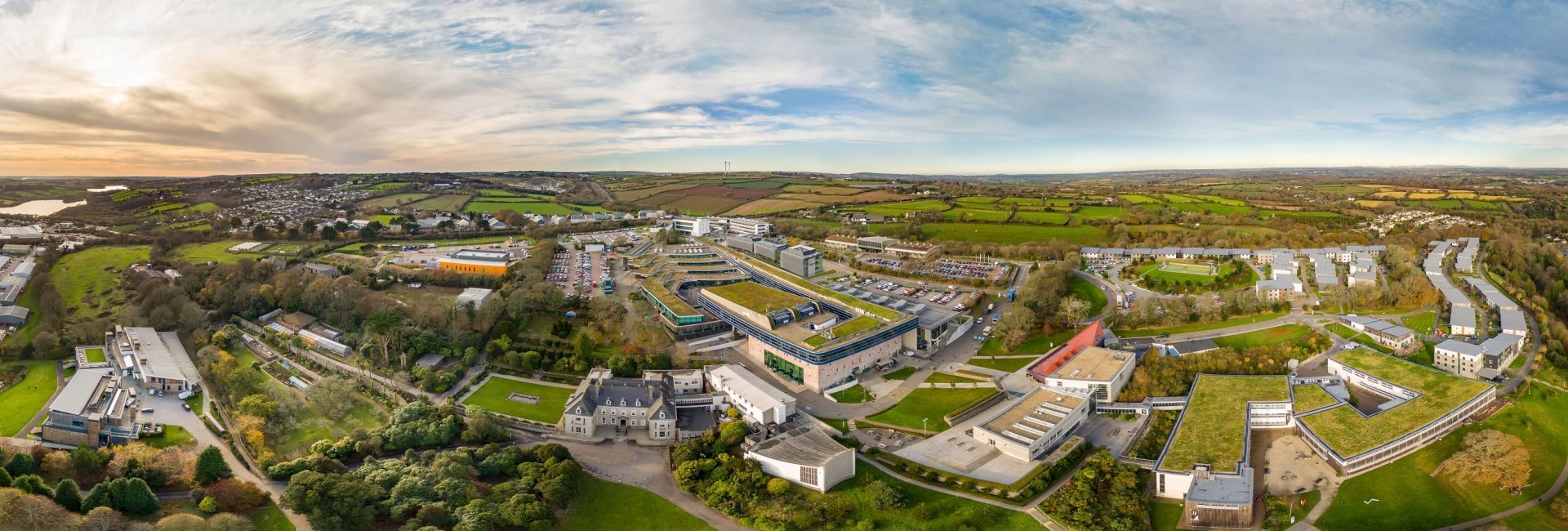
Open Day (in-person)
23 May 2026, 08:00
Falmouth
Transformative courses for tomorrow’s creatives.
This Combined Arts online degree gives you the opportunity to explore a wide range of creative disciplines, following your ambition and passion while developing your own creative voice and growing a wide range of transferrable skills.
This Integrated Master’s model combines undergraduate and postgraduate study in one efficient, effective degree which will give you a strong creative theoretical background, as well as creative space to explore your own independent research and projects.
Studied 100% online and in a way that works for you, the Combined Arts courses bring expertise from across the creative disciplines; design, writing, illustration, visual communication, and fine art. You will focus on in-demand skills aligned with future careers. With a focus on problem-based learning, you’ll grow as an engaged and innovative creative who can apply your knowledge to real-world problems.
This accelerated pace offers you the opportunity to enter the workplace with a postgraduate qualification ahead of your peers, with the flexibility to focus on areas of the creative industries that matter to you and your future career.
Why study this course at Falmouth?
Simplicity and flexibility: The Combined Arts Integrated Master’s courses offer a flexible and personalised learning experience, allowing you to shape your own academic journey and build your study around your life
Broad creative arts and design basics curriculum: You'll gain a breadth of creative and critical skills from across a range of arts disciplines, enhancing your employability.
Problem-based curriculum design: With an emphasis on creativity and problem-solving, you’ll be equipped to approach real-world challenges in both life and work.
Interdisciplinary approach: This course cultivates the ability to tackle complex problems by integrating diverse academic perspectives.
A connected community: Join a global community of diverse practitioners and make career-defining connections.
This online Combined Arts degree is structured around a broad learning experience, drawing on diverse academic fields, meaning that you will graduate with discipline-specific skills for the creative industries, but also with an ability to grapple with complex challenges through a transdisciplinary lens.
This course uses a problem-based learning approach. Supported by your tutors, you’ll be given challenges alongside the resources and tools to solve or meet them. You decide your own learning boundaries and are supported to make yours an exciting, and effective learning experience.
The Combined Arts: Creativity course is perfect for storytellers, makers, and imaginative thinkers. It focuses on the ability to generate new ideas, solutions, or approaches by using imagination, critical thinking and other essential creative skills.
On this course, your practice could involve various skills, including visual communication, content creation, storyboarding, copywriting, prototyping, art direction, and creative writing. It can also include technical skills linked with a chosen medium, such as understanding photography or video techniques.
While the definition of creativity has evolved and, in some cases, may be industry specific, there are conserved core components of creativity that this course will explore. Through your approach to your PBL cases, your artistic, interdisciplinary skills will intertwine and build on one another, creating a robust foundation for creativity in various personal and professional contexts. Empathy - particularly cognitive empathy - has been linked to increased creative activity, and some PBL cases will explore those aspects that link creativity to wellbeing.
Year One
The first year of the Integrated Master’s Combined Arts focuses on development of core skills that you’ll need throughout your studies. These will be developed as you progress through the programme.
You will be introduced to problem-based learning, how it works and the benefits to you as a learner, and you will build your confidence in managing your own self-directed study under the guidance of your tutors.
This first year covers themes such as study skills, sustainability, communication and organisation, and is the solid foundation on which you’ll build advanced skills and with that, your own creative practice.
Modules:
The Art of Problem-Based Learning
Places and Spaces: Community, Identity and Change
Visualise and Innovate: Creative Problem-Solving
Transformations: Imagining Community Spaces
Year Two
The second year of this Combined Arts Integrated Master's builds on the first and continues the focus on building a first-rate personal creative skillset.
The year ahead covers advanced creative practice, analytical skills and collaborative working, as well as themes of inclusivity and wellbeing in creative practice to give you a resilient future in the creative industries. This year becomes the creative space to engage with more advanced skills and refine your research, ethical and analytical skills that will underpin your developing creative practice.
Modules:
Collaboration
The Creative Cultural Sphere
The Entrepreneurial Creative
Future Skills
Creativity Unbound: Perspectives and Voices on Nature and Place
Final Major Project
Year Three
The third and final year (Level 7) of the Combined Arts Integrated Master’s has an increased focus on refining and developing your personal research practice using problem-based learning examples, to help drive learning and skill development, in line with a master’s level programme.
As the problems get more complex, you will stretch your skills to meet that complexity, and in doing so, grow into a unique citizen-graduate.
Modules:
Research Skills as the Foundation of Success
Practice Research by Researching Practice
Sustainable Strategies
The Multifaceted Art of Storytelling
Final Major Project.
100% of your assessment will be coursework. There are no exams on this course.
Assessment methods may include:
The following entry points are available for this course:
If English is not your first language, you will need to demonstrate English language skills that are sufficiently developed for successful completion of your studies. We accept a range of recognised English language qualifications that are equivalent to the International English Language Testing System (IELTS) Academic minimum score of 6.0 overall, with a minimum of 5.5 in Reading, Writing, Speaking and Listening.
At Falmouth, we recognise excellence in many forms, and we see the whole you.
Our diverse community is creative, innovative and entrepreneurial.
We recognise that these qualities aren’t always shown in academic grades alone. That’s why, while many of our applicants achieve high academic grades, we also welcome those who can demonstrate their potential through an exceptional portfolio or performance.
At a minimum, we typically require the equivalent of 64 UCAS Tariff points for undergraduate courses where we can review a portfolio or audition, or a minimum of 96 UCAS points for those courses that do not require a portfolio or audition. For our Integrated Foundation Year courses, we typically require a minimum of 32 UCAS points for courses where we can review a portfolio or audition, or 64 UCAS points for those that do not require a portfolio or audition.
To support this approach, during a friendly conversation with our academic team, we’ll consider your ideas, your creative output and your ambition to ensure you’ll thrive at Falmouth.
If you are able to demonstrate relevant, current, equivalent experience instead of formal qualifications, we encourage you to apply. Please contact our Applicant Services team before applying, for advice regarding your individual experience and eligibility.
If you are an international applicant and require a Student visa to study in the UK, you must have a recognised English language test approved and vouched for by the University at the appropriate level. You can see what we accept on our website https://www.falmouth.ac.uk/study/international/english-language-requirements Our Applicant Services team can help you with any general questions you may have about study visas or suitable language tests. For more specific advice, we recommend you also consult UKCISA http://www.ukcisa.org.uk/
Find out more about qualification requirements for this course.
View our list of accepted English language tests and qualifications using the link below https://www.falmouth.ac.uk/study/international/english-language-requirements
At Falmouth University, we take a rounded approach to admissions. Instead of focusing on criteria like grades alone, we operate a contextual admissions policy, where we look at you as a person: your talents, your experiences and your potential. Every offer we make is shaped around you and your circumstances, and our conditional offers are always intended to be realistic and achievable.
This section shows the range of grades students (with UK A-Levels or Pearson BTEC Level 3 National Extended Diplomas) who received offers were previously accepted with (learn more). It is designed to support your research but does not guarantee whether you will or won't get a place. Admissions teams consider various factors, including interviews, subject requirements, and entrance tests. Check all course entry requirements for eligibility.
We are unable to show previous accepted grades for this course. This could be because the course is new, it's a postgraduate course, there isn't enough historical data, or the provider has opted out of sharing their entry grades data for this course - learn more.
No fee information has been provided for this course
Tuition fee status depends on a number of criteria and varies according to where in the UK you will study. For further guidance on the criteria for home or overseas tuition fees, please refer to the UKCISA website.
No additional fees or cost information has been supplied for this course, please contact the provider directly.
Woodlane
Falmouth
TR11 4RH
Visit our website Visit our course page
Email:online.study@falmouth.ac.uk
Phone:01326 213827