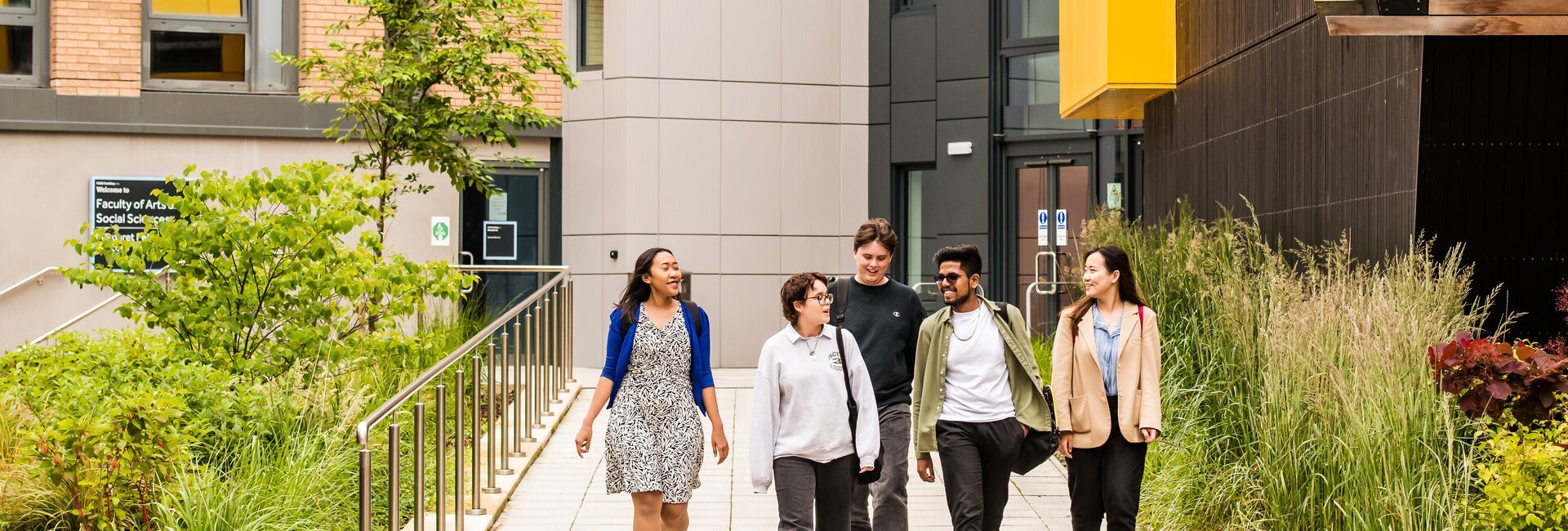
Lancaster University undergraduate open day
27 Jun 2026, 08:00
Lancaster

Chemists, with their ability to analyse and problem-solve, have played a big part in shaping our world. Our teaching is research-led, so you will learn at the forefront of the subject, tackling genuine scientific work. Solve contemporary problems with our leading academics and work in outstanding purpose-built laboratories to set yourself up for a career in a wide range of industries.
The Chemistry logic
Our world-leading staff teach chemistry in logical stages, in an approach that integrates the topics of organic, inorganic and physical chemistry. Research conducted by our academics continually shapes the content that they teach, so you’ll never be far from their findings. Part of the Department’s ethos is for all to act as sustainable chemists.
What to expect
With our three-year BSc Hons Chemistry degree, there’s an expansive introduction to the subject in Year 1, covering the fundamentals of atoms and molecules; organic and inorganic reactions; chemical thermodynamics and reaction kinetics. You will build on these topics during the rest of your degree while also developing an understanding of other areas of chemistry.
Year 2 brings you topics such as spectroscopy and electrochemistry as well as more advanced areas such as d-block metal chemistry, materials chemistry and quantum mechanics.
Year 3 offers you more flexibility and an exciting opportunity to undertake a major research project alongside our academics, postdoctoral staff and postgraduate students. These projects are directly connected to contemporary research questions that our academics are tackling and give you research experience that will be invaluable in your future career.
You may wish to transfer to one of our MChem programmes should you perform to a sufficiently high standard in your first two years.
Personal development
There will be lots of moments of discovery throughout your degree, whether that's working out the product of an unfamiliar chemical reaction or bringing out your passion for the environment by learning about cutting-edge sustainable chemistry. These small achievements add up to a wealth of transferable skills such as communication, critical thinking, data analysis, problem solving, teamwork and time management, all of which make you stand out to future employers.
3 things our chemistry students want you to know:
We’re part of a close-knit community of students and staff. Small group teaching means a strong support network and a very productive learning environment
We develop our practical skills in outstanding, research-grade labs. These have been created specifically for chemistry, and to deliver the project work in our third and fourth years
There's so much support in the Chemistry Department, from academics, lab technicians and teaching office staff. If you need help with your studies, you're encouraged to ask questions in workshops and tutorials. Alternatively, you can contact your lecturers outside of teaching sessions
This is the equal consideration deadline. You can still apply after this date, but your application may not receive guaranteed consideration.

Lancaster University has participated in the Teaching Excellence Framework. These ratings were awarded in 2023, for four years.
See why these ratings were awarded
What does this TEF outcome mean?
The following entry points are available for this course:
Discover what it's like to study Chemistry at Lancaster University: insights on the course, making friends, personal statement tips, uni prep, and recommended books, podcasts, and videos.

This should include Chemistry and one other science subject from: Biology, Computing, Economics, Environmental Science, Geography, Geology, Information Technology, Mathematics, Physics or Psychology.
Considered on a case-by-case basis alongside A level Chemistry grade B. Our typical entry requirement would be 30 Level 3 credits at Distinction plus 15 Level 3 credits at Merit, but you would need to have covered appropriate science content.
32 points overall with 16 points from the best 3 HL subjects including 6 in Chemistry and 6 in a further HL science subject
DDM may be considered alongside A level Chemistry grade B, along with sufficient science content
GCSE Mathematics grade 6/B, GCSE English Language grade 4/C.
We will also look at your overall GCSE profile when considering your application as a whole.
We do have flexibility when considering GCSE requirements. Please visit our website for more details.
We accept the Advanced Skills Baccalaureate Wales in place of one A level, or equivalent qualification, as long as any subject requirements are met.
We are happy to admit applicants on the basis of five Highers, but where we require a specific subject at A level, we will typically require an Advanced Higher in that subject. If you do not meet the grade requirement through Highers alone, we will consider a combination of Highers and Advanced Highers in separate subjects. Please contact our Admissions team for more information.
You can find full details of our entry requirements and the application process on our website. https://www.lancaster.ac.uk/study/undergraduate/how-to-apply/
| Test | Grade | Additional details |
|---|---|---|
| IELTS (Academic) | 6.5 | with at least 5.5 in each element |
| TOEFL (iBT) | 87 | with 18 in Reading, 17 in Listening, 17 in Speaking and 20 in Writing. For tests taken after 21 January 2026, we require 4.5 overall with at least 4 in each element. |
| PTE Academic | 58 | with at least 42 in each element |
| Cambridge English Advanced | Level B2 | 176 overall with at least 162 in each element |
| Cambridge English Proficiency | Level C1 | 176 overall with at least 162 in each element |
| Trinity ISE | Distinction | ISE II with a minimum of Distinction in each element |
https://www.lancaster.ac.uk/study/entry-requirements/undergraduate-english-requirements/
At Lancaster, we are committed to widening access to higher education for all. As part of this we take a holistic approach to reviewing applications, taking into account exceptional circumstances and potential as much as we can. We run a Contextual Offer Scheme which incorporates a reduced grade offer for applicants that meet our eligibility criteria. For more information on the scheme, and other widening participation activity such as the Lancaster Access Programme, please visit our website.
We accept a wide range of international qualifications. If your qualification is not listed here, please see our website for more information, or contact our Admissions team for advice. https://www.lancaster.ac.uk/study/entry-requirements/undergraduate-qualifications/
This section shows the range of grades that students who received offers were previously accepted on to this course with (learn more).
It is designed to support your research but does not guarantee whether you will or won't get a place.
Admissions teams consider various factors, including interviews, subject requirements, and entrance tests. Check all course entry requirements for eligibility.
We are unable to show previous accepted grades for this course. This could be because the course is new, it's a postgraduate course, there isn't enough historical data, or the provider has opted out of sharing their entry grades data for this course - learn more.
No fee information has been provided for this course
Tuition fee status depends on a number of criteria and varies according to where in the UK you will study. For further guidance on the criteria for home or overseas tuition fees, please refer to the UKCISA website.
For information about fees and funding please visit www.lancaster.ac.uk/fees.
Email:ugadmissions@lancaster.ac.uk
Phone:01524 592028
Bailrigg
Lancaster
LA1 4YW
At Lancaster University