Course contact details
Main Contact
Email:degrees@sparsholt.ac.uk
University Centre Sparsholt
Sparsholt
Winchester
SO21 2NF

What makes UCS special?
University Centre Sparsholt is recognised worldwide for its expertise in providing education in fishery, aquaculture and marine studies. Our lecturing staff are known to be the experts in the industry and can often be found at conferences and industry forums discussing the latest techniques and their supporting research. Students gain real industry experience on and off‑site that is under‑pinned by the high level of technical lecture content to prepare them for a range of careers or progression to courses at Master’s and PhD level. Our industry contacts enable great employment prospects. Owing to the success of the work experience, the majority of our students have secured industry relevant employment before they graduate. Previous placements range from Scottish salmon farms, specimen carp fisheries in England, France and Spain and a tilapia farm in Jamaica to river keeping on local chalk streams, bait manufacturers, the London Aquarium and the Fish Disease Laboratory at Weymouth.
What Makes This Course Unique?
Exceptional facilities, industry connections and immersive learning environment:
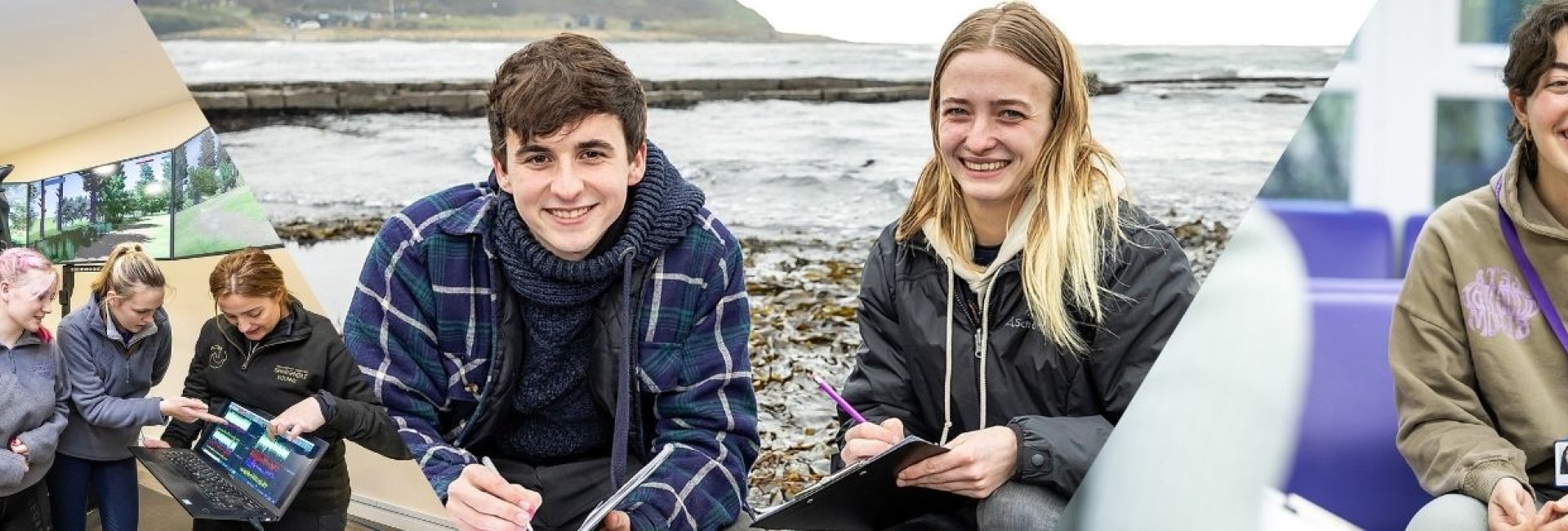
Practical experience – excursions to the coast and other relevant institutions enable students to experience a vast range of techniques and their practical applications.
Aquatic Research and Conservation Centre – purpose‑built facility housing a variety of ornamental and tropical species gives students vital exposure to practical fishkeeping.
Industry related placements – excellent links with potential placement destinations including public aquariums, NGOs, charities and small aquatic businesses.
What will I learn?
Gain a wide range of knowledge in subjects such as marine ecology, coastal processes, marine organisms and ecosystems through a combination of practical and theoretical sessions.
Practical learning to ensure you graduate with career confidence:
Weekly industry‑relevant practicals in our aquatic centre.
Participate in fieldwork on the UK coastline.
Laboratory experience in techniques for coastal evaluation.
How will I be assessed?
Our assessments mirror the challenges you will face in your career, combining academic depth with practical application:
Research that addresses real‑world problems.
Field‑based assignments that allow you to showcase your skills to employers
A range of presentation types and written assignments that develop key graduate skills such as communication expertise.
Focused on Your Future:
This course opens doors to diverse career paths in a vast sector, such as Fishery Officer or fishery observer; Ecological Consultant for planning and development; Research Scientist tackling global environmental challenges; Technician in an aquarium facility.
This degree will also upskill you in a range of transferable graduate skills such as higher‑level communication, data literacy and project management.
How our graduates are shaping the future:
Working within zoos and aquaria.
Educating the next generation within schools and on social media.
Working within charities to gain information on threatened species.
Pushing the frontiers of ecological research by working in postgraduate education such as Master’s and Doctoral level degrees.
YEAR ONE – SOLID FOUNDATIONS
Fundamentals in marine science
Introduction to marine ecology and conservation
Marine fisheries Principles in aquatic science
YEAR TWO – GET JOB‑READY
Research methods in the marine environment
Marine industry skills
Fintastic beasts and where to find them
Plus choice of two optional modules from:
– Aquarium husbandry and welfare
– Global fish production methods
– Aquatic system design
*subject to change
Assessment includes coursework (such as practical portfolios, laboratory reports, case studies and essay style assignments) plus formal exams. Research opportunities are also a feature, often enabling data collection within organisations such as the Inshore Fisheries Conservation Authority.
The following entry points are available for this course:
Minimum requirement is 64 UCAS tariff points.
Students who successfully complete the FdSc may apply to 'top-up' to the BSc.
We welcome applications from people with non-standard or international qualifications.
Entry requirements for students joining after Year 1: Successful completion of a NQF level 4 (Cert HE or HNC) or Year 2: NQF level 5 (Dip HE, HND or FdSc) in a relevant subject. Please email degrees@sparsholt.ac.uk for further information.
| Test | Grade | Additional details |
|---|---|---|
| IELTS (Academic) | 6 | Overall score of 6.0 with minimum scores of 5.5 in any of Speaking, Reading, Writing and Listening (CEFR B2) www.ielts.org/about-ielts/ielts-for-migration/united-kingdom |
| Trinity ISE | Pass | Pass in each of Speaking, Reading, Writing and Listening (CEFR B2) www.trinitycollege.com/qualifications/SELT/UKVI |
| PTE Academic | 60 | Minimum score of 60 or higher in each of Speaking, Reading, Writing and Listening (CEFR B2) www.pearsonpte.com/selt-tests/pte-academic-ukvi |
We will also accept the following qualification: LanguageCert International ESOL SELT - minimum score of 33/50 in each of Speaking, Reading, Writing and Listening (CEFR B2) https://www.languagecert.org/en/uk-visa-exams/study-in-the-ukhttps://www.sparsholt.ac.uk/international/english-language-requirements/
This section shows the range of grades that students who received offers were previously accepted on to this course with (learn more).
It is designed to support your research but does not guarantee whether you will or won't get a place.
Admissions teams consider various factors, including interviews, subject requirements, and entrance tests. Check all course entry requirements for eligibility.
We are unable to show previous accepted grades for this course. This could be because the course is new, it's a postgraduate course, there isn't enough historical data, or the provider has opted out of sharing their entry grades data for this course - learn more.
This report uses your grades to show how students with similar results have done when applying to this course in the past. Sometimes, there isn’t data for every possible set of grades. When that happens, universities and colleges occasionally fill in the gaps for sets of grades that are typically accepted.
| Location | Fee | Year |
|---|---|---|
| England, Scotland, Wales, Northern Ireland, Channel Islands & Republic of Ireland | £9780* | |
| EU & International | TBC |
* This is a provisional fee and subject to change.
Tuition fee status depends on a number of criteria and varies according to where in the UK you will study. For further guidance on the criteria for home or overseas tuition fees, please refer to the UKCISA website.
Tuition fee status depends on a number of criteria and varies according to residency. For further guidance on the criteria for home or overseas tuition fees, please refer to the UKCISA website.
Students from EU member states can apply for an EU scholarship. Please contact degrees@sparsholt.ac.uk
Full Fees and Finance information and details of any additional course costs can be found on our website: https://www.ucsparsholt.ac.uk/student-information/fees-finance/
University Centre Sparsholt (UCS) will award bursaries of up to £4,500 to up to four new students each academic year.
There is flexibility in how these bursaries can be used, but they are intended to help with the cost of studying in order to make university more affordable.
The recipients of the bursaries will continue to receive the same amount for each year of their studies, as long as expectations for attendance and engagement are met.
The bursaries are a part of the University Centre's Access and Participation Plan 2025/26 -2028/29 and therefore priority will be given to students whose backgrounds are traditionally underrepresented among the UCS student body.
Further details regarding how to apply will be supplied to all offer holders who have accepted an offer to study with us when they complete their 'Next Steps' registration form in the Summer term.
https://www.ucsparsholt.ac.uk/student-information/fees-finance/
Email:degrees@sparsholt.ac.uk
Sparsholt
Winchester
SO21 2NF
At University Centre Sparsholt