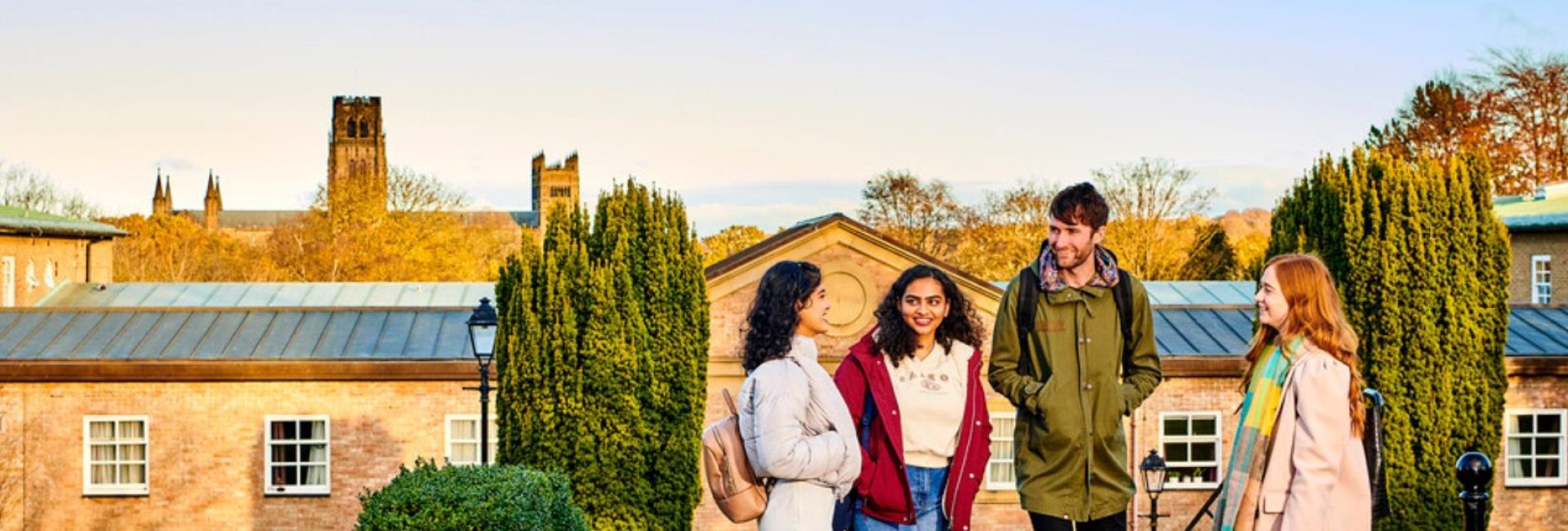
Durham University - Undergraduate Pre-application Open Day
26 Jun 2026, 08:00
Durham

This degree will equip you with the skills to understand religion and its power to shape the human condition. You will engage with the role of religion in a wide range of contexts, including politics, literature, bioethics and war.
Urgent current ethical questions are studied, and you will be encouraged to arrive at well-informed and reflective positions on topics such as the environmental crisis, end-of-life issues, poverty and warfare.
The course enables you to better understand the world we live in, and to explore the forces that shape our own attitudes, hopes and fears. In turn, it will empower you to go out into the world to make a difference for the common good. You can also apply to add a placement year or a year abroad to your degree, increasing the course from three years to four.
Why Durham University?
The Department of Theology and Religion is an inclusive and friendly international teaching and research community where ‘belief’ and ‘beliefs’ are studied in detail, whether those beliefs are atheistic, humanistic or religious.
With around 50 academics in many different fields, around 100 undergraduates in each year, we are the largest department in the UK, and one of the most varied and dynamic.
We offer a range of activities outside timetabled sessions to complement academic learning: the Department has an extensive series of research-related activities which you are encouraged to attend. These include several research seminars and public lectures from high-profile guest speakers and visiting scholars.
We have a historic strength in the study of Christian thought, history, practice and texts, while offering strong provision in politics, ethics, non-Christian faith traditions, humanism and atheism.
Rankings
3rd in the UK Times and Sunday Times Good University Guide 2026
5th in the Guardian University Guide 2026
5th in the UK Complete University Guide 2026
Top 100 in the QS World University Rankings 2026
Facilities
Our library facilities are extensive, and the main University library, the Bill Bryson Library, is only the beginning. The Meissen Library is the largest collection of German-language theological materials in Britain.
Some of the College libraries hold theological collections and the Department has some library resources of its own, including Hebrew and Jewish studies. Our neighbour, Durham Cathedral, houses The Sharp Library which focuses on modern and pastoral theology.
The historic library at Palace Green holds the University's Special Collections, including extensive collections of rare books and manuscripts of particular interest to theology and religion students.
Careers Opportunities
Our degrees are designed to give you a strong and broad foundation of subject-specific knowledge as well as transferable skills and personal qualities developed during your studies: thinking clearly, writing well, presenting arguments, analysing texts, assessing evidence, solving problems, pursuing and organising research. These skills are highly valued across many sectors.
Our graduates readily find employment in fields such as education, social work, politics, journalism, business management, banking, the clergy, the performing arts and the charity sector. A significant number also progress onto higher-level study, such as postgraduate study in Theology and Religion or professional qualifications in law and education.
For current information please scroll to the bottom of the page for Provider Information and select Visit our Course Page under Course Contact Details.
Modules are assessed by essays and end-of-year examinations, some by a combination of the two. Forty per cent of your degree will be assessed by coursework.
Our curriculum places a strong emphasis on self-directed learning and you will be provided with reading lists, handouts, suggestions for preparation and other online materials to guide you in your independent research.
In your final year, you will submit a dissertation, which allows you to explore in depth a topic of your choice.
In addition to the help provided by your subject lecturers, you can also access extensive support for your assessments through ASC, the Academic Skills Centre. See below for details: https://www.durham.ac.uk/departments/centres/academic-skills-centre/
This is the equal consideration deadline. You can still apply after this date, but your application may not receive guaranteed consideration.

Durham University has participated in the Teaching Excellence Framework. These ratings were awarded in 2023, for four years.
See why these ratings were awarded
What does this TEF outcome mean?
The following entry points are available for this course:
Discover what it's like to study Religion, Society and Culture at Durham University: insights on the course, making friends, personal statement tips, uni prep, and recommended books, podcasts, and videos.

T levels will be considered on a case-by-case basis where the subject area aligns with the course applied to. Please note that additional A levels or equivalent may be required to study certain courses.
If you’re interested in applying, then please Ask Us and we’ll see if we’re able to consider this for you: www.durham.ac.uk/study/ask-us/
We normally make offers based on Advanced Highers. If you’ve not been able to take three Advanced Highers, then we’ll consider a combination of Advanced Highers and Highers, or just Highers (if your school doesn’t offer Advanced Highers at all).
665 in higher level subjects
Other BTEC level 3 qualifications are also accepted in combination with each other or with other qualifications. See our website for more information on our BTEC qualification equivalencies.
Other level 3 Cambridge Technical qualifications are also accepted in combination with each other or with other qualifications. See our website for more information on our Cambridge technical qualification equivalencies.
If you’re taking other qualifications not listed above, please check our qualification pages to see if we accept these: www.durham.ac.uk/study/undergraduate/how-to-apply/entry-requirements/
If you have a non-standard academic profile, then ask us about it here: www.durham.ac.uk/study/ask-us/ https://www.dur.ac.uk/study/ug/apply/entry/
Acceptable evidence and levels required can be viewed by visiting the link below under English Language requirements. You should be able to demonstrate satisfactory English proficiency before the start of a programme of study, whether via the submission of an appropriate English language qualification or by attendance on an appropriate pre-sessional course. For more information on pre-sessional courses please visit: https://www.durham.ac.uk/study/international/entry-requirements/english-language-requirements/pre-sessional-english-language-required/https://www.durham.ac.uk/study/international/entry-requirements/english-language-requirements/
Contextual Offer:
A level Grades BBB/ABC or equivalent
This section shows the range of grades that students who received offers were previously accepted on to this course with (learn more).
It is designed to support your research but does not guarantee whether you will or won't get a place.
Admissions teams consider various factors, including interviews, subject requirements, and entrance tests. Check all course entry requirements for eligibility.
We are unable to show previous accepted grades for this course. This could be because the course is new, it's a postgraduate course, there isn't enough historical data, or the provider has opted out of sharing their entry grades data for this course - learn more.
| Location | Fee | Year |
|---|---|---|
| EU & International | TBC | |
| England, Scotland, Wales, Northern Ireland, Channel Islands & Republic of Ireland | £10050* |
* This is a provisional fee and subject to change.
Tuition fee status depends on a number of criteria and varies according to where in the UK you will study. For further guidance on the criteria for home or overseas tuition fees, please refer to the UKCISA website.
The tuition fees shown for home students remain subject to parliamentary approval. They are for one complete academic year of full-time study and are set according to the academic year of entry. Durham University will charge home rate tuition up to the maximum allowed by the UK Government. Fees for subsequent years of your course may rise in line with an inflationary uplift as determined by the government.
The tuition fees shown for international and EU students are for one complete academic year of full-time study and are set according to the academic year of entry. Fees are subject to an annual inflationary increase. Tuition fees will rise annually by up to the higher of 6% or the latest annual percentage increase in the Consumer Prices Index.
As a student you may also get involved in optional activities which incur additional costs. To find out more visit https://www.dur.ac.uk/colleges-and-student-experience/additional-charges/.
Durham University offers a range of scholarship opportunities to academically well-qualified and highly motivated students. For further details, including deadlines for application, please visit: https://www.durham.ac.uk/study/scholarships/
Phone:0191 334 1000
The Palatine Centre
Stockton Road
Durham
DH1 3LE
At Durham University