Course contact details
Swansea University Postgraduate
Email:study@swansea.ac.uk
Phone:+44 (0)1792 295358
Swansea University
Singleton Park
Swansea
SA2 8PP

The MSc by Research in Experimental Physics allows you to undertake a year-long individual programme of personally and professionally enriching research. Your experimental physics research project will be shaped by participation in activities such as seminars, workshops, laboratory activity and fieldwork, as well as your involvement in one of our established research groups.
We have three main research groups.
The Atomic, Molecular and Quantum Physics Group (AMQP) is supported by grants from EPSRC, the EU, The Royal Society, the Higher Education Funding Council for Wales and various industrial and government sources.
The areas of research are:
Analytical laser spectroscopy,
Ultrafast Dynamics, Imaging and Microscopy, Optomechanics
Antihydrogen, positronium and positrons
Cold atom physics
Nano-scale physics and the life sciences
The Applied Physics and Materials (APM) Group is supported by grants from the European Union, Welsh Government, National Science Foundation, Australian Research Council, Welsh European Funding Office, and EPSRC.
The areas of research include:
Biophotonics: Nano- and micro-structured materials, biomimetics, analyte sensing and light-tissue interaction
Nanomedicine
sustainable Advanced Materials: next-generation semiconductors, bioelectronic materials and devices, optoelectronics including photodetection, solar energy conversion, advanced electro-optics and transport physics of disordered solids
The Particle Physics and Cosmology Theory (PPCT) Group is one of the five largest particle physics groups in the UK. It is supported mainly by STFC, but also has grants from EPSRC, the EU, the Royal Society and the Leverhulme Trust.
The areas of research include:
Amplitudes in gauge and supergravity theories
Hot and Dense matter, High-performance computing
Gauge/string duality, Higher spin holography, Integrability, Large-N gauge theories, supersymmetry and duality
Holography and lattice theories in physics beyond the Standard Model
Quantum fields in curved spacetime and theoretical cosmology
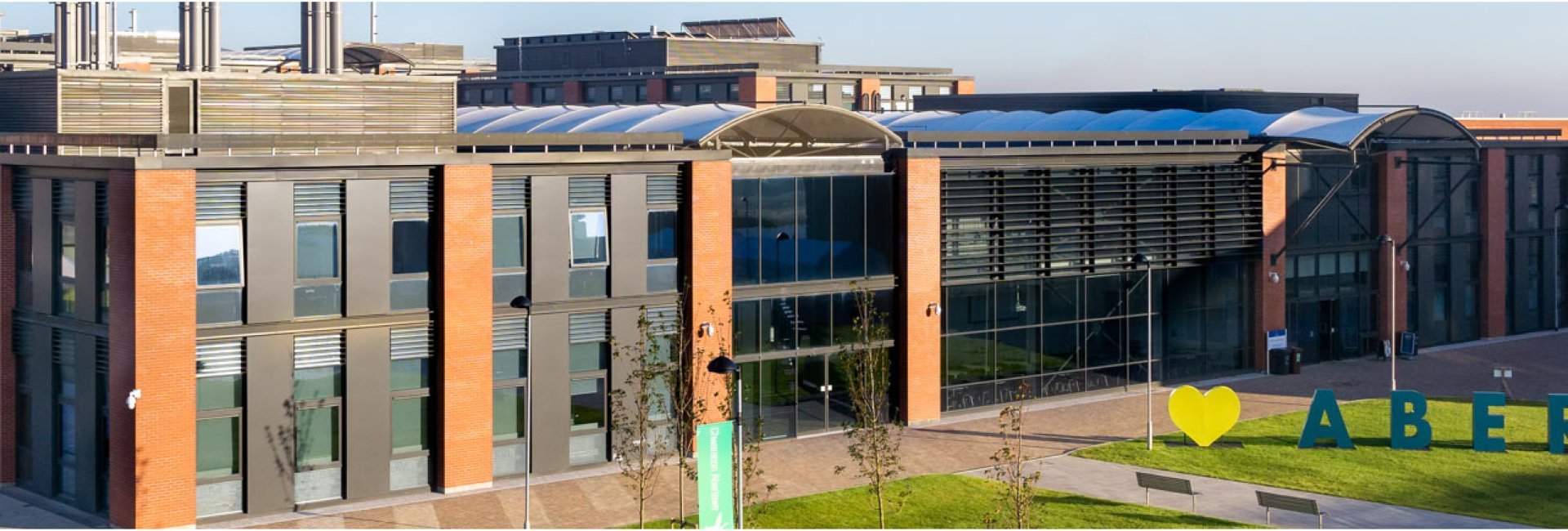
From September 2027, the Physics Department will be based at the Bay Campus, where all Physics programmes will be taught, benefitting from our advanced research laboratories and state-of-the-art facilities.
Discover what it's like to study Experimental Physics at Swansea University: insights on the course, making friends, personal statement tips, uni prep, and recommended books, podcasts, and videos.

Select a course option at the top of this page to view entry requirement information.
Choose a specific option to see funding information.
Course optionsEmail:study@swansea.ac.uk
Phone:+44 (0)1792 295358
Singleton Park
Swansea
SA2 8PP
At Swansea University