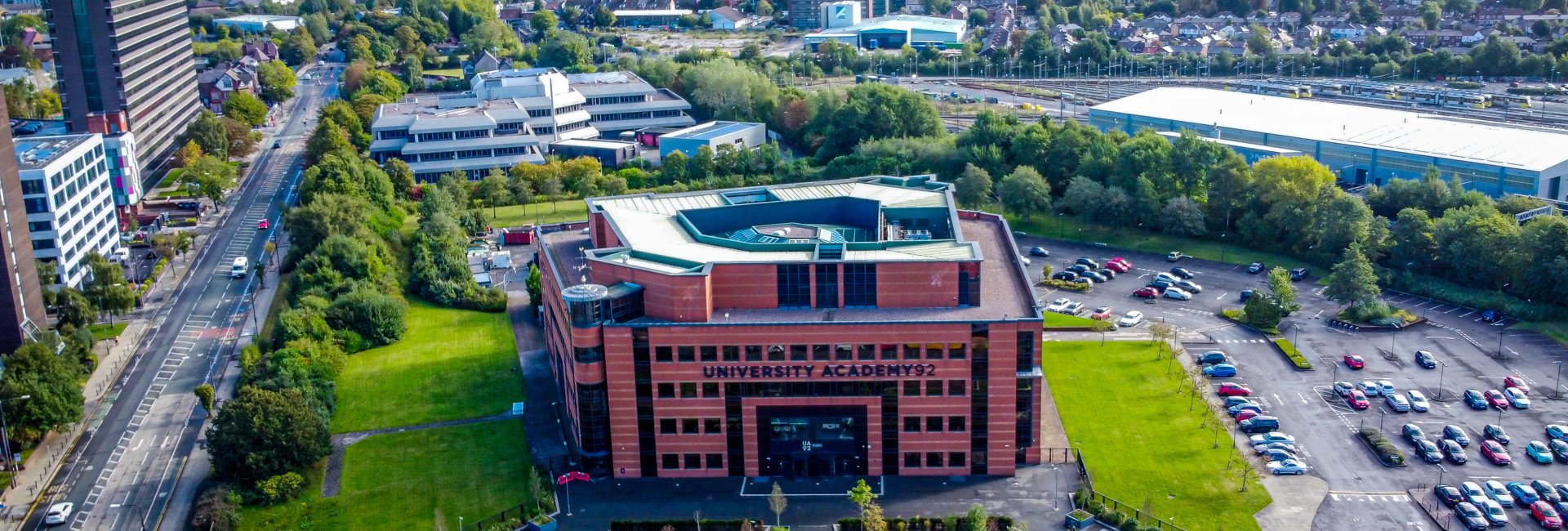
Course contact details
Student Futures Team
Email:futures@ua92.ac.uk
Phone:0161 507 1992
University Academy 92 (UA92)
UA92 Campus
Talbot Road
Trafford
Manchester
M16 0PA

The BA (Hons) Sports Journalism degree will give you the skills and knowledge to craft compelling sports stories. From breaking news coverage to in-depth editorial pieces, you will develop the technical expertise to deliver engaging content.
Learn what it means to be a sports journalist and operate professionally within the relevant laws, regulations and codes of practice. Develop your investigative, analytical and creative skills and understand how to harness data to back-up your stories. You’ll also develop your practical skills in interviewing, presenting, editing and reporting.
Our teaching team has lots of experience working for top-name broadcasters like BBC Sport and CNN, so you’re definitely in good hands! Plus, our industry connections mean you’ll meet some amazing people and begin to build your professional network.
So, if you are looking to study a sports journalism course in Manchester, our 3-year BA (Hons) Sports Journalism degree is the perfect choice for you.
As a Sports Journalism graduate, you’ll be ready to take on the opportunities and tackle the challenges of the fast-paced field of sports media. Whether you dream of becoming a broadcast journalist, news editor, TV producer, content creator, copywriter or public relations officer, a career in sports journalism has so many options.
Sports journalism offers some of the most creative and rewarding careers in the media, with some of the most engaged and passionate audiences in the world. As well as creative and fulfilling work, sports journalists often enjoy travel, flexibility and high-earning potential.
If you are passionate about sports and have a flare for storytelling, this is your opportunity to become the next leading voice in sports journalism.
Alongside your course modules, you will engage with the 92 Programme, which is built into every degree and tailored to each subject area.
Engaging with the 92 Programme is a requirement for all students and will count towards your overall grade.
Through taught sessions, immersive experiences and coaching, you will build confidence, resilience, wellness, self-reflection and professionalism, skills designed to support your future success.
Module 1 - Media, Technology and Culture
You’ll reflect on your own media usage, explore how rapid changes in information and communication technologies shape other social, economic and cultural transformations and consider issues of media production, dissemination and reception.
Module 2 - Communication Techniques and Creating Content
You’ll explore a range of visual and audio storytelling techniques to produce content and explore the best ways to present your work.
Module 3 - Media Production
You’ll develop practical media skills, working individually and collectively using different digital tools (including cameras, audio equipment, editing software), and learn to display your work online in a professional context.
Module 4 - Introduction to Sports Journalism
You’ll explore the key principles of sports journalism and get to grips with the ethical standards and professional codes to which sports journalists must adhere. You’ll gain an understanding of what sports journalists do and learn mobile digital tools to help your digital storytelling.
Module 1 - Sports Journalism and Broadcasting
You’ll look at case studies of different journalistic roles in sports, developing a personal career plan and identifying the key skills and experience required. You’ll engage in practical sports journalism to showcase your skills and present your work in a professional context.
Module 2 - Media Narratives
You’ll explore how to communicate stories in a non-linear, online environment, examine digital narratives and learn how to create stories using different narrative structures and understand how digital technologies, immersive media and interactivity, have reconfigured media experiences and the news.
Module 3 - Audio and Video Production
You’ll further develop your video and audio production skills, working to create sophisticated media artefacts for commercial clients, building on communication and research skills from concept to delivery.
Module 4 - News journalism
You’ll explore how ‘news’ is identified, gathered, researched, authenticated, recorded, and presented. You’ll produce engaging news reporting on a variety of topics and develop your journalism skills and understanding of a ‘newsroom’ environment.
Module 1 - Media Law and Ethics
You’ll gain an in-depth knowledge of the legal, ethical and regulatory constraints that exist within the media industries. Focusing on a UK context, you’ll explore some of the key tensions that determine the media coverage of events and get to grips with relevant laws, regulations and professional codes of conduct.
Module 2 - Advanced Sports Journalism
You’ll further refine your reporting, editorial and presentation skills by undertaking an advanced journalistic project focused on the world of sport. You’ll advance your interviewing and writing techniques and explore feature writing and long-form journalistic storytelling.
Module 3 - Data journalism
You’ll explore the increasingly important role numerical data plays in contemporary journalism, increase your data awareness, design skills and knowledge of data journalism and consider how data can be used and visually understood by your audience.
Module 4 - Final Project
You'll complete a project, on a relevant subject area that demonstrates your research, problem-solving and practical skills.

University Academy 92 (UA92) has participated in the Teaching Excellence Framework. These ratings were awarded in 2023, for four years.
See why these ratings were awarded
What does this TEF outcome mean?
This course may be available at alternative locations, please check if other course options are available.
Course optionsIn addition to meeting the academic criteria, if your first language isn't English, you will be asked for a recognised English Language qualification. Acceptable English Language Qualifications and required grades can be found below. IELTS Academic (UKVI Approved) - 6.5 with no score lower than 5.5 IELTS Academic (Other centres) - 6.5 with no score lower than 5.5 ToEFL IBT - 87 overall, minimum of 17 in listening, 18 in reading, 17 in speaking and 20 in writing ToEFL IBT Special Home Edition - 87 overall, minimum of 17 in listening, 18 in reading, 17 in speaking and 20 in writing Cambridge English: Advanced CAE - 176 overall with at least 162 in each element Cambridge English: Proficiency (CPE) - 176 overall with at least 162 in each element PTE - 59 with no score lower than 59 LanguageCert English Language - B2 Communicator with 39 in each skill area Common European Framework - B2 International Baccalaureate (IB) Standard Level English Language Syllabus - Grade 5 or above International Baccalaureate (IB) Higher Level English Language Syllabus - Grade 4 or above Trinity College London – Integrated Skills in English - ISE II - Pass GCSE/ IGCSE/ O Level English - Grade C/4 If you are an international student, in order to obtain a student visa, you will be required to demonstrate that you have the correct level of English language competency to study in the UK.
This section shows the range of grades that students who received offers were previously accepted on to this course with (learn more).
It is designed to support your research but does not guarantee whether you will or won't get a place.
Admissions teams consider various factors, including interviews, subject requirements, and entrance tests. Check all course entry requirements for eligibility.
This course may have Historical entry grades data available, please select a course option to view.
Course optionsThis report uses your grades to show how students with similar results have done when applying to this course in the past. Sometimes, there isn’t data for every possible set of grades. When that happens, universities and colleges occasionally fill in the gaps for sets of grades that are typically accepted.
| Location | Fee | Year |
|---|---|---|
| England, Scotland, Wales & Northern Ireland | £9790 | |
| EU & International | £17728 |
Tuition fee status depends on a number of criteria and varies according to where in the UK you will study. For further guidance on the criteria for home or overseas tuition fees, please refer to the UKCISA website.
UA92 will review tuition fees each year. For UK students if Parliament permits an increase in tuition fees, UA92, along with other HEIs in England, may increase fees each year using RPI-X, subject to the maximum fee limits set out in regulations
Email:futures@ua92.ac.uk
Phone:0161 507 1992
UA92 Campus
Talbot Road
Trafford
Manchester
M16 0PA
At University Academy 92 (UA92)