Course contact details
BSMS Admissions
Email:medadmissions@bsms.ac.uk
Phone:01273 646444
Brighton and Sussex Medical School
Medical Teaching Building
University of Sussex
Falmer
BN1 9PX

At BSMS, we combine proven, traditional methods with the latest innovations in teaching and research. We offer a distinctive and innovative course that prepares its graduates to enter an ever-changing and developing world of healthcare.
On our course, you'll have early clinical contact with patients and carers, and interactions with health professionals in hospital and community settings. This helps you build crucial interpersonal, teamworking and communication skills. You'll also develop the essential knowledge underpinning clinical practice in medicine with anatomy taught by full cadaveric dissection, allowing you to turn theory into reality.
As a graduate, you'll be well prepared to enter the ever-changing and developing world of healthcare – you'll be ready to make your mark locally, nationally and internationally. At BSMS, you learn all of the science and practical skills you need to be a highly professional and accomplished doctor. We also excel at helping you to develop the personal skills and attributes that make you an effective, person-centred medical professional.
You’ll discover that everything we do here is patient centred. We are committed to instilling a strong sense of professionalism in our graduates, both in relation to their patients and their peers. With our support and guidance you can become the doctor you need to be.
The academic year
The teaching year is extended to around 40 weeks, with short breaks at Christmas and Easter and a longer break in the summer.
Year 3
Year 3 starts with a two-week course introducing you to clinical medicine as it is practised in secondary care.
At the heart of Year 3 are ward-based attachments including:
General Medicine, Acute Medicine and Cardiology
Elderly Medicine and Psychiatry
Surgery, including Perioperative Medicine, Emergency Medicine, Orthopaedics and Urology
In Year 3, you will consolidate your increasing clinical experience with an understanding of the underlying clinical, social science and public health issues through weekly teaching sessions in the Scientific Basis of Medicine module. This module also consolidates and expands your research skills in preparation for your Individual Research Project in Year 4.
You will learn about cutting-edge developments in areas such as genetics, immunology, infectious diseases and therapeutics and gain further experience in safe prescribing of drugs, an essential skill for your medical career. You will also continue the Time for Dementia programme and attend regular meetings with your tutor, which will support your personal and professional development via your e-portfolio.
Where will I study?
From Year 3, you will be based in hospitals across Sussex and Surrey. Much of the teaching takes place in Brighton at the Royal Sussex County Hospital and the Audrey Emerton Building (AEB), which provides comprehensive learning facilities, including a fully stocked medical library, computer suites, a clinical skills training area, teaching rooms for large and small group study and a top-floor restaurant with panoramic sea views. Most placements outside Brighton of four weeks or more are residential, to allow you to be fully immersed in the partner hospital team.
You will maintain an individual e-portfolio that is similar to the one you will use as a junior doctor, which help you reflect on how your personal strengths are developing along with your clinical skills and experience.
Intercalation
The intercalated degree is an optional addition to a medical degree. Subject to performance, you may have the opportunity to undertake an intercalated BSc or Masters degree, between Years 3 and 4.
Please note, intercalation numbers are capped at 40% of the total cohort, with priority given to those without a prior degree.
Read More about intercalation >
Year 4
During this year you will also undertake a rotation of clinical placements in the specialist subjects of
General Practice
ENT, Ophthalmology and Neurology
Infectious Diseases, Microbiology and Sexual Health
Rheumatology and Dermatology
Oncology, Haematology and Palliative Care
Obstetrics and Gynaecology
Paediatrics
The clinical focus in Year 4 is on understanding how primary, community and secondary care structures work together to integrate care for the patient. You will also participate in Time for Autism and complete a year-long Individual Research Project, supervised by a university or hospital team.
“Now have a better understanding of autism as I had no experience before. Feel more comfortable talking to autistic patients.”
Find out more about Time for Autism >
Where will I study?
Students are likely to spend most of this year in Brighton but with periods of between one to five weeks at our partner hospitals across West and East Sussex.
The academic year
You will start the year by undertaking a 15-week placement at one of our regional centres in West Sussex, East Sussex or Redhill. During this time you will rotate around a range of disciplines.
Your learning will be based on close involvement with routine clinical cases, acting as a member of the clinical team in medicine, emergency medicine, elderly medicine, surgery and psychiatry.
At the start of Year 5 you will also apply for your Foundation Year training posts, and later in the year take the national Situational Judgement Test and Prescribing Safety Assessment.
Preparation for foundation programme
After finals you will join a clinical team at one of our partner hospitals, working closely with junior doctors to complete the preparation for foundation programme module (Foundation 0). This eight-week placement is designed to prepare you for the role of foundation doctor.
Electives
Towards the end of Year 5, you will undertake an elective period to gain clinical or non-clinical experience in another environment in the UK or abroad.
Preparing for Foundation Year training
A series of presentations will be given in Years 4 and 5 to help you prepare for the application process and your Foundation training.
Although the first year of registration can be taken anywhere in the country, many BSMS graduates choose to stay in the Brighton or Sussex area where they can take advantage of the postgraduate training and support offered by the medical school.
BSMS and Health Education England South East (HEE SE) jointly oversee the Academic Training Programme. The programme is aimed at doctors who are considering an academic career in medicine.
READ MORE ABOUT ACADEMIC TRAINING >
You will study the normal and abnormal functioning of the human body using a system-based approach, with integrated modules covering the core biomedical and psychosocial sciences. Student-Selected Components (SSCs) allow you to undertake individual studies and explore selected topics in depth, informed by the latest research.
Weekly clinical symposia, focusing on specific medical problems or diseases, emphasise the importance of problem-solving and the integration of clinical and scientific information from different disciplines. There is an emphasis throughout on small group teaching, in addition to core lectures and symposia, with most Year 1 and 2 classes in small groups.
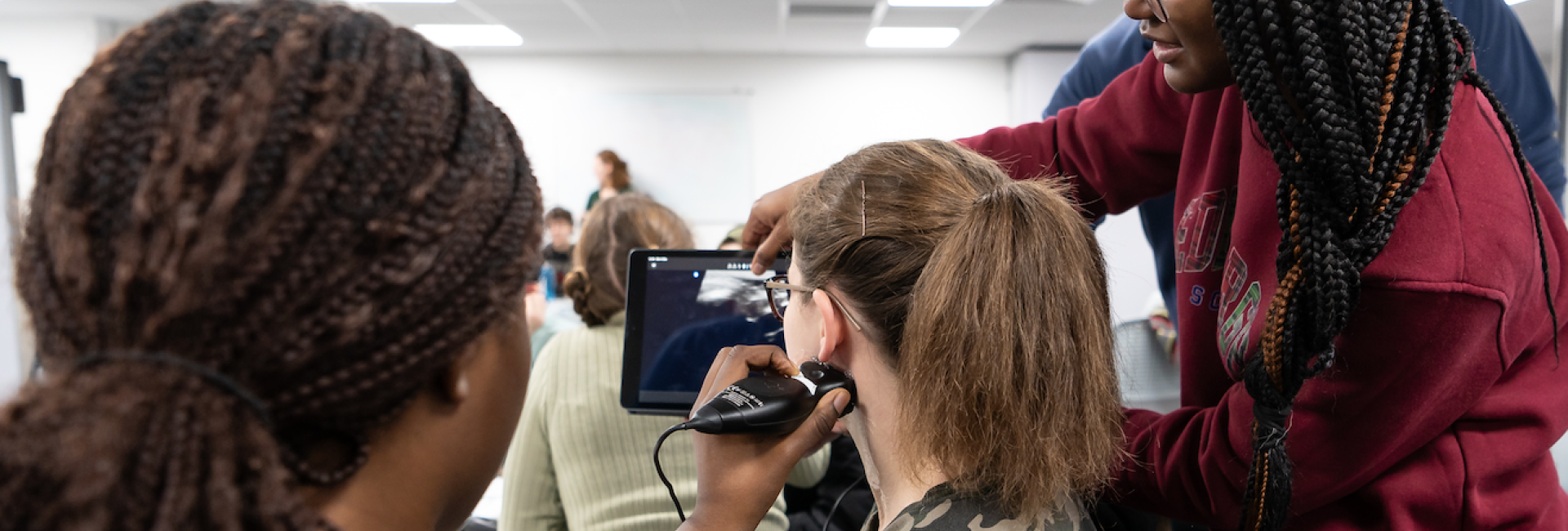
Your anatomy study will explore the human body and its relevance to clinical practice. This will include a combination of cadaveric dissection, prosection, living anatomy, ultrasound sessions, and virtual and augmented reality.
The academic year
The academic year is between 32 and 34 weeks, and is organised into three terms. About 20% of your learning at this stage will be clinically based and will include gaining experience in hospitals and primary and community care.
Developing clinical skills from day one
You will start to develop clinical skills in history taking, physical examination, diagnosis and effective communication with patients in a classroom setting and by gaining experience in primary, secondary and community care placements. For example, you may spend time learning from a family with a new baby (Year 1) and with a patient with dementia or a chronic health condition (Years 2 and 3).
You will also spend time with a person living with dementia and their carer in our award-winning Time for Dementia programme. Find out more about the programme here >
BSMS has an integrated curriculum designed to develop your knowledge, academic and clinical skills, and instil a professional approach throughout the degree; the variety of assessment methods used reflects this.
Individual module assessments vary from single best answer questions that assess knowledge and understanding, to the practical assessment of communication and clinical skills, and case presentations.
Formal assessments occur throughout the course. Each includes elements that test the integration of your clinical experience with your understanding of the underlying biomedical, clinical and social sciences. These include the reports from your family studies, your patient portfolio and your research project.
A range of other assessments are also conducted during the course, primarily to guide you in your learning. Your personal development portfolio, recording the skills and experience you have gained, will also form part of your assessment, in line with General Medical Council recommendations.
Types of assessments
>Case-based discussion
A time-limited oral presentation of a case you have seen on placement to a panel of examiners. The presentation must cover history and examination findings, discussion of differential diagnoses and the management plan. The presentation will include time for questioning / discussion from the examiners.
>Presentation
A verbal presentation about a topic that students have researched. The content and length will vary depending on the specific module assessment. This can include using written and online tools.
>Case in depth
A formal structured written report on a case you have seen on placement. The Case in Depth covers the history, examination, investigations undergone and treatment of the patient and focuses on the clinical decision making and evidence base for treatment alongside the ethical and communication issues of the case.
>Speciality sign off report/logbook/attendance
At the end of each placement you will be assessed by your supervisor on the following areas: attendance, involvement with team and team activities and professionalism whilst on placement.
>OSCEs (Observed Structured Clinical Examinations)
Practical examinations that test clinical skills. During an OSCE students are observed in a series of ‘stations’; scenarios based on activities that would take place in a clinical setting such as taking a patient’s medical history, examining patients or interpreting scans / test results or even a combination of these activities. Some OSCE stations will use real patients or actors playing patients.
>Knowledge test
A time limited multiple choice examination.
Professionally accredited courses provide industry-wide recognition of the quality of your qualification.
The following entry points are available for this course:
| Test | Grade | Additional details |
|---|---|---|
| IELTS (Academic) | 7 | 7.0 in all sections |
This section shows the range of grades that students who received offers were previously accepted on to this course with (learn more).
It is designed to support your research but does not guarantee whether you will or won't get a place.
Admissions teams consider various factors, including interviews, subject requirements, and entrance tests. Check all course entry requirements for eligibility.
We are unable to show previous accepted grades for this course. This could be because the course is new, it's a postgraduate course, there isn't enough historical data, or the provider has opted out of sharing their entry grades data for this course - learn more.
This report uses your grades to show how students with similar results have done when applying to this course in the past. Sometimes, there isn’t data for every possible set of grades. When that happens, universities and colleges occasionally fill in the gaps for sets of grades that are typically accepted.
| Location | Fee | Year |
|---|---|---|
| England, Scotland, Wales & Northern Ireland | £10050* | |
| International | £51450* |
* This is a provisional fee and subject to change.
Tuition fee status depends on a number of criteria and varies according to where in the UK you will study. For further guidance on the criteria for home or overseas tuition fees, please refer to the UKCISA website.
No additional fees or cost information has been supplied for this course, please contact the provider directly.
Email:medadmissions@bsms.ac.uk
Phone:01273 646444
Medical Teaching Building
University of Sussex
Falmer
BN1 9PX
At Brighton and Sussex Medical School