Course contact details
Recruitment and Admissions Office
Phone:0191 334 1000
Durham University
The Palatine Centre
Stockton Road
Durham
DH1 3LE

Course details
The History programme at Durham is designed to give you a sense of the diversity of human experience - geographically and chronologically. Right from the start of your degree you will learn about a very broad range of places and different time periods. You can also explore diverse themes, concepts, methods, and approaches, such as environmental and scientific history, visual cultures, and gender and sexuality. Since our academics have expertise in a tremendous variety of fields, you will be supported in developing your own specialist historical interests and the skills necessary actively to research these yourself. The course will also equip you with problem solving and presentation skills that are valuable in many careers.
Throughout your degree, you will be encouraged to attend an extensive programme of activities, including research seminars and public lectures from high-profile guest speakers.
Why Durham University?
The History degree at Durham is designed to give you a sense of the diversity of human experience – geographically and chronologically. We offer an unusually broad range of options that will take you to very different places and times.
We offer an unusually broad range of options that will take you to very different places and times. You can also explore diverse themes and approaches, such as environmental and scientific history, visual cultures, and gender and sexuality.
You can also explore diverse themes and approaches, such as environmental and scientific history, visual cultures, and gender and sexuality. The course will equip you with critical and presentational skills that are valuable in many careers.
Facilities
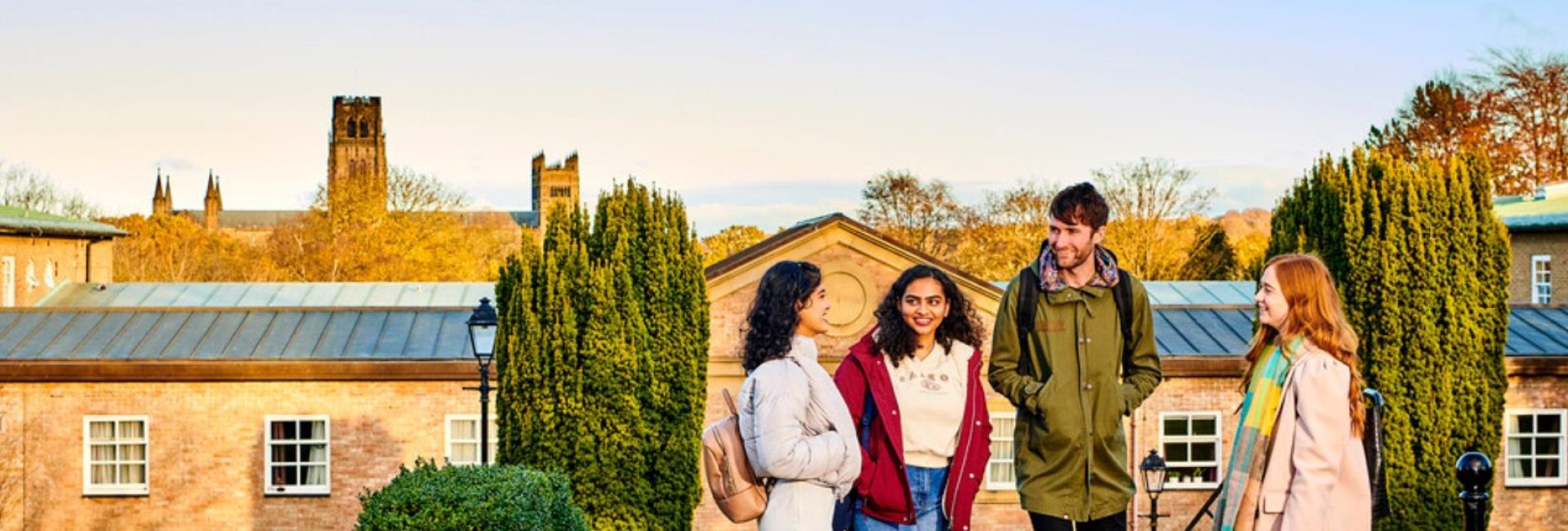
The Department of History occupies the heart of Durham World Heritage Site. Our location is within easy reach of all University colleges, lecture halls and libraries.
Our work incorporates everything from manuscripts to photography, printed sources to museum collections. You will work with staff on a rich array of primary sources, which range from medieval manuscripts in the cathedral archive, through the ceramics, prints and textiles held by the Oriental Museum, to the documents of the Sudan Archive, and more. Durham holds historical resources of international significance.
Rankings
3rd in the UK Times and Sunday Times Good University Guide 2026
5th in the Guardian University Guide 2026
5th in the UK Complete University Guide 2026
Top 100 in the QS World University Rankings 2026
Career Opportunities
Our aim is to make you better at thinking, speaking, and writing for yourself; and better at critically assessing the words that others speak and write. Thinking analytically, arguing clearly and concisely - these are fundamental skills in many jobs.
Our graduates have gone on to find successful careers in a wide variety of fields. They work in teaching at schools and universities, in museums and galleries, in law, finance, banking and accountancy, the Civil Service, the charity sector, media, journalism, and the military and further study.
Durham Education 2027
The University is committed to continuous improvement and is currently undertaking a review to enhance our courses. As we make updates, some details of courses advertised for 2027 entry may change. These enhancements are being developed in consultation with students and in response to student feedback. We will not be making changes to degree subjects, academic standards or the broad concepts that will be taught, but to how courses are organised. In some cases this may mean that the balance of compulsory and optional modules may change. Any updates will be communicated transparently and by the end of summer 2026, ensuring applicants know exactly what to expect from their chosen degree.
For current module information please visit our course page.
https://www.durham.ac.uk/study/courses/history-v100/september-2027/
The History degree involves coursework and examinations. In each year of the programme, you will have to do some of both – though coursework is the larger part of the assessment. There is also an assessed spoken presentation in the second year, because we think it is important that we develop and test your skills in talking to an audience.
This is the equal consideration deadline. You can still apply after this date, but your application may not receive guaranteed consideration.

Durham University has participated in the Teaching Excellence Framework. These ratings were awarded in 2023, for four years.
See why these ratings were awarded
What does this TEF outcome mean?
The following entry points are available for this course:
Discover what it's like to study History at Durham University: insights on the course, making friends, personal statement tips, uni prep, and recommended books, podcasts, and videos.

We welcome enquiries regarding applications for deferred entry which may be considered in special circumstances. Please contact us using www.durham.ac.uk/study/askus/
Ancient History is not accepted in lieu of History but can be one of your other subjects taken. https://www.dur.ac.uk/study/ug/apply/entry/
Acceptable evidence and levels required can be viewed by visiting the link below under English Language requirements. You should be able to demonstrate satisfactory English proficiency before the start of a programme of study, whether via the submission of an appropriate English language qualification or by attendance on an appropriate pre-sessional course. For more information on pre-sessional courses please visit: https://www.durham.ac.uk/study/international/entry-requirements/english-language-requirements/pre-sessional-english-language-required/https://www.durham.ac.uk/study/international/entry-requirements/english-language-requirements/
Our contextual offer for this programme is A level AAB (or equivalent) including History at grade B. To find out if you’re eligible, please visit https://www.durham.ac.uk/study/undergraduate/how-to-apply/what-happens-to-your-application/contextual-offers/.
This section shows the range of grades that students who received offers were previously accepted on to this course with (learn more).
It is designed to support your research but does not guarantee whether you will or won't get a place.
Admissions teams consider various factors, including interviews, subject requirements, and entrance tests. Check all course entry requirements for eligibility.
We are unable to show previous accepted grades for this course. This could be because the course is new, it's a postgraduate course, there isn't enough historical data, or the provider has opted out of sharing their entry grades data for this course - learn more.
This report uses your grades to show how students with similar results have done when applying to this course in the past. Sometimes, there isn’t data for every possible set of grades. When that happens, universities and colleges occasionally fill in the gaps for sets of grades that are typically accepted.
| Location | Fee | Year |
|---|---|---|
| EU & International | TBC | |
| England, Scotland, Wales, Northern Ireland, Channel Islands & Republic of Ireland | £10050* |
* This is a provisional fee and subject to change.
Tuition fee status depends on a number of criteria and varies according to where in the UK you will study. For further guidance on the criteria for home or overseas tuition fees, please refer to the UKCISA website.
The tuition fees shown for home students remain subject to parliamentary approval. They are for one complete academic year of full-time study and are set according to the academic year of entry. Durham University will charge home rate tuition up to the maximum allowed by the UK Government. Fees for subsequent years of your course may rise in line with an inflationary uplift as determined by the government.
The tuition fees shown for international and EU students are for one complete academic year of full-time study and are set according to the academic year of entry. Fees are subject to an annual inflationary increase. Tuition fees will rise annually by up to the higher of 6% or the latest annual percentage increase in the Consumer Prices Index.
As a student you may also get involved in optional activities which incur additional costs. To find out more visit https://www.dur.ac.uk/colleges-and-student-experience/additional-charges/.
Durham University offers a range of scholarship opportunities to academically well-qualified and highly motivated students. For further details, including deadlines for application, please visit: https://www.durham.ac.uk/study/scholarships/
Phone:0191 334 1000
The Palatine Centre
Stockton Road
Durham
DH1 3LE
At Durham University