How to choose the right university course
Current students give their tips on how to decide which course is right for you.
Are you stuck deciding which subject, course type, or uni or college is right for you? Read on for our tips and advice on tackling this big decision.
Current students give their tips on how to decide which course is right for you.
It’s important you choose a subject you enjoy and will help you reach your goals. Here are some things to help you choose the right subject for you:
UK degree courses tend to be very specialised from day one, allowing students to focus on their chosen subject. However, there are others that allow you more flexibility in what you study. Make sure you read the course descriptions carefully, and click through to university websites for further information.

To increase your chances of getting a place on a course we give you the option of applying to up to five courses at once, usually all in a similar subject so that your application is relevant to all of them.
Please note, there are a couple of restrictions though:

UCAS Discovery exhibitions bring together over 100 unis, colleges and apprenticeship employers with all the experts you need to help you shortlist your options.
After leaving school, most students going onto university or college study for an undergraduate degree. These are usually made up of modules (some compulsory and some optional) that add up to a full degree.
Here are some examples of the types of undergraduate courses you can do.
Bachelor degrees usually last either three or four years if studied full-time (although some courses are longer). You can concentrate on a single subject, combine two subjects in a single course (often called dual or joint honours courses), or choose several subjects (combined honours). Most courses have core modules which everyone studies, and many courses allow you to choose options or modules to make up a course that suits you.
Some bachelor degrees offer a sandwich year, involving an additional placement or year in industry, which forms part of the course. If you're an international student, you'll need to check you're eligible to work in the UK, or that your visa allows you to do a placement course. Most international students on a tier 4 visa will be eligible for a year in industry or work placements as part of their course, but there may be some conditions. Check with the university or college before making this choice in your application. You can find out more on the UKCISA website.
There are also courses which include postgraduate-level study, known as integrated master's. Integrated master's being at undergraduate level, then continue for an extra year (or more) so you're awarded a master's degree at the end. These are most common in engineering or science subjects. If you're interested in an integrated master's, you'll need to include the term 'master's' when using the UCAS search tool.
Some degrees offer a foundation or qualifying year as the first year, sometimes called ‘year zero’. They are generally one year, full-time courses delivered at a university or college, and can be offered as a 'standalone' course, or as part of a degree. You'll still be treated as a full-time undergraduate student.
Foundation years are designed to develop the skills and subject-specific knowledge required to undertake a degree course, and specialise in a subject area.
If your grades weren’t suitable, or you studied combinations of subjects at school or college that mean you don’t meet the entry requirements for your chosen course, a foundation year could be perfect. Not all universities and colleges offer foundation years.
Most students who take a foundation year choose to stay at the same university or college to complete their full degree, but it may be possible to apply for a full-time degree course elsewhere if you complete the course successfully. You will need to check this with the individual universities and colleges concerned. You will also pay tuition fees for your foundation year.
If you're interested in a foundation year, you'll need to include this in the undergraduate keyword field in the UCAS search tool.
This one-year qualification – often shortened to ‘Art Foundation’ – is widely recognised as a primary route to gain entry to some of the most prestigious art and design degree courses. The learning is tailored to a student’s specific area of art and design subject interest, so they can progress to study that area at degree level. For funding purposes, this course is classified as a further education course, so student loans (for tuition and living costs) are not available, even if you take the course at a university or college. However, UK/EU students under the age of 19 on 31 August of the year of entry will not be charged a tuition fee. As a result, many students choose to take this course straight after school or college, in their home town or city.
Foundation degrees are usually two-year courses (longer if part-time), that are equivalent to the first two years of an undergraduate degree. They are not the same as a foundation year.
These can be a good destination for school leavers at 18, as they offer a qualification that can help gain degree entry. This route is a good option for students who need a course with lower entry requirements and fewer examinations, would prefer a vocational degree/to study while they work, or are not yet ready to commit to three years at university.
Foundation degrees often combine academic skills and knowledge with workplace performance and productivity. They may have been designed in partnership with employers, and therefore focus on a particular job role or profession, enabling you to gain professional and technical skills to further your career. They can be used as a standalone qualification for employment, but are more commonly used as the basis for progression to a final ‘top-up’ year, leading to a full bachelors degree. The final year may be taken at a different university or college.This is a new type of higher level apprenticeship, which can lead to a bachelors degree as part of an apprenticeship. It is important to check the full details of a given job and apprenticeship with the employer and training provider. These courses are a good fit for students who want to gain work experience rather than studying full-time at university, but would like to achieve the same degree status.
Students need to be highly committed – competition can be fierce and entry qualifications can be high. If you’re considering this option, you may want to keep your options open by making an application to a full-time bachelors degree through UCAS at the same time.
The Higher National Certificate (HNC), a one-year work-related course, is equivalent to the first year of a university degree programme. The Higher National Diploma (HND) is a two-year, work-related course, which is equivalent to the first two years of a bachelors degree. As with a foundation degree, it is possible to progress from these courses to complete a full bachelors degree at a university, either through a specific top-up course, or by directly entering a degree in year three.
If you wanted to study a degree in stages, or exit after one or two years of study, the following qualifications may also be suitable. They don’t directly lead to a degree, but you may be able go on and join the second or third year of a full degree (perhaps at the same university/college, or elsewhere) if you change your mind and want to graduate with a bachelors degree after all.
Higher Technical Qualifications are being introduced in 2022. They are either new or existing Level 4 and 5 qualifications (such as HNDs/foundation degrees/Diploma HE).
Higher Technical Qualifications are for students over 18 who want to study a subject to prepare them for skilled jobs, and also for adults looking to retrain or upskill. They’ve been developed by awarding bodies with employers, so you’ll get the right training, knowledge, and skills to succeed in the workplace – and might suit you if you want a more practical, employer-led programme.
If you need a visa to study in the UK, you need to check your visa status allows you to do a part-time course, and/or work in the UK. Check if you need a visa and find out if you’re eligible to work on UKCISA's ‘Can you work?’ website.

As well as university and college courses, you can also choose to study at a UK conservatoire. Courses at conservatoires are more performance-based than you will find at a uni or college. Conservatoires offer courses in music, dance, drama, and musical theatre.
Most students study undergraduate courses full-time, however this is not the only way. There are lots of different modes of study, designed to fit around your own circumstances.
Many universities and colleges offer part-time degree courses, which are normally taken over a longer period, so you can learn at a more relaxed pace, or work (if eligible) alongside your studies.
There are some real benefits to studying part-time:
Doing it part-time made me a better student – I was more determined and focused as it made me think 'this is my money and time, and I mustn't waste it'.
Tom Yates, BA English, Birkbeck, University of London
The flexibility of the evening lectures was an attraction to me in choosing a place of study. Without this flexibility, I wouldn't have been able to work and fund my course.
Imogen Aylen, BSc Psychology, Birkbeck, University of London
You will find some part-time degree courses advertised in the UCAS search tool and some on university or college websites. Applications for part-time courses are usually made directly to the university or college.
Distance learning means studying remotely, allowing you to learn in your own time. Blended learning combines face-to-face sessions with online learning, giving a good mix of learning from the experts and teaching yourself, with course materials available online.
Your course activities and assignments will be supported by a range of online learning resources, with regular support from your tutor, interacting with fellow students via email, online forums, phone, and virtual conferencing.
Courses often include day schools or residential weekends where you work with other students on a specific project, followed by continued contact with the team as you work together, resulting in another residential where results are presented and assessed.
You will find some distance and blended courses advertised in the UCAS search tool and some on university or college websites. UCAS does not provide a central admissions service for distance or blended learning – you will need to apply directly to the university or college to be considered for the programme.
Accelerated degrees are offered by some universities and colleges, in some subject areas. Students on accelerated degrees undertake the same course content as students on typical degrees, but complete their degrees one year sooner. For example, accelerated degree students can complete the full content of a typical three-year degree, but graduate in two years.
If you are employed in the UK, it is also possible to study in the workplace. Some course providers partner with official organisations to create customised programmes – right through from a Certificate to a doctorate-level qualification. For example, the Royal Institute of British Architects (RIBA) offers a flexible study programme for those already working in the industry who want to qualify officially.
Higher and degree apprenticeships could also be an option for work-based learning – find out more about apprenticeships.
Some students set their heart on a particular university, while others just want to choose the course they like the sound of best. Either way is fine, but make sure you do your research, as changing your university or college once you’ve started isn’t always easy.
Find the right accommodation. Finding somewhere you'll be happy to live is an important consideration when you're deciding where you want to study. To help you make the right choice, read our accommodation advice.
You could choose to study at a UK higher education college instead of a university – find out more.
Here are our top tips to help you when choosing where to study:

If you find yourself torn between a few different universities, you may also find it helpful using Unibuddy to speak to some of their current students:
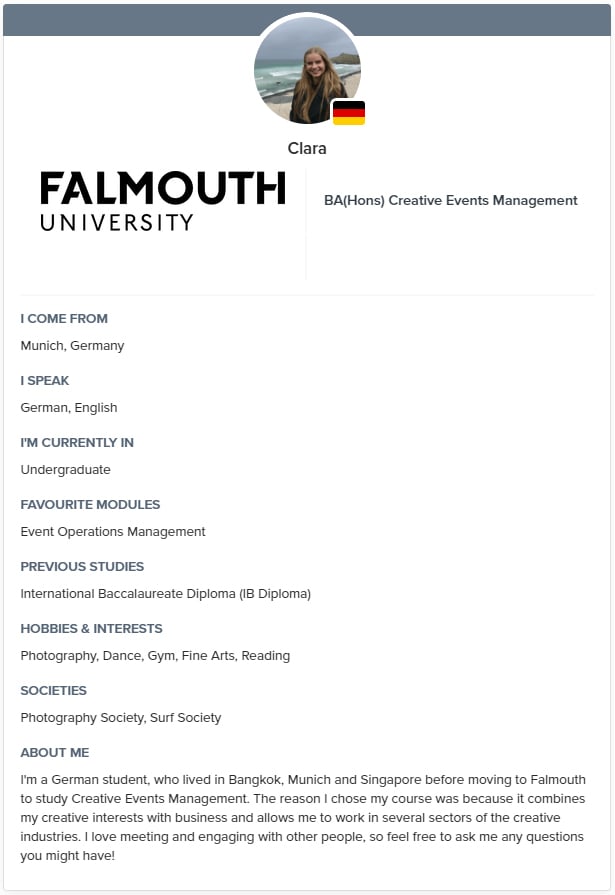
Chat to students like Clara on Unibuddy!
Ask me about why I chose my particular course and university, or anything else uni related you can think of!
You can filter students to speak to on Unibuddy by using the 'Universities' drop-down menu.